


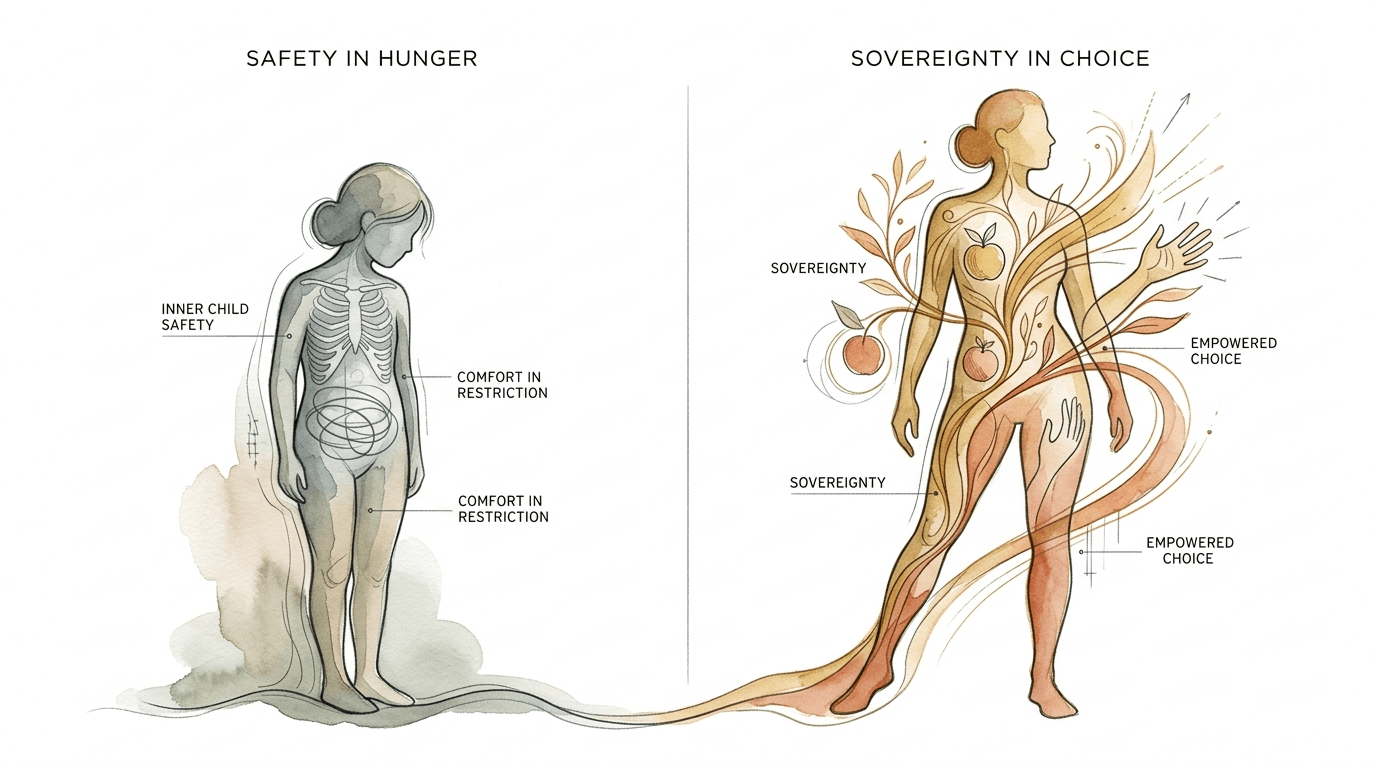
What if your current hunger is actually a 7-year-old version of you looking for the safety they never had?
Many of us aren’t battling calories; we’re battling a survival identity forged in childhood. When food was your only source of safety, your brain learned to associate ‘fullness’ with ‘security.’ To lose the weight, you have to convince your inner child that the adult is finally in charge and that you are safe now.
This realization is the turning point for many who have tried every diet under the sun. You are not weak-willed. You are not lazy. You are simply operating on an old software program designed to keep you alive during a time when you felt vulnerable [1.17].
When you understand the psychology of your inner child, weight loss stops being a war. It becomes a rescue mission. You are stepping back into your own life to provide the protection that was missing decades ago [1.2].
Inner Child Weight Loss Psychology
Inner child weight loss psychology is the study of how early childhood experiences, specifically trauma or neglect, shape our relationship with food and body weight in adulthood. It suggests that overeating is often not a lifestyle choice but a sophisticated survival mechanism [1.7].
In many cases, an inner child who felt unprotected or unseen learned to use food as a primary source of comfort and regulation. This creates a “survival identity” where being “full” is the only time the nervous system feels truly relaxed [1.1].
This exists because the human brain is wired for survival above all else. If you experienced instability as a child—whether it was financial stress, emotional neglect, or physical harm—your brain looked for a way to self-soothe [1.6]. Food is often the most accessible tool for a child to change their internal state.
In the real world, this manifests as “the safety shield.” This is the phenomenon where your body holds onto extra weight as a literal physical barrier between you and the world [1.11]. If being noticed felt dangerous as a child, your subconscious may believe that being “smaller” is a threat to your safety [1.15].
Traditional dieting ignores this psychological root. It tries to force the body to change while the inner child is still screaming in fear. Until that child feels safe, the body will fight to maintain its “protective layer” [1.8].
How to Reparent Your Inner Child for Weight Loss
Reparenting is the process of giving yourself the emotional support and guidance that you lacked during your formative years [1.2]. It is a step-by-step technique to move from survival-based eating to conscious, adult-led choices.
Step 1: Build Awareness of the “Hunger Voice”
The first step is to distinguish between physical hunger and emotional “child” hunger. Physical hunger comes on slowly and can be satisfied by many types of food. Child hunger is sudden, urgent, and usually demands specific comfort foods [1.9].
When you feel an intense urge to eat, pause for sixty seconds. Ask yourself, “How old do I feel right now?” If the answer is five, seven, or ten, you are likely experiencing an emotional flashback rather than true metabolic hunger [1.1].
Step 2: Visualization and Connection
Once you identify the child voice, visualize that younger version of yourself. See their face, their body language, and their surroundings [1.4]. Are they scared? Are they lonely? Are they overwhelmed?
Instead of judging the urge to eat, offer that child presence. Imagine sitting next to them or giving them a hug. Tell them, “I see you, and I understand why you want to eat right now. You were trying to keep us safe” [1.4].
Step 3: Establish the Adult-in-Charge
You must clearly communicate to your subconscious that you are now an adult with resources that the child didn’t have. Remind your inner child that you have a job, a home, and the ability to protect yourself [1.17].
Say out loud: “I am the adult now. I am in charge, and I will keep us safe. We don’t need the food to feel secure anymore” [1.17]. This verbal affirmation helps the nervous system downshift from a survival state [1.8].
Step 4: Practice Somatic Soothing
Since the inner child lives in the nervous system, you must soothe the body, not just the mind. Try deep breathing, a warm bath, or gentle movement [1.4]. These activities signal to the brain that the “threat” has passed, which naturally reduces the drive for dopamine-seeking through food [1.7].
Benefits of a Trauma-Informed Approach
Choosing inner child work over traditional restriction offers several measurable advantages. This approach addresses the underlying “why” behind your behaviors, leading to changes that actually stick.
One major benefit is the reduction of “shame cycles.” Traditional diets often lead to a “binge-shame-restrict” loop. By viewing overeating as a survival skill rather than a character flaw, you remove the shame that usually triggers the next binge [1.1].
Another advantage is improved metabolic health. Chronic stress from childhood trauma can disrupt cortisol patterns and hunger hormones like leptin [1.3, 1.7]. When you heal the trauma, your nervous system exits “survival mode,” allowing your hormones to rebalance and your metabolism to function efficiently [1.7].
You also gain a sense of internal peace. Many people report that after doing this work, food stops being a constant “noise” in their heads [1.8]. You move from a state of “Safety in Hunger” to “Sovereignty in Choice,” where you eat because you want to nourish yourself, not because you are trying to hide.
Challenges and Common Mistakes
The biggest mistake people make is trying to “fix” the inner child with the same harshness they received from their parents. If you use a critical, demanding tone with yourself, you are just reinforcing the child’s need for the safety of food [1.1].
Another pitfall is expecting instant results. Survival identities are forged over years of repetition. They do not disappear after one journaling session. Many practitioners find that significant breakthroughs often happen around the six-month mark of consistent practice [1.2].
Misunderstanding the “safety shield” is also common. People often get frustrated when they lose ten pounds and then suddenly “self-sabotage.” In reality, this is often the inner child feeling exposed and vulnerable as the physical protection disappears [1.15].
Finally, many people try to do this work entirely in their heads. They think through the concepts but don’t engage the body. Because trauma is stored in the nervous system and cells, you must include somatic (body-based) practices to see real change [1.16, 1.17].
Limitations of Inner Child Work
While powerful, inner child psychology is not a magic wand for all weight issues. It may not be ideal for individuals with acute, unmanaged medical conditions that affect weight, such as severe thyroid disorders or genetic metabolic diseases.
Environmental limitations also play a role. If you are currently living in an unsafe or highly unstable environment, your nervous system is correct to stay in survival mode. You cannot convince a child they are safe if the adult is still in actual danger [1.12].
This method also requires a high level of self-reflection. It may not work well for individuals who are not yet ready or able to confront past memories. In cases of severe Binge Eating Disorder (BED) or other clinical eating disorders, this work should be done alongside a licensed therapist or medical professional [1.13, 1.14].
Safety in Hunger vs. Sovereignty in Choice
To understand the shift, we can look at the contrast between a survival state and a state of agency.
| Factor | Safety in Hunger (Survival) | Sovereignty in Choice (Adult) |
|---|---|---|
| Core Driver | Fear, Anxiety, and Vulnerability | Agency, Self-Love, and Wisdom |
| Food Role | A shield or a numbing agent | Nourishment and pleasure |
| Mental State | Reactive and urgent | Proactive and calm |
| Willpower | High effort, low sustainability | Natural alignment, high ease |
| Goal | To disappear or stay “protected” | To thrive and be visible |
“Safety in Hunger” is the state where the inner child believes that controlling (or satisfying) hunger is the only way to stay safe [1.17]. “Sovereignty in Choice” is the adult right to decide what is best for the body based on current needs, not past fears [1.12, 1.18].
Practical Tips and Best Practices
If you want to start applying this today, begin with these actionable strategies:
- Keep a Childhood Photo: Place a photo of yourself as a young child on your fridge. Before you open the door to emotional eat, look at the photo and ask, “What does she actually need right now?” [1.2].
- The “Three-Move” Process: When an urge hits, name the feeling, state your current age, and then perform a soothing action like washing your face with cool water [1.17].
- Journal to the Child: Write a letter to your younger self. Tell them that you are sorry they had to go through those hard times alone and that you are here now to take the weight of the world off their shoulders [1.4].
- Slow Down the Meal: Practice “attuned eating.” Before the first bite, take three deep breaths to signal to your nervous system that it is safe to digest [1.10].
- Affirm Your Protection: Frequently tell yourself, “I am safe to be seen. I am safe to be healthy. I am safe to be happy” [1.1, 1.15].
Advanced Considerations for Practitioners
For those who want to go deeper, consider the neurobiological link between trauma and leptin resistance. Research suggests that early life trauma can make the brain less responsive to leptin, the hormone that tells you when you are full [1.3].
This means your “fullness” signal is literally broken at a physical level due to psychological stress. Healing the inner child is actually a way to repair this neural pathway [1.5]. This is why traditional “eat less” advice fails—it doesn’t account for the fact that your brain isn’t receiving the “stop” signal properly.
You should also consider “attachment styles” and how they relate to food. If you had an anxious attachment to a caregiver, you may have an anxious attachment to food [1.6]. You might “cling” to food because you are afraid it won’t be there later. Addressing your attachment style can provide a roadmap for how you handle hunger [1.10].
Sarah’s Story: From Panic to Peace
Consider “Sarah,” who grew up in a home where money was tight. Every payday, her parents would celebrate with pizza and ice cream. For Sarah, these foods became the literal definition of peace and safety [1.11].
As an adult, whenever she felt stressed at work, she would find herself at a drive-thru. She wasn’t hungry; she was looking for that “payday peace.” Her inner child was trying to recreate the only moment of safety she knew [1.11].
Once Sarah identified this pattern, she didn’t just try to “stop eating pizza.” Instead, she started a ritual where she gave her inner child a different form of celebration—like a quiet hour of reading or a walk in the park—while telling herself, “We have enough now. We are safe every day, not just on payday.” Within months, her cravings diminished because the emotional void was filled with real security [1.11].
Final Thoughts
Weight loss is often treated as a math problem involving calories and exercise. But for millions of people, it is actually a psychological problem involving safety and survival [1.17]. If your body is holding onto weight, it is not your enemy; it is an ally that thinks it is protecting you from a world that once felt dangerous.
By turning toward your inner child with compassion instead of criticism, you can break the survival agreements that have kept you stuck. You have the power to reparent yourself and create a new identity based on sovereignty rather than fear [1.8].
Start small. Be patient. Remind that younger version of you that the storm is over. You are the adult now, and you are finally safe. As the internal safety grows, the need for the physical shield will naturally fall away [1.11].
Sources
1 apple.com | 2 doctorrileysmith.com | 3 balancedme.com.au | 4 dianepetrella.com | 5 webmd.com | 6 emotionaltherapy.uk | 7 mindfuleatinginstitute.net | 8 mindfuleatinginstitute.net | 9 sustainability-directory.com | 10 mdpi.com | 11 nationaleatingdisorders.org | 12 nih.gov | 13 seeds.ca | 14 teacreek.ca | 15 nourished-strong.com | 16 sciencedaily.com