


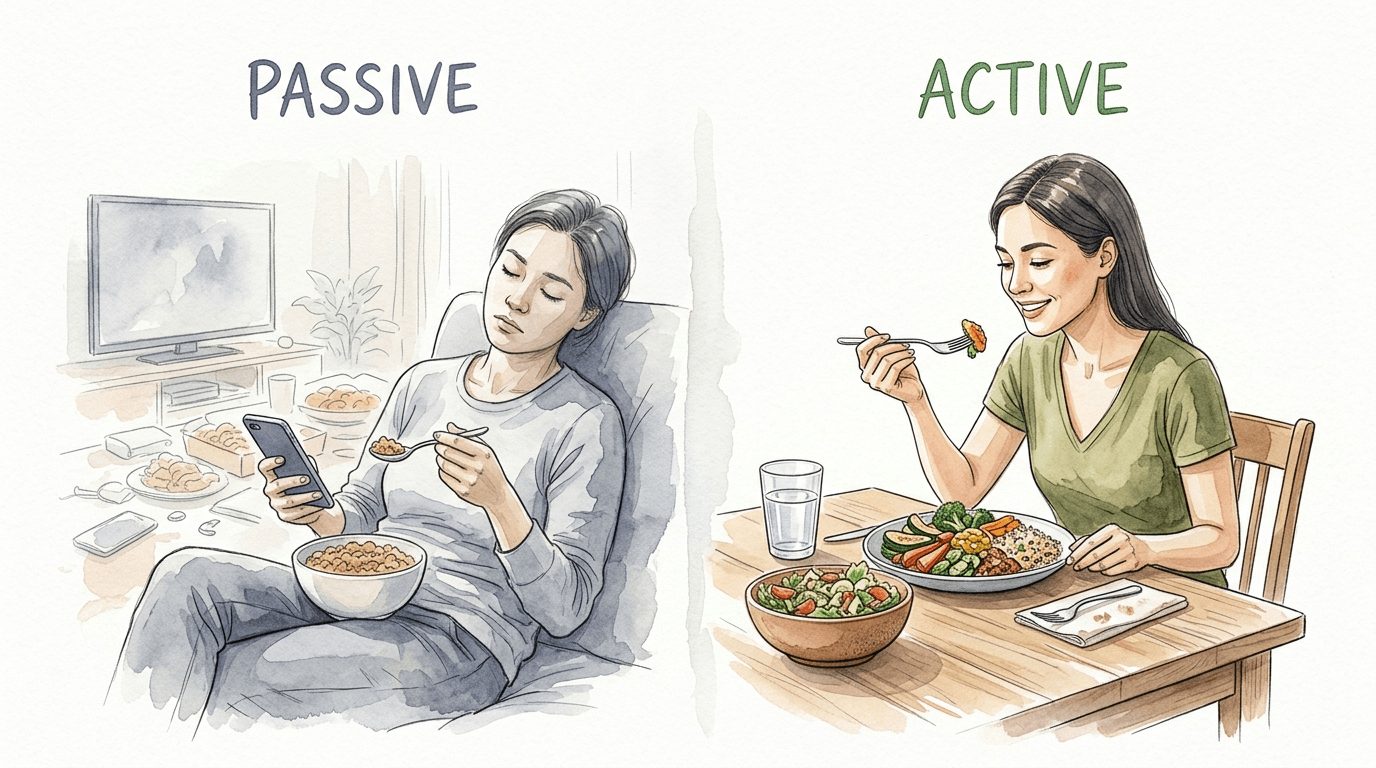
When you stop eating as a secondary task, your body stops storing it as secondary energy. Passive eating is a leak in your metabolic bucket. It’s the calories you eat while standing, driving, or scrolling that your brain never ‘files’ as a meal. Active appreciation turns nutrition into a ceremony. When you show up for your food, your body shows up for your metabolism.
The way you eat matters just as much as what you eat. Modern life has turned nutrition into a background process. We treat meals like software updates running in the hidden tabs of our brains. This mental disconnect creates a physiological gap that stalls your progress and leaves you hungry for more.
Active eating is the solution to this modern “metabolic amnesia.” It is a deliberate shift from being a consumer to being a participant. This strategy ensures your brain and gut are on the same page. When they communicate, your hormones align, your digestion sharpens, and your body finally feels satisfied.
Active Mindful Eating Strategy
The Active Mindful Eating Strategy is a cognitive framework that treats every meal as a primary event. It is the opposite of passive consumption. Instead of fitting food into the gaps of your schedule, you carve out a dedicated space for the act of nourishment. This is not just about “slowing down.” It is about sensory engagement.
In the real world, passive eating looks like a handful of chips while answering emails. It looks like finishing a sandwich while merging onto the highway. Active eating looks like sitting down, putting the phone in another room, and noticing the exact texture of your first bite. It is a metabolic handshake between your mind and your stomach.
Think of your metabolism like a high-performance engine. If you throw fuel in while the car is moving at 70 miles per hour, most of it spills. Active eating is the equivalent of pulling into the station, turning off the engine, and fueling with precision. It ensures that every calorie serves a purpose rather than just adding to the “secondary energy” pile.
The Biological Engine: How Active Eating Works
Your body prepares for food long before the first swallow. This is known as the cephalic phase digestive response. When you see, smell, and anticipate a meal, your brain triggers the release of saliva, stomach acid, and digestive enzymes. Research suggests that the cephalic phase can account for up to 30% to 40% of your total digestive response.
When you eat passively, you skip this phase. Your brain is busy processing a TikTok video or a traffic jam. It doesn’t send the signal to the gut to “get ready.” As a result, food arrives in a stomach that isn’t fully prepared. This leads to poor nutrient absorption and digestive discomfort. Active eating re-engages this system.
Hormonal regulation is the second pillar. Two key hormones, ghrelin and leptin, manage your hunger and fullness. Ghrelin tells you when to eat. Leptin tells you to stop. Distracted eating blunts the leptin response. Your brain misses the “I’m full” signal because it is occupied with secondary tasks. Active eating gives your hormones the 20 minutes they need to communicate effectively.
Core Benefits of Active Nutrition
The primary benefit of this strategy is improved metabolic efficiency. When your brain “files” a meal as a significant event, it regulates your blood sugar more effectively. You avoid the massive spikes and crashes associated with mindless snacking. This leads to more stable energy levels throughout the day.
Weight management becomes a natural byproduct rather than a forced struggle. Studies show that people who eat distractedly consume significantly more calories at their *next* meal. Their brains literally “forget” that they already ate. Active eating creates a strong “meal memory.” This memory acts as a natural appetite suppressant for hours afterward.
Psychological satisfaction is the hidden win. Passive eaters often feel “snackish” even after a large meal because they didn’t actually experience the food. Active appreciation triggers the reward centers in the brain. You feel more satisfied with smaller portions because you actually tasted every gram. You stop chasing “more” and start enjoying “enough.”
Challenges and Common Metabolic Mistakes
The biggest challenge is the “Productivity Trap.” Many people feel that taking 15 minutes to eat without a screen is a waste of time. They think they are being efficient by working through lunch. In reality, the metabolic cost of this “efficiency” is high. You end up with brain fog and a mid-afternoon energy crash that kills your output anyway.
The “Standing Snack” is another frequent error. Eating while standing or walking tells your nervous system that you are in a state of transition. This keeps you in sympathetic (fight-or-flight) mode. Digestion requires parasympathetic (rest-and-digest) activation. If you are on the move, your body is not prioritizing the breakdown of nutrients.
“Portion Distortion” occurs when the brain is offline. When you eat from a bag or a large container while scrolling, your hand-to-mouth reflex takes over. You lose the visual cue of how much you have consumed. This leads to a total disconnect between your caloric intake and your satiety levels. You don’t realize you’re overeating until the bag is empty.
Limitations and Realistic Constraints
Active mindful eating is not always possible in every environment. High-stress workplaces or busy family schedules can make “ceremonial eating” feel impossible. If you have small children, a quiet meal is a luxury you might not have for years. In these cases, forcing a perfect mindfulness practice can actually increase stress, which is counterproductive for digestion.
Environmental noise is another boundary. If you are in a loud, chaotic cafeteria, your nervous system may stay in a heightened state regardless of your intentions. You cannot always control your surroundings. In these situations, the “Active” part of the strategy might just be a 30-second breathing exercise before the first bite rather than a full 20-minute meditation.
It is also important to note that mindful eating is not a cure-all for clinical metabolic disorders. While it improves efficiency, it does not replace medical treatment for conditions like Type 2 diabetes or severe hormonal imbalances. It is a powerful tool for optimization, but it must be used as part of a broader, evidence-based approach to health.
Comparing Passive vs. Active Eating
Understanding the differences between these two states helps you identify where you are leaking metabolic energy.
| Feature | Passive Eating | Active Eating |
|---|---|---|
| Nervous System | Sympathetic (Stress/Alert) | Parasympathetic (Rest/Digest) |
| Hormonal Signal | Leptin resistance/delayed | Optimal Leptin/Ghrelin flow |
| Brain State | Secondary task (Scanning) | Primary task (Savoring) |
| Digestion | Shallow/Incomplete | Robust (Cephalic Response) |
| Satiety | Temporary/Short-lived | Long-lasting/Deep |
| Caloric Impact | Higher intake at next meal | Lower, regulated intake |
Practical Tips for Immediate Results
Start with the “First Three Bites” rule. You don’t have to be perfectly mindful for the entire meal. Commit to the first three bites. No phone, no talking, no distractions. Notice the temperature, the texture, and the way the flavor changes as you chew. This small window is often enough to trigger the cephalic phase.
Use the “Utensil Reset” technique. Put your fork or spoon down completely between every single mouthful. Do not pick it back up until you have finished swallowing. This physical break forces a mental pause. It prevents the “shovel effect” where you are already preparing the next bite while still chewing the current one.
Eliminate the “Screen Shadow.” Your brain cannot fully process satiety signals if it is focused on a bright, blue-light-emitting screen. Make your dining table a phone-free zone. If you are eating at work, walk away from your desk. Even five minutes in a different environment can reset your metabolic focus.
Best Practices for Consistency
- Eat at the same designated spot every day to build a habit.
- Drink a glass of water before starting to signal the gut.
- Chew each bite at least 20 times to assist mechanical digestion.
- Acknowledge the source of the food to build “Active Appreciation.”
Advanced Metabolic Considerations
For those looking to master their metabolism, consider the role of the vagus nerve. The vagus nerve is the highway of communication between the gut and the brain. You can “tone” this nerve through deep, diaphragmatic breathing before a meal. Three deep breaths can flip the switch from stress to digestion in under sixty seconds.
Insulin sensitivity is also influenced by your state of mind. When you are stressed or distracted, your body releases cortisol. Cortisol triggers the release of glucose into the bloodstream. If you are eating at the same time, you are adding even more sugar to a system that is already spiked. Active eating keeps cortisol low, allowing insulin to do its job more efficiently.
Consider the “Post-Meal Audit.” Ten minutes after you finish eating, check in with your body. Do you feel energized or heavy? Are you still thinking about food, or has the “hunger noise” gone quiet? Serious practitioners use this feedback loop to adjust their food choices and eating speed. This turns nutrition into a data-driven process of self-optimization.
Examples and Real-World Scenarios
Scenario A: The Corporate Commuter. A busy executive eats a protein bar while driving to a 9:00 AM meeting. Their brain is focused on the presentation. The body treats the bar as “secondary energy.” Digestion is sluggish. By 10:30 AM, they are hungry again because the brain never registered the meal. This leads to a high-calorie “panic snack” later.
Scenario B: The Active Transition. The same executive pulls over for five minutes. They sit in the park or even just turn off the radio in the car. They focus entirely on the protein bar for three minutes. They notice the chewiness and the flavor. The brain “files” the protein and fats. They arrive at the meeting satisfied and stay energized until a late lunch.
Scenario C: The Digital Dinner. A family eats while watching a movie. No one notices when they are full. They finish their plates and reach for dessert automatically. Scenario D: The Ceremonial Table. The family turns off the TV. They talk about the food. They eat slower. They realize they are full before the plates are empty. They save the leftovers, reducing their total caloric load without feeling restricted.
Final Thoughts
Active mindful eating is the missing link in most health and fitness routines. You can have the perfect macros and the cleanest ingredients, but if your brain isn’t “checked in” to the meal, your metabolism will never run at its peak. Passive eating is a leak that slowly drains your progress and leaves you in a cycle of constant craving.
Turning nutrition into a ceremony doesn’t require hours of meditation or a retreat. It requires a simple decision to show up. By reclaiming your mealtimes from screens and schedules, you give your body the signal it needs to thrive. You stop storing food as secondary energy and start using it to fuel a more vibrant life.
Start with your very next meal. Put the phone down. Sit in a chair. Take a breath. Show your body that the food matters, and your body will show you what it’s truly capable of. This is the ultimate metabolic strategy: being present for the fuel that powers your existence.
Sources
1 umn.edu | 2 foodguides.com | 3 taracoleman.com | 4 wac.net | 5 goodrx.com | 6 nchpad.org | 7 levels.com | 8 nih.gov | 9 msaweightloss.com | 10 nih.gov | 11 harvard.edu | 12 medicspot.co.uk | 13 naturaleater.com | 14 foodguides.com | 15 excellforlife.com | 16 insidetracker.com | 17 healthline.com | 18 cornellhealthcarereview.org | 19 pitt.edu | 20 ummhealth.org | 21 ucsd.edu | 22 sustainability-directory.com