

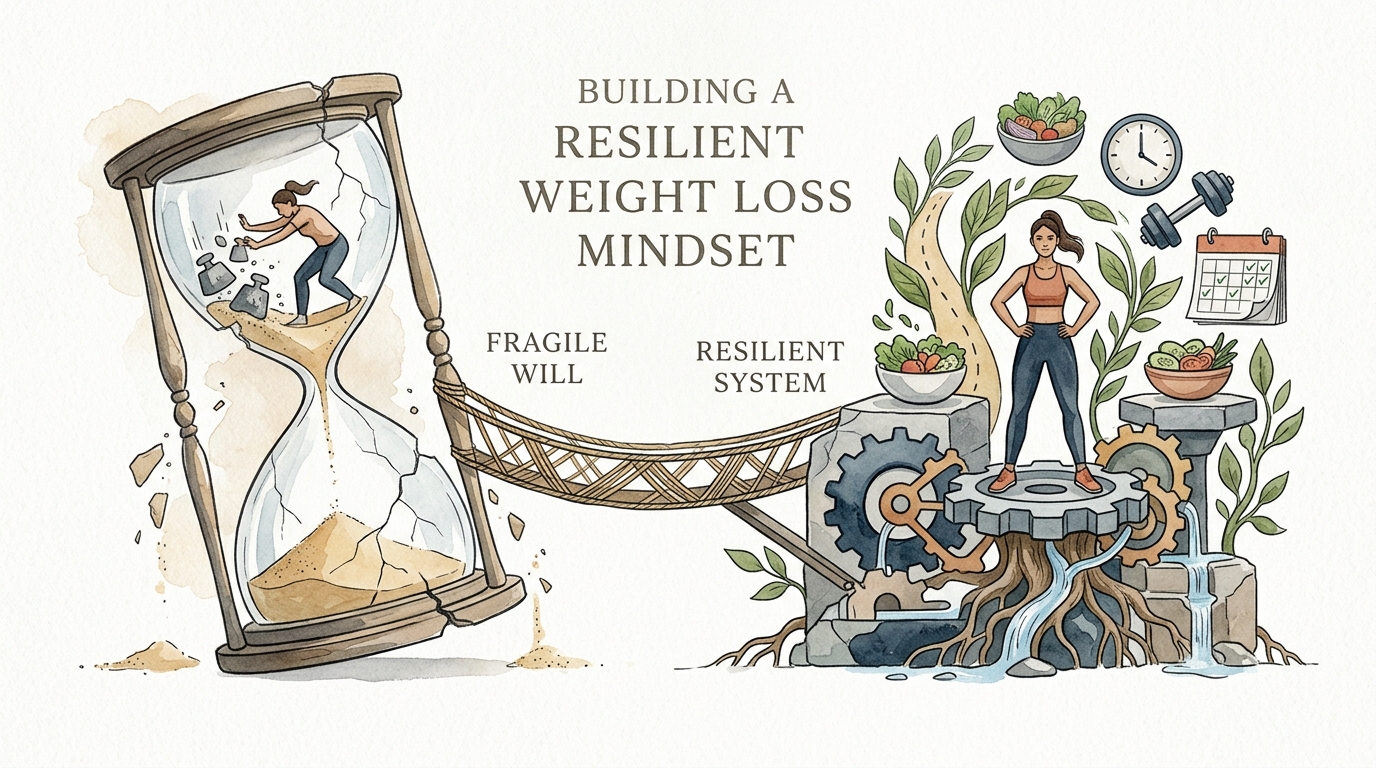
One mistake shouldn’t ruin your entire week, yet for most people, it’s the end of the road. If a single ‘bad’ meal sends you into a downward spiral, your system is fragile. True weight loss success comes from building a resilient mind that views a slip-up as a data point, not a disaster.
Most of us have been there. You start the week with a perfectly prepped meal plan and a high-energy workout schedule. Then, Tuesday afternoon hits, a coworker brings in donuts, and you find yourself three glazed treats deep before you can even think. For a fragile mind, the day is “ruined,” the week is “over,” and you might as well order pizza for dinner. This is the all-or-nothing trap that kills more weight loss goals than slow metabolisms ever will.
Building a resilient system is about moving away from the “white-knuckle” approach of sheer willpower. It is about creating a mental framework where progress is measured by consistency over the long term, not perfection in the short term. When you shift your perspective, you stop fighting against your own biology and start working with it.
In this guide, we are going to dive deep into what it takes to build a mindset that can withstand the chaos of real life. We will explore the science of habit formation, the psychological shift from goals to systems, and practical strategies to ensure you never let a single meal dictate your self-worth again.
Building A Resilient Weight Loss Mindset
At its core, a resilient weight loss mindset is a growth mindset applied to your health. According to research by psychologist Carol Dweck, individuals with a growth mindset believe their abilities can be developed through effort and persistence. In the context of weight loss, this means viewing your body and your habits as things you can improve over time, rather than fixed traits you are stuck with.
Resilience exists where flexibility meets discipline. A fragile system breaks under pressure—if you can’t hit your exact macro targets or your hour-long gym session, you quit. A resilient system adapts. If you only have ten minutes to exercise, a resilient mindset says, “Ten minutes is better than zero.” It recognizes that a healthy lifestyle is a spectrum, not a light switch that is either on or off.
This mindset is essential because the journey to weight loss is rarely a straight line. Research consistently shows that plateaus, hormonal shifts, and life stressors are guaranteed parts of the process. For instance, chronic stress increases cortisol levels, which can lead to abdominal weight gain and emotional eating. A resilient mind anticipates these hurdles and builds “if-then” scenarios to handle them without losing momentum.
Visualize your weight loss journey as a long-distance road trip. If you get a flat tire, you don’t set the car on fire and give up on the destination. You fix the tire and keep driving. Resilience is the spare tire of your weight loss system.
How to Build Your Resilient System Step-by-Step
Building resilience isn’t about trying harder; it’s about designing a system that makes failure difficult. Here is how you can transition from a fragile “dieting” mentality to a resilient lifestyle system.
1. Identify and Label Your Triggers
Resilience starts with self-awareness. You need to know exactly when your “willpower” typically fails. Is it the 3:00 PM energy slump? Is it the stress after a long commute? Use these moments as data. Instead of judging yourself for wanting a snack, ask yourself why the urge is there. This shifts the focus from a moral failing to a biological or environmental problem that needs a solution.
2. Design Your Environment for Success
Stop relying on willpower. Willpower is a finite resource that depletes throughout the day. A resilient system relies on environmental design. This means keeping highly processed “trigger foods” out of the house and making healthy choices the path of least resistance. If your gym clothes are already laid out and your healthy lunch is prepped, you are far less likely to skip your routine when life gets hectic.
3. Use the Power of “Not Yet”
Language shapes your reality. When you hit a plateau or struggle with a new habit, avoid saying, “I can’t do this.” Instead, add the word “yet.” As noted by psychologists, saying “I haven’t mastered this habit yet” keeps the door open for future growth. It acknowledges the current struggle without making it a permanent failure.
4. Focus on Systems, Not Just Goals
A goal is a destination, like “lose 20 pounds.” A system is the daily process, like “walking 10,000 steps and eating 30 grams of protein at breakfast.” Systems provide immediate feedback and daily wins. As author James Clear points out, you do not rise to the level of your goals; you fall to the level of your systems. When you focus on the system, you can feel successful every single day that you show up, regardless of what the scale says.
Benefits of a Resilient Mindset
Why bother with all this mental work? Because the physical results of a resilient mindset are far superior to those of a rigid, fragile one. Here are the practical benefits you can expect:
- Reduced Stress and Cortisol: By removing the guilt associated with “bad” meals, you lower your stress levels. This helps prevent the cortisol-driven weight gain often seen in chronic dieters.
- Long-Term Maintenance: People who view weight loss as a skill to be learned rather than a temporary restriction are significantly more likely to keep the weight off for years.
- Increased Consistency: Resilience allows you to “stay in the game” even during busy seasons of life. You stop the cycle of starting over every Monday.
- Improved Relationship with Food: You begin to see food as fuel and data rather than “good” or “bad.” This reduces the likelihood of binge-restrict cycles.
Choosing a resilient approach means choosing peace of mind. It allows you to enjoy a social dinner or a holiday meal without the psychological “hangover” of regret that usually leads to a week-long binge.
Challenges and Common Mistakes
Even with the best intentions, building resilience is a skill that takes time. Many people fall into these common traps while trying to change their mindset:
The Perfectionism Trap
Many beginners think that being “resilient” means never making a mistake. This is actually the opposite of resilience. Resilience is defined by how you respond to a mistake. If you think you must be 100% perfect to succeed, you are setting yourself up for a fragile system that will inevitably shatter at the first sign of a birthday cake.
Overestimating Exercise Burn
A common mistake is using exercise as a way to “punish” yourself for eating. This creates a toxic relationship with movement. Research suggests that up to 72% of people overestimate how many calories they burn during a workout. Resilient systems treat exercise as a tool for health, mood, and muscle preservation, not a “reset button” for a bad diet.
Ignoring Non-Scale Victories (NSVs)
If the scale is your only metric for success, your mindset will remain fragile. Weight fluctuates daily due to water retention, salt intake, and hormone changes. A resilient system tracks multiple data points: energy levels, sleep quality, strength gains, and how your clothes fit. This ensures that even when the scale is stuck, you can see evidence of your progress.
Limitations: When a Mindset Shift Isn’t Enough
While mindset is the foundation of success, it is important to recognize that weight loss is also a biological process. There are situations where environmental or medical constraints require more than just “thinking differently.”
Genetic factors can influence how your body responds to certain foods and how easily it holds onto fat. Metabolic adaptation—where your body burns fewer calories as you lose weight—is a real biological hurdle that requires strategic adjustments to your system. Furthermore, medical conditions like PCOS or thyroid imbalances can make weight loss significantly more challenging, regardless of how resilient your mind is.
It is also vital to consider environmental limitations. Someone living in a “food desert” with limited access to fresh produce will face structural challenges that mindset alone cannot solve. In these cases, a resilient system involves seeking external support, whether through medical professionals, community resources, or personalized coaching.
Fragile Will vs. Resilient System
To truly understand the difference, let’s look at how these two approaches handle common weight loss scenarios.
| Scenario | Fragile Will (The “Dieter”) | Resilient System (The “Lifestyle”) |
|---|---|---|
| A “Bad” Meal | “I failed. I’ll start again on Monday.” | “Interesting. I was stressed. Back to the plan now.” |
| Scale Plateau | Quits the diet because “it’s not working.” | Checks sleep, protein, and measurements. Stays consistent. |
| Busy Work Week | Skips all exercise and eats fast food. | Does 10-minute home workouts and picks the best available options. |
| Motivation Fades | Stops everything until they feel “inspired” again. | Relies on pre-set habits and environment design. |
Practical Tips for Immediate Application
You can start building your resilient system today. Here are the most effective best practices to implement right now:
- Prioritize Sleep: Getting fewer than 7 hours of sleep wreaks havoc on your hunger hormones, ghrelin and leptin. A resilient system starts with a consistent bedtime.
- The 80/20 Rule: Aim to be “on plan” 80% of the time. Allow the other 20% for flexibility. This prevents the feeling of deprivation that leads to binges.
- Increase Protein Intake: Protein is the most satiating macronutrient. High-protein meals (aiming for 25-40g per meal) help regulate appetite and preserve lean muscle mass during weight loss.
- Daily Walking: Don’t underestimate the power of NEAT (Non-Exercise Activity Thermogenesis). A daily 30-minute walk improves mood, aids digestion, and keeps your metabolism hummed without the stress of high-intensity training.
- Wait 20 Minutes: When a craving hits, set a timer for 20 minutes. Creating space between the impulse and the action allows your “logical brain” to catch up with your “emotional brain.”
Advanced Considerations for Long-Term Success
For those who have mastered the basics, building a truly elite resilient system involves data-driven refinement. This means move beyond just “trying to eat healthy” and starting to track trends over months and years.
Serious practitioners use their “slips” as specific experiments. If you find yourself overeating every Friday night, a resilient system doesn’t just “try harder” next Friday. It analyzes the cause. Are you eating too little during the day? Is it a social trigger? Once you identify the pattern, you can “scale” your system by adding a high-protein snack on Friday afternoons or choosing a different social setting. This is the difference between an amateur dieter and someone who has mastered their biology.
Additionally, consider the role of metabolic flexibility. A resilient body is efficient at switching between burning carbs and burning fat. This is achieved through a combination of strength training and varied nutritional approaches. By building muscle mass, you increase your basal metabolic rate, giving your “system” more room for error.
Real-World Example: The Friday Night Spiral
Let’s look at how a resilient mindset changes a very common situation. Imagine Sarah, who has a goal to lose 30 pounds. On Friday night, she goes out with friends and eats three slices of pizza and has two drinks. This is significantly over her “allotted” calories.
The Fragile Path: Sarah wakes up Saturday feeling guilty. She thinks, “I’ve ruined my progress.” She skips breakfast to “punish” herself, which leads to her being ravenous by lunch. She then overeats again, feels even worse, and spends the entire weekend in a “might as well” binge. By Monday, she has gained 3 pounds of water weight and feels defeated.
The Resilient Path: Sarah acknowledges the pizza was delicious and enjoyed the time with her friends. She wakes up Saturday and, instead of fasting, eats a high-protein breakfast to stabilize her blood sugar. She goes for a 45-minute walk to clear her head. She views the Friday night meal as a single data point in a month of 90+ meals. She is back on track by Saturday morning, and by Wednesday, the scale reflects her consistent progress again.
Final Thoughts
Weight loss is 10% what you do in the gym and 90% how you handle the 23 hours you aren’t there. A fragile mindset is the biggest barrier to the body you want. By shifting your focus from “perfection” to “resilience,” you turn every obstacle into an opportunity to learn more about your body and your habits.
True success isn’t about never falling off the wagon; it’s about how fast you get back on. Build a system that makes “getting back on” automatic. Focus on your sleep, your protein, your environment, and your self-talk. Over time, these small, resilient actions compound into massive, life-changing results.
Start small. Choose one habit today—perhaps just the 20-minute craving rule or a consistent bedtime—and commit to it. You don’t need a perfect week; you just need a resilient one. Experiment with these concepts and watch as the journey becomes not just easier, but actually enjoyable.
Sources
1 eatlove.is | 2 crunch.com | 3 modelthinkers.com | 4 corerejuvenationmedspa.com | 5 lakewoodranchmedicalcenter.com | 6 medium.com | 7 psychologytoday.com | 8 lark.com | 9 elevatebynicci.com | 10 vitaminshoppe.com | 11 thedietologist.co.uk | 12 myjuniper.com | 13 healthline.com | 14 spatzmedical.com | 15 worldclasschiro.com | 16 obesityaction.org | 17 psychologytoday.com