

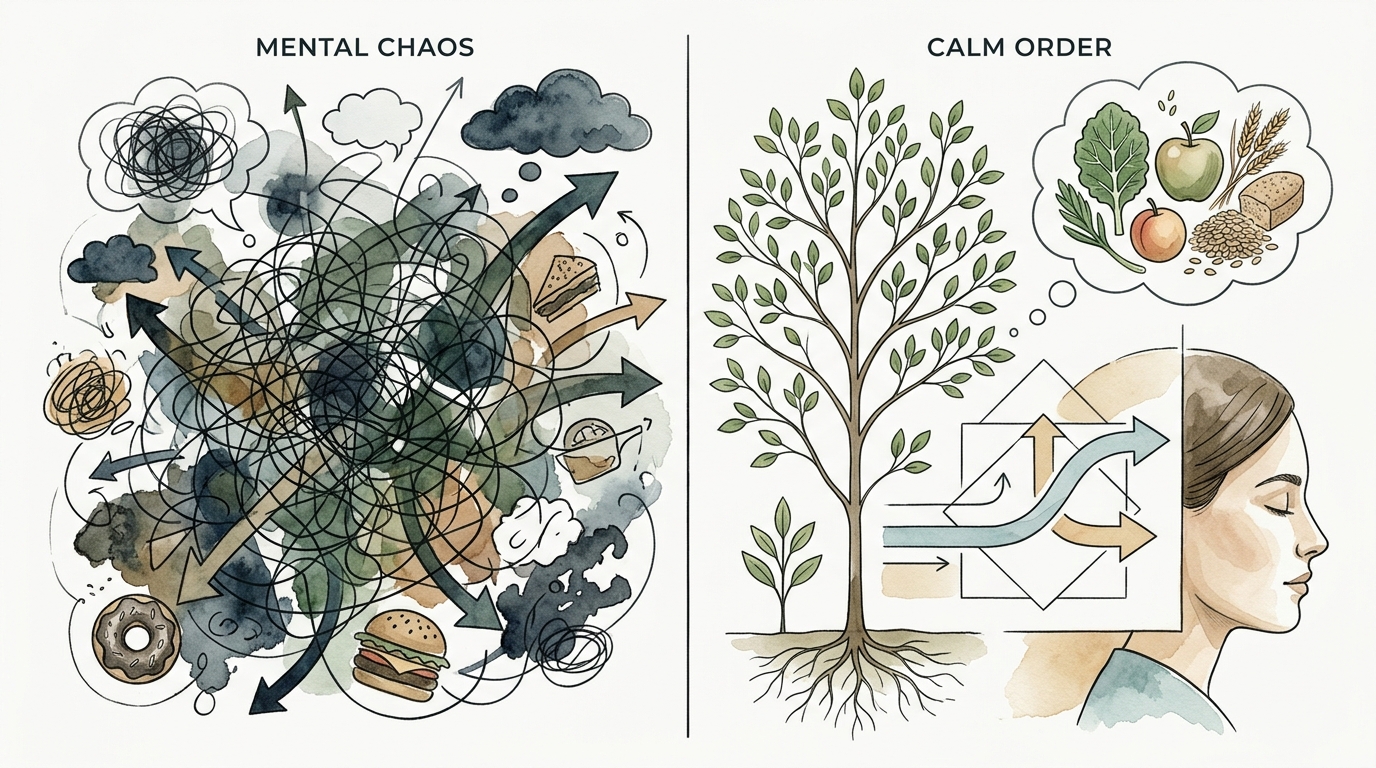
You aren’t actually hungry; your brain is just noisy and looking for an escape. Weight loss isn’t just about what’s in your pantry; it’s about the state of your mind when you open the door. When you move from reactionary eating to intentional choices, the body follows the mind.
Millions of people struggle with the scale because they treat a psychological challenge with a biological solution. Diets focus on the stomach, but the real control center is between your ears. Breaking the cycle of “comfort eating” requires more than willpower. It requires a shift from Mental Chaos to a state of Calm Order.
This guide explores the mechanics of why we eat when we aren’t hungry. You will learn how to rewire your neural pathways and reclaim your relationship with food. It is time to stop reacting and start choosing.
Stopping Emotional Eating Patterns
Emotional eating is the act of consuming food in response to feelings rather than physical hunger. Most people do it without realizing it. You might reach for a bag of chips after a stressful meeting. You might finish a pint of ice cream because you feel lonely on a Friday night. This isn’t a character flaw. It is a deeply ingrained biological survival mechanism.
Your brain is designed to seek safety. In the wild, high-calorie food meant survival. Today, your brain interprets stress as a threat. It seeks a “reward” to neutralize that threat. Food provides a quick hit of dopamine. This chemical creates a temporary sense of peace. The problem is that the peace is fleeting, but the calories remain.
Stopping these patterns is about interrupting the “trigger-response” loop. In the real world, this looks like identifying that specific moment of tension before you reach for the cupboard. It is the difference between being a passenger in your own mind and being the driver. When you understand the “why” behind the craving, the “what” you eat becomes easier to manage.
How It Works: The Mechanics of the Mind
Breaking an emotional eating habit involves retraining your nervous system. You are essentially teaching your brain that it can handle discomfort without a snack. This process relies on a concept called Interoceptive Awareness. This is your ability to sense what is happening inside your body in real time.
The STOP Technique
One of the most effective tools for immediate intervention is the STOP method. Use this whenever you feel a sudden, urgent need to eat.
- S – Stop: Pause exactly where you are. Do not open the fridge. Do not grab the bag. Just freeze for ten seconds.
- T – Take a Breath: Deep breathing signals to your nervous system that you are safe. Inhale for four seconds and exhale for six. This lowers your heart rate.
- O – Observe: Look at your body. Is your stomach growling? Or is your chest tight with anxiety? Identifying the sensation separates physical need from emotional want.
- P – Proceed with Intention: If you are truly hungry, eat a balanced meal. If you are stressed, choose a non-food coping mechanism like a short walk.
Urge Surfing
Cravings are like waves in the ocean. They build in intensity, reach a peak, and eventually crash. Most people try to fight the wave, which only makes it feel more powerful. Instead, try “surfing” it. Acknowledge that the craving is there. Watch it grow. Notice that it does not last forever. Usually, a craving will dissipate within 10 to 15 minutes if you do not feed it.
Benefits of Mastering Your Mindset
Gaining control over emotional eating offers more than just weight loss. It changes how you experience your daily life. When you stop using food as a crutch, you develop emotional resilience. You learn that you are capable of handling stress, boredom, and sadness on your own terms.
Practical benefits include:
- Stabilized Energy Levels: Emotional eating usually involves high-sugar or high-fat foods. These cause insulin spikes and crashes. Intentional eating keeps your energy steady.
- Improved Digestion: Stress shuts down the digestive system. Eating while calm allows your body to process nutrients effectively.
- Enhanced Self-Esteem: Every time you make an intentional choice, you build trust with yourself. This reduces the “guilt-shame” cycle that often follows a binge.
- Weight Stabilization: Research from 2024 shows that mindfulness interventions are more effective for long-term weight maintenance than restrictive dieting alone.
Challenges and Common Mistakes
The biggest mistake people make is relying on pure willpower. Willpower is a finite resource. It is like a battery that drains throughout the day. If you have a stressful day at work, your willpower battery is empty by 6:00 PM. This is when emotional eating usually strikes.
Other common pitfalls include:
- Extreme Restriction: Cutting out entire food groups makes those foods more “salient” to the brain. This increases cravings and leads to eventual overeating.
- Ignoring Triggers: You cannot fix what you do not see. Failing to track your “mood-food” connection keeps you stuck in the same loop.
- The “All-or-Nothing” Mentality: If you have one cookie, you might feel like you “ruined” the day and eat ten more. This logic is flawed. One mistake is a data point, not a defeat.
Limitations and Realistic Constraints
While mindset shifts are powerful, they are not a “cure-all” for every situation. There are realistic boundaries to this approach. For example, individuals with clinical eating disorders or severe hormonal imbalances may require professional medical intervention.
Environmental factors also play a role. If you live in a “food desert” or a high-stress household, the mental load required to stay intentional is much higher. Biological factors like Leptin Resistance can also make it difficult to feel fullness cues. In these cases, willpower and mindfulness must be supported by a structured medical plan.
Acknowledging these limits isn’t a sign of weakness. It is a sign of a balanced understanding. Knowing when you need a therapist or a doctor is a key part of the journey toward Calm Order.
Comparison: Physical Hunger vs. Emotional Hunger
Understanding the difference is the first step toward freedom. Use this table to help identify which one you are experiencing in the moment.
| Feature | Physical Hunger | Emotional Hunger |
|---|---|---|
| Speed of Onset | Gradual; builds over time. | Sudden; hits like a lightning bolt. |
| Food Preference | Open to many options (veggies, protein). | Specific cravings (pizza, chocolate, chips). |
| Location | The stomach (growling, emptiness). | The head (mental images, “mouth hunger”). |
| Satiety | Stops when you are full. | Hard to stop even when stuffed. |
| After-effects | Feeling satisfied and fueled. | Guilt, shame, or regret. |
Practical Tips for Immediate Application
Action is the antidote to anxiety. Start applying these best practices today to reclaim your autonomy.
- The 5-Minute Buffer: When a craving hits, tell yourself you can eat that food, but only after waiting five minutes. Use that time to drink a glass of water or step outside. Often, the urge will lose its intensity.
- Keep a “Food and Mood” Journal: Don’t just track calories. Track how you feel before and after you eat. You will quickly see patterns, like “I eat sugar every time I talk to my boss.”
- Eliminate Distractions: Stop eating while scrolling your phone or watching TV. Research shows we consume up to 25% more calories when distracted. Focus entirely on the flavor and texture of your food.
- Label Your Emotions: Say it out loud: “I am not hungry; I am just lonely.” Giving the feeling a name takes away its power over your actions.
Advanced Considerations for Serious Practitioners
If you have mastered the basics, look deeper into the Neurobiology of Cravings. Chronic stress keeps your cortisol levels elevated. High cortisol actively signals your brain to store fat and seek high-density carbohydrates. This creates a biological “feedback loop.”
To break this, you must focus on Vagus Nerve Stimulation. Techniques like cold exposure (splashing your face with ice water) or specific humming exercises can activate the parasympathetic nervous system. This literally “turns off” the stress response that drives emotional eating.
Furthermore, consider the role of the Gut-Brain Axis. Your gut microbiome produces about 95% of your body’s serotonin. If your gut is unhealthy, your mood will be unstable, making you more prone to emotional eating. Supporting your gut with fermented foods can indirectly improve your mental clarity.
Scenario: The Stressful Tuesday
Imagine it is Tuesday afternoon. You just received a critical email. Your heart is racing. Your first instinct is to go to the breakroom for a donut.
In the old pattern (Mental Chaos): You walk to the breakroom on autopilot. You eat two donuts while standing up. You don’t even taste them. Ten minutes later, you feel sluggish and guilty. You tell yourself the day is “ruined,” so you order a heavy takeout dinner.
In the new pattern (Calm Order): You feel the heart race. You recognize the “Lightning Bolt” of emotional hunger. You use the STOP technique. You take three deep breaths. You realize you are actually feeling inadequate, not hungry. You decide to drink a cup of herbal tea instead. The craving passes. You feel proud and focused for the rest of the day.
Final Thoughts
Rewiring your brain takes time, but the rewards are permanent. You are moving from a life of reaction to a life of intention. Weight loss is the natural byproduct of a mind that is at peace. When you learn to soothe your emotions without a fork, you unlock a level of freedom that no diet can provide.
Consistency is more important than perfection. Every time you pause before a craving, you are strengthening a new neural pathway. Keep practicing the STOP technique and keep observing your triggers. The body will follow where the mind leads.
Experiment with these tools this week. Start with the five-minute buffer and see how often your “hunger” simply disappears. You have more control than you think. It is time to step out of the chaos and into the calm.
For those looking to deepen their understanding, explore internal linking to topics like Metabolic Flexibility and Circadian Eating to further optimize your physical results.
Sources
1 teladochealth.com | 2 mayoclinic.org | 3 neosciencehub.com | 4 numan.com | 5 nashvilleweightloss.com | 6 franciscanhealth.org | 7 heartandstroke.ca | 8 harvard.edu | 9 helpguide.org | 10 themindfulnessapp.com | 11 summahealth.org