

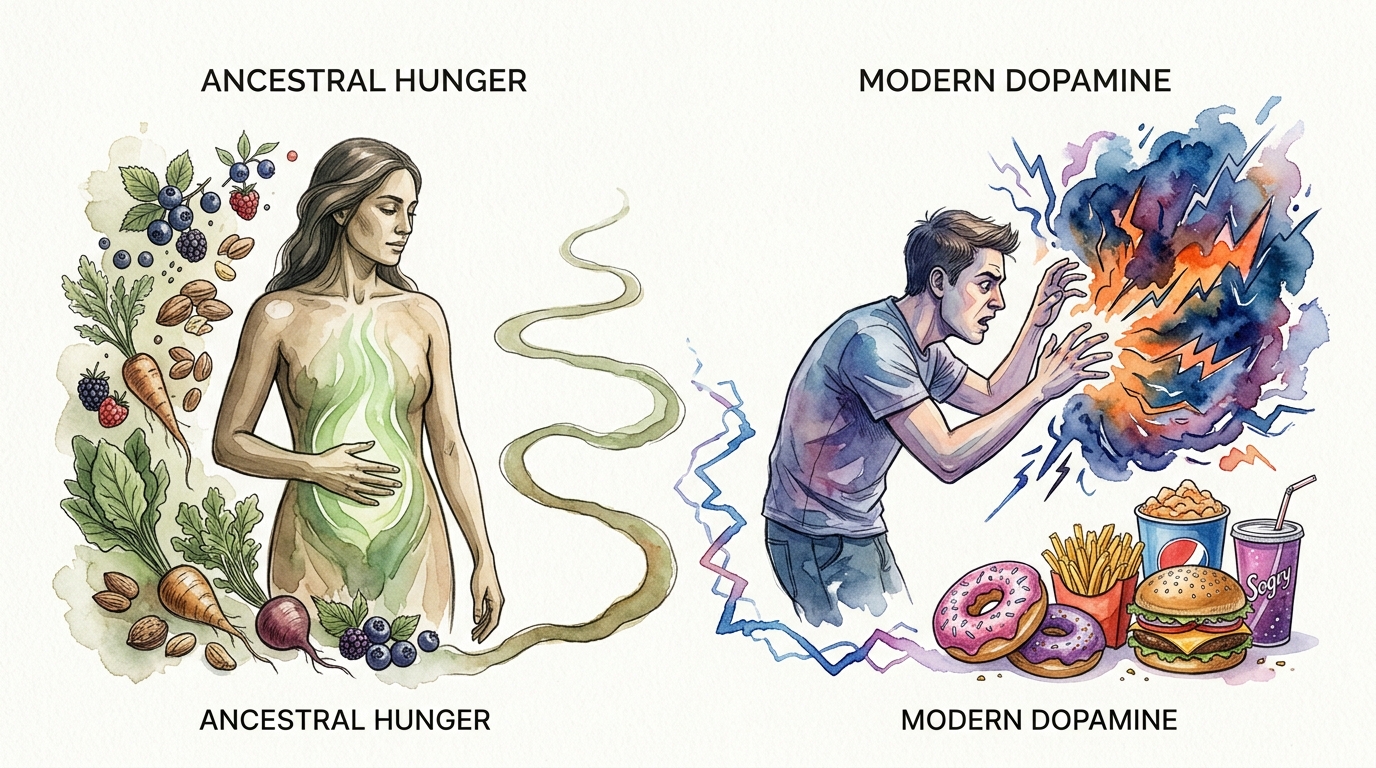
Your brain isn’t broken, it’s just being hijacked by a system it wasn’t built to handle. We evolved to seek calories in a world of scarcity. Now we live in a world of infinite dopamine loops designed to bypass our ‘full’ switch. To lose weight, you don’t need more willpower; you need to reconnect with the ancestral signals that modern food has silenced.
Most people blame themselves for late-night snacking or being unable to stop at just one chip. This is a misunderstanding of biology. Modern food environments are engineered to trigger the same reward pathways as addictive drugs. Understanding how this hijack works is the first step toward reclaiming your health and your waistline.
Natural Hunger Cues Vs Hyperpalatable Cravings
Natural hunger is a physiological state driven by energy needs. It builds slowly, usually hours after your last meal. When you are naturally hungry, your body is signaling that its fuel reserves are low. You might feel a slight rumble in your stomach, a dip in energy, or a subtle loss of focus. Almost any whole food sounds appealing in this state. A plain apple or a piece of grilled chicken feels like a solution to the problem.
Hyperpalatable cravings are entirely different. These are intense, sudden urges for specific types of food—usually those high in fat, sugar, and salt. These cravings do not originate in the stomach; they originate in the brain’s reward centers. You might feel “starving” for a specific brand of cookies even if you just finished a large dinner. This is the hallmark of modern dopamine loops overriding ancestral hunger.
Hyperpalatable foods are manufactured to be “irresistible.” They use a specific combination of ingredients that rarely occur together in nature. In the wild, you might find sweet fruit (sugar) or fatty meat (fat), but you almost never find a food that is 50% fat and 50% sugar. When we eat these engineered combinations, our brain releases a surge of dopamine that is significantly higher than what we evolved to handle. This creates a “memory” of pleasure that the brain wants to repeat, leading to cravings that feel like a survival necessity but are actually a biological glitch.
The Mechanics of the Brain Hijack
The process of food addiction begins in the mesolimbic dopamine system. This is the part of the brain responsible for “wanting” and “seeking.” When you eat something high in sugar and fat, the Ventral Tegmental Area (VTA) sends a signal to the Nucleus Accumbens (NAc), flooding it with dopamine. This chemical is not about “liking” the food as much as it is about “reinforcing” the behavior. Your brain records the environment, the smell, and the taste, marking it as a top priority for survival.
As you continue to consume these foods, a process called downregulation occurs. The brain, in an attempt to protect itself from overstimulation, reduces the number of D2 dopamine receptors available. This means you now need more of the same food to get the same level of satisfaction. This is known as Reward Deficiency Syndrome. It explains why a single cookie used to be enough, but now you need the whole box.
The Role of Leptin and Ghrelin
Two main hormones govern your appetite: Leptin and Ghrelin. Ghrelin is the “hunger hormone” produced in the stomach. It tells your brain when it is time to eat. Leptin is the “satiety hormone” produced by your fat cells. It tells your brain when you have enough stored energy and can stop eating. In a healthy system, these two stay in balance.
Hyperpalatable foods disrupt this balance. High levels of insulin—triggered by refined carbs and sugar—can block leptin from reaching the brain. This creates leptin resistance. Even though you have plenty of fat stores (energy), your brain thinks you are starving. This is why many people who are overweight feel constant, gnawing hunger. Their brain is literally unable to “see” the energy they already have.
The Engineering of the Bliss Point
The food industry uses a concept called the Bliss Point to maximize consumption. Coined by psychophysicist Howard Moskowitz, the Bliss Point is the precise ratio of salt, sugar, and fat that provides the maximum amount of pleasure without overwhelming the palate. If a food is too sweet, you stop eating it (sensory-specific satiety). If it hits the Bliss Point, your brain’s “stop” signal is never triggered.
Food scientists also manipulate “mouthfeel” and “vanishing caloric density.” Foods like Cheetos are designed to melt in the mouth quickly. This tricks the brain into thinking the calories have vanished, so it doesn’t send a signal to the stomach that you are full. You can consume thousands of calories before your biological sensors even realize you’ve started eating.
The Holy Trinity of Overeating
- Sugar: Provides immediate energy and a massive dopamine spike.
- Fat: Provides a rich mouthfeel and calorie density that the brain is wired to store.
- Salt: Acts as a flavor enhancer that makes you want to take the next bite immediately.
Benefits of Reclaiming Your Ancestral Signals
Re-sensitizing your brain to natural hunger signals offers benefits that go far beyond weight loss. When your dopamine receptors recover, you begin to find pleasure in everyday things again. A simple meal of steak and broccoli starts to taste vibrant and satisfying. You no longer feel like a slave to the vending machine or the drive-thru.
Metabolic health also improves rapidly. As you reduce the intake of hyperpalatable “junk,” your insulin levels stabilize. This allows your brain to finally “hear” the leptin signals coming from your fat cells. Once leptin sensitivity is restored, your body naturally begins to down-regulate its own hunger. You will find yourself naturally eating less without having to count every calorie or white-knuckle your way through cravings.
Short-Term vs Long-Term Gains
| Factor | Hyperpalatable Diet | Ancestral/Whole Food Diet |
|---|---|---|
| Energy Levels | Spikes and crashes | Stable and consistent |
| Hunger Quality | Urgent and specific | Gradual and flexible |
| Mental Clarity | Brain fog/cravings | Sharp and focused |
| Weight Control | Constant struggle | Natural regulation |
Challenges and Common Mistakes
The biggest challenge in breaking the dopamine loop is the withdrawal phase. Because hyperpalatable foods act on the same pathways as drugs, removing them can cause irritability, headaches, and intense cravings for 3 to 7 days. Many people mistake this for “true hunger” and give up, thinking their body “needs” the sugar. Understanding that this is a neurological detox is essential for success.
A common mistake is trying to “moderate” trigger foods too early. If your D2 receptors are already downregulated, having “just one” bite of a Bliss Point food is like a recovering alcoholic having “just one” sip of beer. It re-ignites the entire dopamine circuit and makes the next several days much harder. Complete avoidance for a period of 2 to 4 weeks is often necessary to allow the brain to reset.
Environmental Pitfalls
- The “See Food” Diet: Keeping snacks on the counter triggers “visual hunger,” prompting the brain to release dopamine before you even taste the food.
- Social Pressure: Friends and family often use food as a tool for connection, making it hard to say no to hyperpalatable treats.
- Hidden Sugars: Many “healthy” foods like yogurt and granola are engineered to hit the Bliss Point.
Limitations of the Biological Reset
Resetting your hunger cues is powerful, but it isn’t a magic wand for every situation. Chronic stress and lack of sleep are massive disruptors of the dopamine and leptin systems. If you are only sleeping five hours a night, your ghrelin levels will be naturally higher, and your willpower (controlled by the prefrontal cortex) will be significantly lower. No amount of “clean eating” can fully override the biological urge to seek quick energy when you are sleep-deprived.
Environmental constraints also play a role. We live in an “obesogenic” environment where hyperpalatable food is the cheapest and most accessible option. For individuals living in food deserts or under extreme financial stress, the “choice” to eat whole, ancestral foods is often a luxury. Systemic factors frequently override individual biological resets, requiring a more comprehensive approach to health.
Practical Tips for a Biological Reset
Restoring your brain’s sensitivity requires a deliberate strategy. Start by prioritizing protein. Protein is the most satiating macronutrient and has a minimal impact on insulin. It also provides the amino acids like tyrosine that are necessary for healthy dopamine production. Aim for 30–50 grams of protein at every meal.
Intermittent fasting is another powerful tool for resetting D2 receptors. Giving your digestive system a break for 16 hours a day reduces insulin and allows the brain to regain sensitivity to leptin. It also helps break the habit of constant “grazing,” which keeps dopamine levels perpetually elevated.
Actionable Steps to Follow
- Clean Your Environment: Remove all ultra-processed foods from your home. If it’s in your house, you will eventually eat it.
- The 20-Minute Rule: It takes about 20 minutes for satiety signals to reach the brain. Eat slowly and wait before reaching for seconds.
- Focus on Fiber: Whole vegetables provide bulk that physically stretches the stomach, sending mechanical “full” signals to the brain.
- Dopamine Fasting: Reduce other sources of instant gratification (like mindless scrolling) to help your brain’s reward system recover faster.
Advanced Considerations: The Gut-Brain Axis
Serious practitioners should look into the Vagus nerve and the gut microbiome. Your gut bacteria can actually influence your cravings. Certain species of bacteria thrive on sugar and can produce chemicals that travel up the Vagus nerve to the brain, effectively “requesting” more of their favorite fuel. By eating a diverse range of fibers and fermented foods, you can shift your microbiome to favor species that support satiety rather than cravings.
Optimization also involves Omega-3 fatty acids. These fats are essential for the structural integrity of neurons and dopamine receptors. Chronic inflammation, often caused by an overabundance of seed oils (Omega-6), can gum up these receptors, making them less responsive. Supplementing with high-quality fish oil or eating fatty fish like salmon can help “grease” the machinery of your brain’s reward system.
Scenario: The Friday Night Loop
Imagine a typical Friday night. You’ve had a long week, your “willpower reserves” are drained, and you decide to order a pizza. As soon as you smell the dough and melted cheese, your VTA starts firing. This is anticipatory dopamine. You haven’t even taken a bite, but your brain is already pushing you toward the behavior.
You eat the first slice. It hits the Bliss Point perfectly—salty, fatty, and slightly sweet from the sauce. Your Nucleus Accumbens is flooded with dopamine. You feel a “rush” of relief and pleasure. However, because this is an engineered food, your leptin signals are ignored. By the third slice, you are physically full, but the dopamine loop is still screaming “more.”
Contrast this with an ancestral meal: a large steak and a pile of roasted asparagus. The steak is nutrient-dense and high in protein. The asparagus provides fiber and volume. There is no “vanishing caloric density.” You feel the weight of the food in your stomach. Your brain receives clear, slow-burning signals of satiety. You finish the meal feeling satisfied, not “hooked.” There is no urge to eat the entire cow; your biology tells you exactly when the job is done.
Final Thoughts
Weight loss is often framed as a battle of character, but in reality, it is a battle of biology. Your brain is a masterpiece of evolution designed to keep you alive in a world that no longer exists. By understanding the mechanics of hyperpalatable cravings and the Bliss Point, you can stop fighting yourself and start working with your physiology.
Reconnecting with your ancestral hunger signals is a journey of re-sensitization. It requires a temporary period of discomfort as your dopamine receptors heal, but the reward is a lifetime of food freedom. When you nourish your body with the foods it was built to handle, the “willpower” problem largely disappears.
Take the first step by choosing one whole-food meal today. Focus on the textures and the natural flavors. Give your brain the space it needs to hear the quiet signals of health over the loud noise of modern processing. Your biology is waiting to support you; you just have to give it a chance to speak.
Sources
1 wisecode.ai | 2 warriorfitnessma.com | 3 healthline.com | 4 clevelandclinic.org | 5 psychscenehub.com | 6 wikipedia.org | 7 scottsproteinballs.com | 8 phynova.com | 9 aliciaeaton.co.uk | 10 universityofcalifornia.edu | 11 psychologytoday.com | 12 nih.gov | 13 mdpi.com | 14 nih.gov | 15 rockefeller.edu | 16 nih.gov | 17 foodtimes.eu | 18 nih.gov