

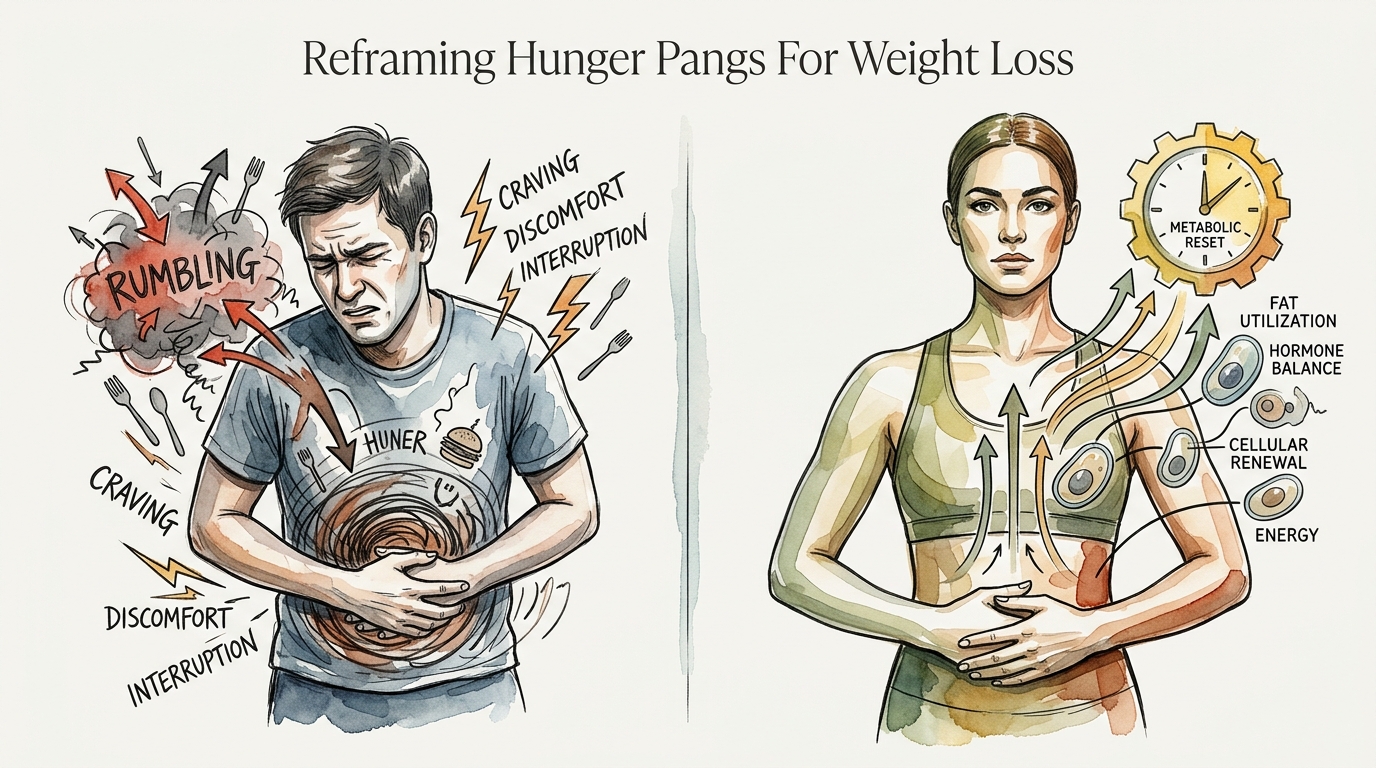
What if that stomach growl was actually the sound of your body finally succeeding?
Most of us treat hunger like a fire alarm that needs to be extinguished immediately. But what if you saw it as a signal that your body is finally tapping into stored energy? Stop fearing the sensation and start using it as your metabolic compass.
Understanding hunger is the difference between fighting your biology and partnering with it. When you shift your perspective, a “pang” is no longer a crisis; it is a confirmation that your system is shifting gears. This guide will show you how to transform the most dreaded part of weight loss into your greatest advantage.
Reframing Hunger Pangs For Weight Loss
Reframing hunger is the psychological and physiological practice of viewing the sensation of an empty stomach as a positive metabolic event rather than a sign of deprivation. In a world of constant food availability, we have been conditioned to view even slight hunger as a medical emergency. However, in the context of fat loss, these signals often represent the moment your body has depleted circulating glucose and is forced to look elsewhere for fuel.
At its core, this concept distinguishes between “homeostatic hunger”—the genuine physical need for calories—and “hedonic appetite,” which is the psychological desire to eat for pleasure, boredom, or habit. For most people in a modern environment, we rarely experience true physical hunger. What we feel are “ghrelin pulses,” waves of the hunger hormone that rise based on our usual eating schedule.
Think of it like a fuel gauge in a car. Just because the light comes on doesn’t mean the engine is about to die. It means you are now using your reserve tank. In human terms, your “reserve tank” is your stored body fat. When you reframe this sensation, you stop being a victim of your hormones and start becoming the architect of your own metabolism.
How the Metabolic Compass Works
To master this approach, you must understand the hormonal dance happening under the surface. Your body is a hybrid engine designed to run on two main fuel sources: glucose (sugar) and fatty acids (fat).
The Ghrelin Wave
Ghrelin is often called the “hunger hormone.” It is secreted primarily by the stomach when it is empty. Interestingly, ghrelin does not stay high forever if you don’t eat. It follows your circadian rhythm and your habits. If you always eat at 12:00 PM, ghrelin will spike at 11:45 AM. If you wait 20 to 30 minutes, the wave often subsides as the body begins to mobilize internal energy stores.
The Shift to Fat Oxidation
When you feel a hunger pang and choose to wait, your body must find energy to maintain your blood sugar. It begins a process called lipolysis, where fat cells release fatty acids into the bloodstream to be burned for fuel. This transition is the hallmark of “metabolic flexibility.” The more you practice “surfing” these hunger waves, the more efficient your mitochondria become at switching from burning sugar to burning fat.
The Role of Insulin
Reframing hunger also involves understanding insulin. When you eat, insulin rises to store energy, effectively “locking” the doors to your fat cells. When you are in a fasted state and feeling those early pangs, insulin levels are low. This low-insulin environment is the only time your body can effectively access and burn stored body fat.
Benefits of Partnering With Hunger
Choosing to see hunger as an asset provides measurable physiological and psychological advantages that go far beyond simple calorie counting.
Improved Insulin Sensitivity
By allowing your body to experience and exist in a state of mild hunger, you give your pancreas a break. Constant snacking keeps insulin chronically elevated, which can lead to insulin resistance. Frequent periods of “reframed hunger” help restore the body’s sensitivity to insulin, making it easier to lose weight and maintain it over the long term.
Enhanced Mental Resilience
Weight loss is as much a mental game as a physical one. When you stop fearing hunger, you reclaim your power. You no longer feel “hangry” or out of control when a meal is delayed. This builds a sense of self-efficacy—the belief that you are in control of your choices, not your cravings.
Natural Appetite Regulation
Paradoxically, the more you get comfortable with hunger, the less intense it often becomes. Over time, your body recalibrates its ghrelin production. Many practitioners find that their “food noise”—the constant background chatter of thinking about the next meal—diminishes significantly as they become more metabolically flexible.
Cellular Repair and Autophagy
Extended periods of hunger can trigger autophagy, a cellular “housekeeping” process where the body breaks down and recycles damaged proteins and cellular components. This is linked to improved longevity and better overall cellular health.
Challenges and Common Mistakes
While reframing hunger is powerful, it is easy to stumble if you don’t distinguish between healthy metabolic signaling and genuine distress.
Mistaking Thirst for Hunger
One of the most common errors is failing to recognize dehydration. The brain’s signals for hunger and thirst are remarkably similar. Many people reach for a snack when their body is actually screaming for water. Always hydrate before assuming a pang is a call for calories.
The “Starvation Mode” Panic
Beginners often worry that feeling hungry will “crash” their metabolism. While extreme, long-term calorie deprivation can slow metabolic rate, the temporary waves of hunger experienced between well-planned meals do not. In fact, short-term fasting can actually increase metabolic rate slightly by boosting adrenaline and growth hormone.
Overcompensating Later
A major pitfall is “saving up” hunger only to binge later in the day. Reframing hunger is not about starving yourself; it is about intentional meal spacing. If you use a morning of hunger as an excuse to eat a 2,000-calorie dinner of processed foods, you negate the metabolic benefits and reinforce a cycle of restriction and excess.
Limitations: When the Compass Points Elsewhere
This approach is a tool, not a universal law. There are specific situations where reframing hunger is inappropriate or even dangerous.
Clinical Eating Disorders
For individuals with a history of anorexia, bulimia, or orthorexia, “reframing hunger” can quickly morph into a tool for self-harm or obsessive control. In these cases, following a structured, professional meal plan is far more important than testing metabolic limits.
Type 1 and Advanced Type 2 Diabetes
Those on insulin or certain blood-sugar-lowering medications must be extremely cautious. For these individuals, a “hunger pang” accompanied by shakiness, sweating, or confusion could be hypoglycemia (low blood sugar), which requires immediate treatment with fast-acting glucose.
High-Performance Recovery
If you are an elite athlete in a heavy training block, ignoring hunger cues can lead to overtraining syndrome and muscle wasting. The body needs a surplus of nutrients to repair tissue after extreme physical exertion. In this context, hunger is less of a “compass” and more of a “fuel required” light for structural repair.
The Nuisance vs. The Asset
To truly change your mindset, it helps to compare the two ways of viewing the sensation of hunger.
| Feature | The Nuisance (Reactive) | The Asset (Empowered) |
|---|---|---|
| Initial Reaction | Anxiety, irritation, and immediate search for food. | Curiosity, calm, and metabolic check-in. |
| Primary Goal | Eliminate the sensation as fast as possible. | Utilize the sensation for fat mobilization. |
| Food Choice | Impulsive, often high-sugar or processed “quick fixes.” | Planned, nutrient-dense, and high-satiety. |
| Metabolic State | Frequent insulin spikes; fat storage mode. | Low insulin; fat oxidation mode. |
| Long-term Effect | Weight-loss plateaus and food obsession. | Sustainable fat loss and metabolic flexibility. |
Practical Tips for Reframing Your Hunger
Ready to start using your metabolic compass? Use these actionable techniques to handle the next wave of hunger with confidence.
- The 20-Minute Rule: When a hunger pang hits, set a timer for 20 minutes. Engage in a distracting task like answering emails, going for a short walk, or reading. Often, the ghrelin wave will pass, and the hunger will vanish.
- The Apple Test: Ask yourself, “Am I hungry enough to eat a plain, raw apple?” If the answer is yes, you are likely experiencing homeostatic hunger. If the answer is “No, but I’d eat some chips,” you are experiencing hedonic appetite.
- Hydration First: Drink a large glass of water or unsweetened tea when you feel a pang. Wait ten minutes. If the hunger persists, it is real; if it disappears, it was thirst.
- Distinguish the “Growl”: A growling stomach (borborygmi) is often just the sound of your digestive tract cleaning itself out. It is not always a request for more food. Learn to hear it as a “cleaning cycle” rather than a “refill request.”
- Ride the Wave: Visualize hunger as a wave in the ocean. It rises, peaks, and then crashes and recedes. You don’t have to fight the wave; you just have to stay on your board until it passes.
Advanced Considerations for Practitioners
For those who have mastered the basics, you can further optimize your metabolic compass by timing your hunger and understanding your body’s specific rhythms.
Circadian Entrainment
Your hunger hormones are deeply tied to your light-dark cycle. Eating late at night disrupts the natural drop in ghrelin that should happen during sleep. Advanced practitioners align their eating window with daylight hours, allowing the body to experience its most significant fat-burning phase during the overnight fast.
Protein and Fiber Preloading
To make the “hunger reframing” process easier, ensure your previous meal was high in protein and fiber. Protein stimulates the release of PYY and GLP-1, hormones that signal satiety to the brain. This doesn’t stop the initial ghrelin pulse, but it makes the “wave” much smaller and easier to manage.
The Psychological “Urge Surfing”
This is a mindfulness technique used in addiction therapy that applies perfectly to hunger. Instead of trying to suppress the thought of food, acknowledge it. Say to yourself, “I am noticing a sensation of hunger in my stomach. This is my body accessing stored fat.” By labeling the sensation objectively, you detach the emotion from the physical feeling.
Scenario: The 3:00 PM Office Slump
Imagine you are at your desk. You ate a healthy lunch at noon, but now it’s 3:00 PM and your stomach is growling. Your coworkers are heading to the breakroom for donuts.
The “Nuisance” mindset says: “I’m starving. I can’t focus. I need a donut to get through the afternoon. My diet is failing because I’m so hungry.”
The “Asset” mindset says: “There is the 3:00 PM ghrelin pulse. My body has finished processing lunch and is now looking for more fuel. Since I’m not giving it a donut, it’s going to start tapping into my body fat for the next two hours. This is exactly what progress feels like. I’ll have some green tea and check back in at 5:00 PM.”
By 3:30 PM, the hunger has vanished. You feel a surge of steady energy because your body successfully switched to fat-burning mode. You didn’t just save 300 calories; you trained your metabolism to be more resilient.
Final Thoughts
Hunger is not a sign of failure. It is not a sign that your diet is “too restrictive” or that you lack willpower. Instead, think of it as the sound of your body doing the work you asked it to do. When you reframe those pangs as a metabolic compass, you stop being afraid of your own biology.
This shift in perspective allows you to move from a state of constant reaction to a state of intentional action. You begin to appreciate the sensation of an empty stomach as a sign of health, clarity, and progress. It is the moment where theory becomes practice, and where weight loss stops being a struggle and starts being a system.
Start small. The next time you feel that familiar growl, don’t reach for the pantry. Take a breath, drink some water, and realize that you are finally succeeding. Experiment with “surfing the wave” just once today, and see how it changes your relationship with food forever.
Sources
1 inbodyusa.com | 2 medicalnewstoday.com | 3 obesityaction.org | 4 webmd.com | 5 faynutrition.com | 6 lumen.me | 7 ljbnutrition.com | 8 graceobgyntx.com | 9 gulfnews.com | 10 coachianwood.com | 11 emetabolic.com | 12 levels.com | 13 healthline.com | 14 drhyman.com | 15 stanford.edu | 16 oncologyspasolutions.com | 17 berrystreet.co | 18 bodyclinic.de | 19 nm.org | 20 livescience.com | 21 workingagainstgravity.com