

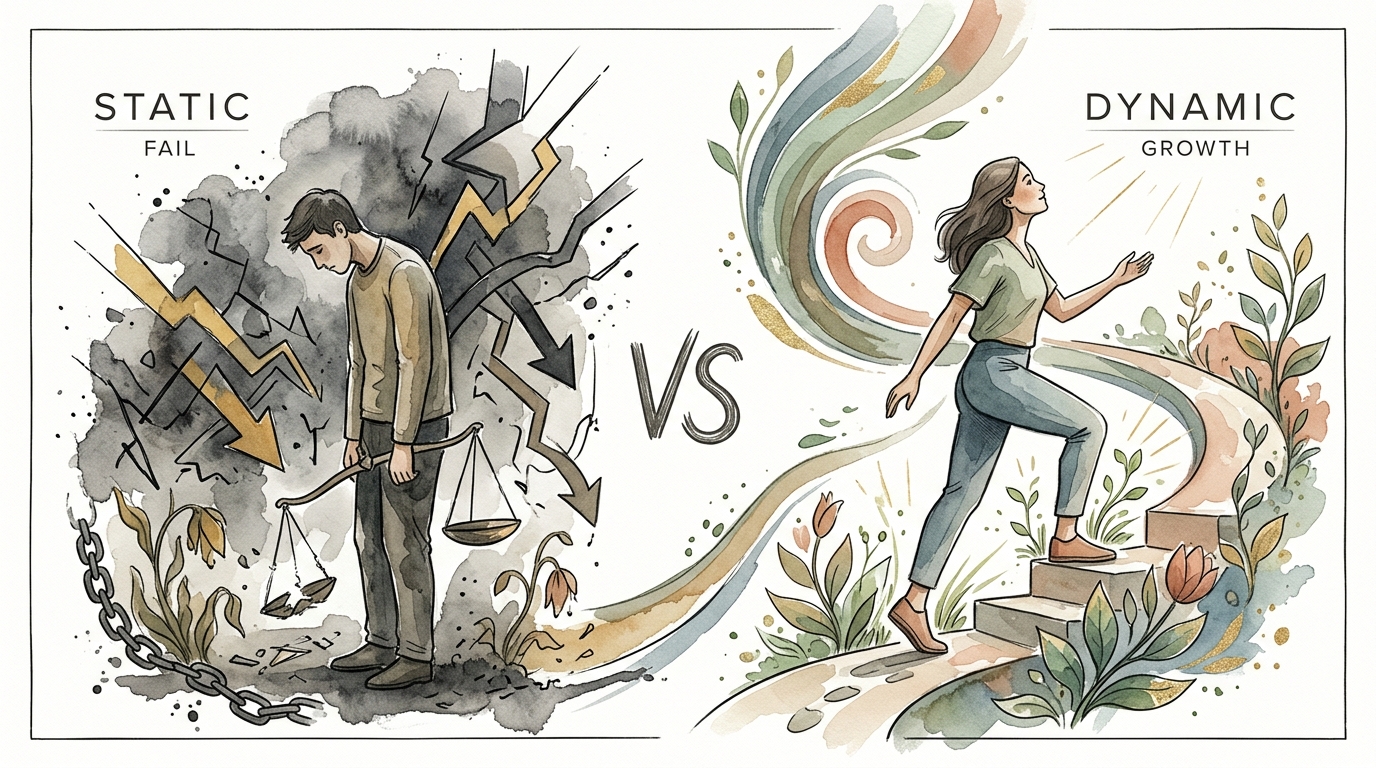
A weight loss plateau isn’t a brick wall; it’s a signal to pivot your strategy. In a static mindset, a plateau means you’ve hit your limit. In a dynamic mindset, a plateau is just a data set telling you to adjust your approach. Which one are you currently living in?
Your body is a survival machine. It loves stability. When you start losing weight, your body doesn’t see a “healthier you.” It sees a threat to its energy reserves. It begins to fight back by making you more efficient. This efficiency is exactly what stalls your progress [1.15, 1.17].
Most people quit when the scale stops moving. They assume they have failed. However, a plateau is actually proof that your previous plan worked. You have successfully changed your body enough that the old plan is no longer a challenge for it. Now, it is time to upgrade your tactics.
Growth Mindset For Weight Loss
A growth mindset is the belief that your abilities and results can change through effort and strategy [1.1, 1.3]. This concept was pioneered by psychologist Carol Dweck. In the context of weight loss, it means viewing your body as a dynamic system rather than a fixed one [1.1].
People with a fixed mindset—what we call “Static Fail”—believe they have a set “metabolism” or “genetics” that prevents further loss [1.9]. When they hit a plateau, they say, “I guess this is as far as I can go.” They see the obstacle as a permanent boundary. This belief often leads to frustration and abandonment of healthy habits [1.1, 1.2].
Conversely, those with a “Dynamic Growth” mindset see a plateau as an interesting puzzle [1.3, 1.7]. They understand that a smaller body requires different energy needs than a larger one [1.15, 1.24]. They use the plateau as a signal to collect data. Instead of blaming themselves, they audit their habits, recalculate their needs, and try a new tactic [1.3, 1.7].
This mindset shifts the focus from “perfection” to “problem-solving” [1.3]. It turns a frustrating stall into a learning opportunity. Research shows that people with this mindset are more likely to engage with health programs and achieve greater long-term success [1.1]. They don’t just lose weight; they learn how to manage their body for life.
How It Works: Navigating the Pivot
Breaking a plateau requires a combination of physiological adjustments and psychological shifts. Your body has adapted to your current routine, so you must introduce a new stimulus to restart progress [1.5, 1.14].
1. Recalculate Your Energy Needs
A smaller body requires fewer calories to function than a larger one [1.15, 1.24]. If you have lost 10% of your body weight, your resting metabolic rate has decreased [1.5]. The calorie deficit that worked on day one might be your new “maintenance” level today. You must recalculate your Total Daily Energy Expenditure (TDEE) based on your current weight [1.15].
2. Audit for “Adherence Drift”
Subtle changes in behavior often contribute to plateaus. You might be slightly increasing portion sizes or grazing more frequently without realizing it [1.15, 1.24]. This is known as “adherence drift.” Recommitting to precise tracking for 7–14 days can reveal where those hidden calories are creeping in [1.8, 1.24].
3. Manage Metabolic Adaptation
Metabolic adaptation, or adaptive thermogenesis, is your body’s attempt to conserve energy [1.5, 1.11]. As you eat less, your body burns less. To fight this, you can use “refeed days” or “diet breaks” [1.5, 1.11]. This involves eating at your maintenance calorie level for a few days or weeks. This signals to your brain that food is plenty, which can help normalize hormone levels like leptin and thyroid [1.11, 1.15].
4. Combat Decreased NEAT
Non-Exercise Activity Thermogenesis (NEAT) is the energy burned during daily movement like walking, fidgeting, and standing [1.13, 1.17]. When you are in a calorie deficit, your body subconsciously reduces these movements to save energy [1.16, 1.17]. You might sit more or move less without noticing. Increasing your daily step count is one of the most effective ways to reverse this drop [1.10, 1.13].
Benefits of a Dynamic Approach
Choosing a dynamic mindset over a static one provides more than just physical results. It changes your entire relationship with health and fitness.
- Reduced Psychological Distress: Viewing a plateau as a data point reduces the shame and self-criticism that usually follow a stall [1.3, 1.4].
- Increased Resilience: You become better at bouncing back from setbacks because you expect them to be part of the process [1.4, 1.12].
- Long-Term Sustainability: Because you focus on “learning” rather than “dieting,” you build skills that help you maintain your weight once you reach your goal [1.2, 1.18].
- Hormonal Harmony: Strategies like diet breaks help prevent the extreme hormonal crashes that lead to “rebound” weight gain [1.11, 1.15].
- Empowerment: You realize you have control over the process. You are the “detective” solving the mystery of your own metabolism [1.3].
Challenges and Common Mistakes
Even with the right mindset, several common pitfalls can keep you stuck in a plateau for longer than necessary.
Panic-Cutting Calories: When the scale stops moving, the natural impulse is to slash calories further. However, dropping your intake too low can accelerate metabolic adaptation and lead to muscle loss [1.14, 1.20]. This makes it even harder to lose weight in the long run.
The “Cardio Only” Trap: Many people try to break a plateau by simply doing more cardio. While cardio burns calories, too much of it can increase stress hormones like cortisol and lead to muscle breakdown [1.11, 1.14]. Without resistance training, your metabolism continues to slow down [1.14, 1.15].
Obsessing Over the Scale: The scale does not always reflect fat loss. You may be losing fat while retaining water or building muscle [1.8]. If you judge your entire progress by a single number, you might quit a plan that is actually working.
Ignoring Sleep and Stress: High cortisol levels from lack of sleep or chronic stress tell your body to hold onto fat, especially in the abdominal area [1.6, 1.11]. You cannot out-train a body that is constantly in “survival mode” due to stress [1.14].
Limitations: When the Pivot Might Not Work
While a dynamic mindset is powerful, it is important to recognize realistic boundaries. Some factors are beyond simple dietary adjustments.
Genetics play a role in how aggressively your body adapts to weight loss [1.11]. Some individuals may experience a more significant metabolic slowdown than others. Additionally, medical conditions like hypothyroidism, PCOS, or Cushing’s syndrome can cause “weight loss resistance” that requires clinical intervention [1.5, 1.20].
Life circumstances also create limitations. If you are going through a period of extreme emotional stress or grieving, your body’s capacity to handle a calorie deficit is reduced [1.4]. In these cases, shifting to a “maintenance” phase rather than pushing for more loss is often the healthiest strategy.
Finally, there is the concept of a “biological set point.” While this can be moved, your body will naturally fight harder the further you get from your starting weight [1.5, 1.22]. Understanding these boundaries helps you maintain realistic expectations and avoid burnout.
Practical Comparison: Static vs. Dynamic Mindsets
The following table illustrates how these two mindsets react to common weight loss challenges.
| Scenario | Static Fail (Fixed Mindset) | Dynamic Growth (Growth Mindset) |
|---|---|---|
| Scale stays the same for 2 weeks | “The diet isn’t working. I’m a failure.” | “My body has adapted. Time to audit my NEAT and protein.” |
| Eating a “non-plan” meal | “I ruined everything. Might as well eat whatever today.” | “That was one meal. I’ll focus on high protein for the next one.” |
| Exercise feels harder | “I’m getting weaker. This isn’t for me.” | “I might need more recovery or a temporary calorie increase.” |
| Long-term goal setting | Focuses only on the “goal weight” number. | Focuses on building habits and skills for life. |
Practical Tips for Breaking Through
If you are currently in a plateau, apply these actionable steps immediately to regain momentum.
- Increase Your Protein Intake: Protein has a higher thermic effect than fat or carbs, meaning your body burns more calories just digesting it [1.13, 1.15]. It also preserves muscle mass during a deficit [1.15].
- Start Heavy Resistance Training: Muscle is metabolically expensive [1.11, 1.14]. By lifting weights, you tell your body to keep its muscle and burn fat instead. This keeps your BMR higher [1.14, 1.15].
- Track Your Steps, Not Just Your Gym Time: Aim for a consistent daily step count (e.g., 8,000–10,000). This ensures your NEAT doesn’t drop as you lose weight [1.13].
- Prioritize 7-9 Hours of Sleep: Sleep regulates the hormones ghrelin (hunger) and leptin (fullness) [1.11, 1.14]. Better sleep makes it easier to stick to your nutrition plan.
- Use Non-Scale Victories (NSVs): Measure your waist, take photos, or track your strength in the gym [1.5, 1.12]. Often, your body is changing even when the scale is not.
Advanced Considerations: The Art of the Diet Break
For serious practitioners, a “diet break” is a sophisticated tool to manage metabolic adaptation. This is not a “cheat week” where you eat everything in sight [1.15]. Instead, it is a planned 1–2 week period where you bring your calories up to your current maintenance level [1.11].
Research suggests that intermittent energy restriction can be just as effective as continuous restriction while being much easier on your psychology and hormones [1.10, 1.11]. During a diet break, your hormone levels (like thyroid and leptin) have a chance to recover. This “resets” your metabolic rate, often making it easier to lose weight once you return to a deficit [1.11, 1.22].
Another advanced tactic is “reverse dieting.” After a long period of weight loss, you slowly increase your calories by 50–100 per week. This helps “train” your metabolism to handle more food without rapid weight gain, setting you up for successful long-term maintenance [1.11].
Examples and Scenarios
Consider the case of “Sarah.” She lost 20 pounds over four months but has been the same weight for three weeks.
The Static Fail Approach: Sarah gets angry. She decides she’s “done” and stops tracking her food. She skips her workouts because “what’s the point?” Within a month, she has regained 5 pounds and feels like she can never lose weight.
The Dynamic Growth Pivot: Sarah looks at her data. She realizes she’s been getting 2,000 fewer steps per day than when she started. She also hasn’t adjusted her calories for her new, lighter weight. She decides to take a one-week diet break at maintenance calories to lower her stress. After the break, she adds two days of strength training and hits her step goal. Two weeks later, the scale drops again.
Final Thoughts
A weight loss plateau is not a sign of failure; it is a sign of biological success. It means your body has successfully adapted to the changes you made. To continue progressing, you must meet your body where it is now, not where it was at the start of your journey.
Embracing a growth mindset allows you to treat these stalls as puzzles to be solved rather than reasons to quit. By focusing on data, adjusting your strategy, and practicing self-compassion, you turn a temporary roadblock into a launching pad for long-term health.
Stop fighting against your body and start working with it. Every plateau is an invitation to learn more about how your unique metabolism functions. Take the data, make the pivot, and keep moving forward. Your future self is waiting on the other side of this adjustment.
Sources
1 rechargeocalaclinic.com | 2 palomahealth.com | 3 theswolekitchen.com | 4 cutlerintegrativemedicine.com | 5 psychologytoday.com | 6 workingagainstgravity.com | 7 forhers.com | 8 katelymannutrition.com | 9 mayoclinic.org | 10 nih.gov | 11 corerejuvenationmedspa.com | 12 mayoclinic.org | 13 rumen.com.au | 14 healthline.com | 15 researchgate.net