

Stop looking for the magic pill and start looking at your own identity.
The weight loss industry wants you to be a perpetual consumer of the ‘next big thing.’ But the people who keep the weight off are those who stop buying fixes and start producing their own results through self-awareness.
Most people treat weight loss like a temporary project.
They buy a subscription, follow a restrictive plan for six weeks, and wait for the results to arrive. This approach creates a cycle of frustration because it relies on external forces to drive internal change.
True transformation requires a shift in how you view yourself. Instead of focusing on what you want to achieve, you must focus on who you wish to become. This guide will help you move from being a consumer of fitness products to a producer of your own health.
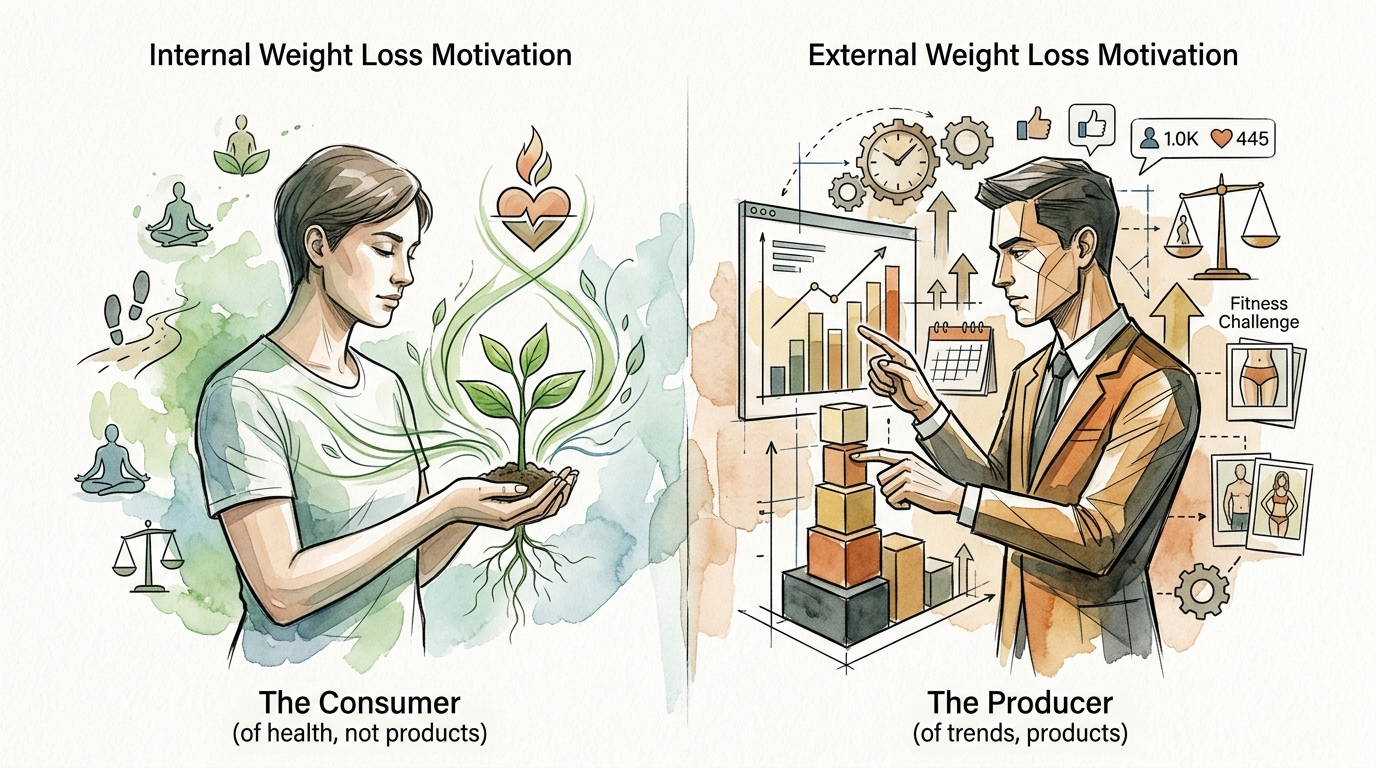
Internal Vs External Weight Loss Motivation
Motivation is the fuel for your journey, but not all fuel is created equal. Psychologists generally categorize motivation into two types: intrinsic (internal) and extrinsic (external). Understanding where your drive comes from is the first step toward lasting success.
External motivation is driven by rewards or the avoidance of negative consequences. Examples include wanting to look good for a wedding, trying to win a weight loss competition, or following a doctor’s orders to avoid health complications. While these factors can provide a “nitro-boost” to get you started, research shows they are rarely enough to sustain long-term maintenance.
Internal motivation comes from within and is tied to your personal values, interests, and enjoyment. When you are internally motivated, you engage in healthy behaviors because they feel good or align with your sense of self. You might exercise because you love the clarity it brings to your mind or eat well because you value having the energy to play with your children.
Studies based on Self-Determination Theory (SDT) highlight that autonomy, competence, and relatedness are essential for sustaining change. Individuals who feel they are making their own choices (autonomy) and feel capable of succeeding (competence) are significantly more likely to keep weight off over the long term. Reliance on external pressure often leads to a “motivational disconnect” once the initial goal is reached or the pressure fades.
How Identity-Based Habits Drive Results
Traditional habit change focuses on outcomes. You set a goal, like losing 20 pounds, and then you try to build processes to reach that goal. This method is often fragile because your identity remains tied to your old habits.
Identity-based habits flip the script. You start by deciding the type of person you want to be. Instead of saying “I want to lose weight,” you tell yourself “I am the type of person who never misses a workout.” This shift in perspective makes the behavior an expression of who you are, rather than a chore you have to perform.
Establishing this new identity requires two simple steps. First, decide who you want to become. Second, prove it to yourself with small wins. Every time you choose a salad over fries or take a ten-minute walk, you are casting a vote for your new identity. These small victories accumulate and eventually reshape your self-image.
Benefits of Shifting Your Motivation
Moving toward internal motivation offers several practical advantages. It reduces the psychological effort required to stay on track. When a behavior becomes part of your identity, you no longer have to “white-knuckle” your way through cravings or laziness.
Long-term adherence is the most significant benefit. Internalized values are stable, whereas external rewards are fleeting. People who enjoy the process of being active or eating well find it much easier to maintain their results through stressful life events.
Mental well-being also improves. Relying on external validation, like “likes” on social media or compliments from others, can create anxiety. Internal motivation fosters a sense of pride and self-efficacy that is independent of what others think.
Challenges and Common Mistakes
The “All or Nothing” trap is a frequent pitfall for those relying on external goals. If you miss a target or slip up on a diet, you might feel like you’ve failed the entire project. This often leads to “throwing in the towel” because the external reward feels out of reach.
Societal pressure can also undermine internal progress. We are constantly bombarded with advertisements for quick fixes and “cheat codes” for fat loss. These external messages encourage a consumer mindset, making you believe that you are always one purchase away from success.
Reverting to your default identity under stress is another common challenge. In times of high pressure, your brain seeks the path of least resistance. If your core identity is still that of an “unhealthy eater,” you will naturally return to those behaviors when your willpower is low.
Limitations of This Approach
Identity change is not a substitute for the laws of physics. While shifting your mindset is crucial for consistency, the mathematics of energy balance still determine weight loss. You cannot “identify” your way out of a significant calorie surplus.
Environmental constraints can also play a role. If you live in a “food desert” or have a schedule that prohibits regular activity, shifting your internal motivation might not be enough. You must also proactively design your environment to support your new identity.
Serious medical conditions or severe obesity may require clinical interventions alongside psychological shifts. In these cases, identity work serves as a powerful supplement to, rather than a replacement for, professional medical guidance.
The Consumer vs. The Producer
The weight loss journey can be viewed through the lens of a “Consumer” versus a “Producer.” One relies on external products, while the other relies on internal skills.
| Feature | The Consumer Mindset | The Producer Mindset |
|---|---|---|
| Source of Change | External fixes, pills, and plans. | Internal skills and self-awareness. |
| Focus | Short-term outcomes and deadlines. | Long-term lifestyle and identity. |
| Reaction to Stress | Gives up until “next Monday.” | Adjusts the plan to maintain the habit. |
| Effort Type | Low effort, high spending. | Consistent effort, high skill. |
Practical Tips for Sustainable Change
To transition from external to internal motivation, you must start with reflection. Ask yourself “why” you want to lose weight, then ask “why” four more times. This layering technique helps you move past surface-level desires (like fitting into a dress) to core values (like being an active grandparent).
- Select activities you actually enjoy. Do not force yourself to run if you hate it. Find a sport or movement that feels like play.
- Use “I am” statements. Replace “I’m trying to eat better” with “I am someone who fuels their body with quality food.”
- Design for success. Clear the junk food from your pantry. Your environment should make your new identity the easiest choice.
- Focus on non-scale victories. Celebrate improved sleep, better mood, or higher energy levels. These are immediate internal rewards.
Advanced Considerations
Serious practitioners should understand the neurobiology of reward. Dopamine is often associated with the anticipation of a reward. When you rely on external goals, your brain only gets a dopamine hit when you see a specific number on the scale.
By focusing on internal motivation, you can train your brain to release dopamine during the activity itself. This is known as the “autotelic” experience—the activity is its own reward. Achieving this state makes habits incredibly resilient to outside interference.
Scaling your new identity is also important. Once you become “someone who exercises,” you can refine it to “someone who masters strength training.” This continuous evolution prevents boredom and keeps you in a state of growth.
Scenario: From Deadline-Driven to Identity-Driven
Imagine an office worker named Sarah. Sarah has a wedding in three months and wants to lose 15 pounds. She buys a high-intensity boot camp package and a strict meal plan. This is a classic “Consumer” approach driven by an external deadline.
Sarah loses the weight, but the day after the wedding, she stops the boot camp. She hasn’t built any internal skills, and her identity is still “someone who struggles with their weight.” Within six months, the weight returns.
Now, imagine if Sarah decided to become “an active person” instead. She starts by walking for 15 minutes during her lunch break. She focuses on how the fresh air makes her feel more focused for the afternoon.
When the wedding comes, Sarah has lost weight, but that wasn’t her primary goal. She keeps walking because she values her mental clarity. She has produced her own results through a shift in identity, making her success permanent.
Final Thoughts
Lasting weight loss is never found in a bottle or a trendy new app. It is built through the quiet, consistent work of reshaping your self-perception. When you stop looking for the magic pill and start looking at your own identity, the struggle begins to fade.
Shifting from external motivation to internal drive allows you to become the producer of your own life. You no longer need a “new year” or a special event to be healthy. Health simply becomes who you are and what you do every day.
Take the first step today by identifying one small win. Prove to yourself that you are the type of person who makes choices that support your well-being. The results will follow naturally from the person you become.
Sources
1 jamesclear.com | 2 lark.com | 3 mapstrategic.com | 4 constanthealth.ca | 5 corporatefitnessworks.com | 6 secondnature.io | 7 strongbodygreenplanet.com | 8 ehps.net | 9 semanticscholar.org | 10 brainzmagazine.com | 11 tryhabitual.com | 12 youtube.com | 13 youtube.com | 14 youtube.com | 15 eocinstitute.org