

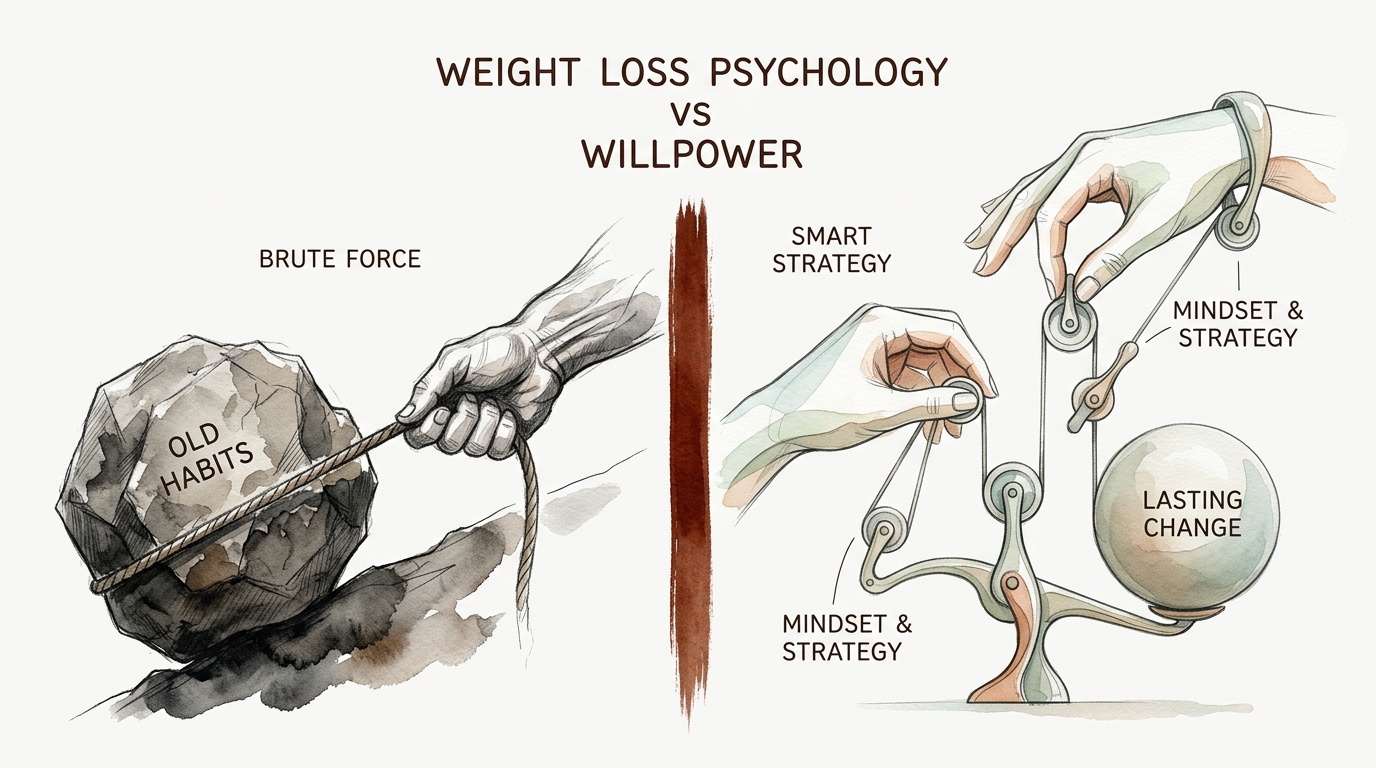
Why relying on pure willpower is the fastest way to fail your diet long-term. Most people treat weight loss like a wrestling match with their own brain. But you don’t win by fighting; you win by outsmarting the system. Here is why mental strategy beats physical struggle every single time.
Losing weight feels like an uphill battle because most people use the wrong tools. They rely on “white-knuckling” through cravings and forcing themselves into grueling workouts. This approach treats your body like an enemy to be conquered. However, your brain is designed to resist restriction.
Strategic weight loss isn’t about working harder. It is about working with your biology instead of against it. When you understand the psychological triggers that drive eating, you can design a life where weight loss happens on autopilot. This guide explores how to move from a “brute force” mindset to a “smart strategy” approach.
Weight Loss Psychology Vs Willpower
Willpower is a finite resource. Researchers often compare it to a battery that drains throughout the day. Every decision you make, from choosing an outfit to handling a stressful meeting, siphons off a bit of that energy. Psychologists call this “ego depletion”.
Relying on willpower to lose weight is a high-risk strategy. Your resolve is strongest in the morning but weakest at night. This explains why you can eat a healthy salad for lunch but find yourself face-down in a bag of chips by 9:00 PM. Your “executive brain” is simply too tired to keep saying no.
Weight loss psychology shifts the focus from resistance to design. Instead of trying to be “stronger,” you look at why the craving exists in the first place. This involves understanding the prefrontal cortex, which handles logic, and the basal ganglia, which stores habits. Most eating is habitual and subconscious.
Real-world success comes from reducing the number of times you have to choose. If you don’t have cookies in the house, you don’t need willpower to avoid them. You’ve already won the battle by changing the environment. This is the core difference between fighting your brain and outsmarting it.
How the “Smart Strategy” System Works
Effective weight loss relies on systems, not motivation. Motivation is a feeling, and feelings are fickle. Systems are structures that remain in place even when you are tired, angry, or bored. A smart strategy uses three primary levers: environmental design, implementation intentions, and habit stacking.
1. Environmental Design
Your surroundings dictate your behavior more than your personality. Research shows that people who keep fruit on their counters weigh less than those who keep cereal visible. Making the healthy choice the “path of least resistance” is the ultimate hack. If your gym bag is already in the car, you are much more likely to go than if you have to find your shoes first.
2. Implementation Intentions
Vague goals like “I will eat better” usually fail. Smart strategists use “If-Then” planning. For example: “If I feel a craving for a snack after work, then I will drink a glass of water and wait ten minutes.” This creates a pre-programmed response in your brain. It removes the need for active decision-making during high-stress moments.
3. Habit Stacking
New habits are hard to start in a vacuum. Stacking involves attaching a new behavior to an existing one. If you already drink coffee every morning, you might stack a five-minute stretch session right after your first cup. This uses the momentum of established routines to build new ones without extra effort.
The Benefits of a Psychological Approach
Sustainable results are the biggest advantage of choosing strategy over struggle. Brute force methods often lead to “yo-yo dieting” because the effort required is too high to maintain for years. A psychological approach feels easier because it reduces “decision fatigue”. You aren’t constantly debating with yourself about what to eat.
Mental health improvements are also significant. When you stop viewing yourself as “weak” for having a craving, your self-esteem improves. You realize that your environment was simply set up for failure. Shifting the blame from your character to your system allows for faster recovery after a slip-up.
Long-term metabolic health is protected. Extreme willpower-based diets often involve severe calorie restriction. This can tank your metabolism and lead to muscle loss. Strategic approaches focus on high-satiety foods and consistent habits, which support a healthy metabolic rate over time.
Challenges and Common Mistakes
The “All-or-Nothing” mindset is the most common pitfall. Many people believe that if they eat one “bad” food, the whole day is ruined. Psychologists call this the “What the Hell Effect”. Once the perceived seal is broken, people tend to overindulge because they feel they’ve already failed. This is a logic error that strategy can fix.
Overestimating willpower is another trap. People often go grocery shopping when they are hungry or keep “trigger foods” in the house for guests. They assume they can just “be strong” when the time comes. This ignores the biological reality of how hunger and stress affect the brain’s decision-making centers.
Misunderstanding hunger cues often leads to failure. There is a difference between physical hunger and “head hunger” or emotional eating. If you don’t address the emotional trigger—like stress or boredom—you will eventually run out of the mental energy needed to resist the food. Smart strategy addresses the root cause of the urge.
Limitations: When Psychology Isn’t Enough
Biological constraints can sometimes override even the best mental strategies. Severe hormonal imbalances, such as leptin resistance or thyroid issues, may require medical intervention. If your body is sending constant, overpowering hunger signals due to a medical condition, “thinking” your way out of it is extremely difficult.
Environmental limitations can also pose a hurdle. People living in “food deserts” or working in high-stress jobs with no access to healthy options face a steeper climb. While strategy still helps, the external friction might be so high that personal systems aren’t enough to achieve massive change without systemic shifts.
Social pressures can be a major boundary. Our culture is built around food as a celebration. Constantly navigating social events where high-calorie food is the norm requires significant mental energy. Strategy can mitigate this, but it doesn’t eliminate the social friction entirely.
Practical Comparison: Brute Force vs. Smart Strategy
Comparing these two styles helps visualize why one leads to burnout while the other leads to lifestyle change. Brute force is a sprint; smart strategy is the architecture of the race track.
| Factor | Brute Force (Willpower) | Smart Strategy (Psychology) |
|---|---|---|
| Primary Tool | Restriction and Self-Discipline | Systems and Environment |
| Mental Effort | Very High (Constant Resistance) | Low (Automated Choices) |
| Failure Response | Guilt, Shame, “What the Hell” | System Analysis, Course Correction |
| Sustainability | Short-Term (Weeks/Months) | Long-Term (Years/Lifetime) |
| Focus | The Outcome (Weight Goal) | The Identity (Healthy Person) |
Practical Tips for Immediate Application
Start with a kitchen audit. Move healthy foods to eye level and hide indulgent snacks in opaque containers on high shelves. Better yet, remove them from the house entirely. You cannot eat what isn’t there.
Use smaller plates. This is a classic psychological “nudge”. A full small plate tricks the brain into feeling more satisfied than a half-empty large plate. It is a physical way to manage portion control without counting every calorie.
Pre-decide your “exceptions”. Instead of trying to never eat dessert, decide exactly when you will have it. For instance: “I only eat dessert when dining out on Saturday nights.” This turns a “forbidden fruit” into a planned event, which reduces its psychological power over you.
- Identify your “trigger times” (e.g., 4 PM slump) and have a system ready.
- Focus on adding high-protein foods rather than just removing “bad” foods.
- Sleep at least 7 hours; sleep deprivation destroys your prefrontal cortex’s ability to regulate impulses.
- Use a “10-minute rule” for cravings: tell yourself you can have the food, but you have to wait 10 minutes first.
Advanced Considerations: Identity and Neuroplasticity
Deep change happens at the identity level. If you see yourself as a “dieter,” you are constantly fighting to maintain a temporary state. If you see yourself as a “healthy person,” your actions become a reflection of who you are. This shift makes healthy choices feel like a choice, not a chore.
Neural pathways are like trails in a forest. The more you walk a certain path—like reaching for an apple instead of a cookie—the wider and easier that path becomes. This is neuroplasticity. Initially, the new habit feels clunky and difficult. Over time, the brain physically rewires itself to make that new behavior the default.
Dopamine management is another advanced tactic. Processed foods are designed to hijack your brain’s reward system. By reducing your intake of hyper-palatable foods for a few weeks, your dopamine receptors can “reset”. This makes natural foods like berries or nuts taste significantly better and more satisfying.
Realistic Scenario: The Tale of Two Dieters
Consider Sarah and Mark. Both want to lose 20 pounds. Sarah chooses the “Brute Force” path. She cuts her calories in half, joins a high-intensity boot camp, and vows to never touch sugar again. For three weeks, she is successful. But on the fourth week, a deadline at work causes her to miss a workout and eat a doughnut. Sarah feels like a failure, gives up, and spends the weekend binge-eating. She regains the five pounds she lost.
Mark chooses the “Smart Strategy” path. He doesn’t cut out his favorite foods but decides to eat protein with every meal to stay full. He stocks his fridge with pre-cut vegetables and hides the chips in the garage. When he faces the same work deadline and eats a doughnut, he recognizes it as a single data point. He thinks, “I was stressed and didn’t have a healthy snack ready. Next time, I’ll keep almonds in my desk.” Mark stays on track and reaches his goal over six months with far less stress.
Final Thoughts
Winning the weight loss game requires a shift from being a warrior to being an architect. You don’t need more willpower; you need a better floor plan for your life. By automating your decisions and designing an environment that supports your goals, you remove the heavy lifting from your conscious mind.
Focus on small, systemic changes that you can maintain forever. When the struggle disappears, the results finally stick. You aren’t just changing what you eat; you are changing how you interact with the world around you. This is the only way to achieve lasting transformation without the misery of constant restriction.
Start today by choosing one small system to implement. Whether it is meal prepping for one day or moving the candy jar out of sight, these tiny wins accumulate into a powerful momentum. Trust the strategy, respect your biology, and watch the system work for you.
Sources
1 clearminds.com | 2 psychologytoday.com | 3 rumen.com.au | 4 youtube.com | 5 expressnews.com | 6 glowyourfocus.com | 7 healthiton.com | 8 lighterlife.com | 9 allactive.co.uk | 10 getonwithit.blog | 11 forbes.com | 12 psychologytoday.com | 13 njlifehacks.com | 14 tryhabitual.com | 15 habitsdoctor.com | 16 sustainability-directory.com