

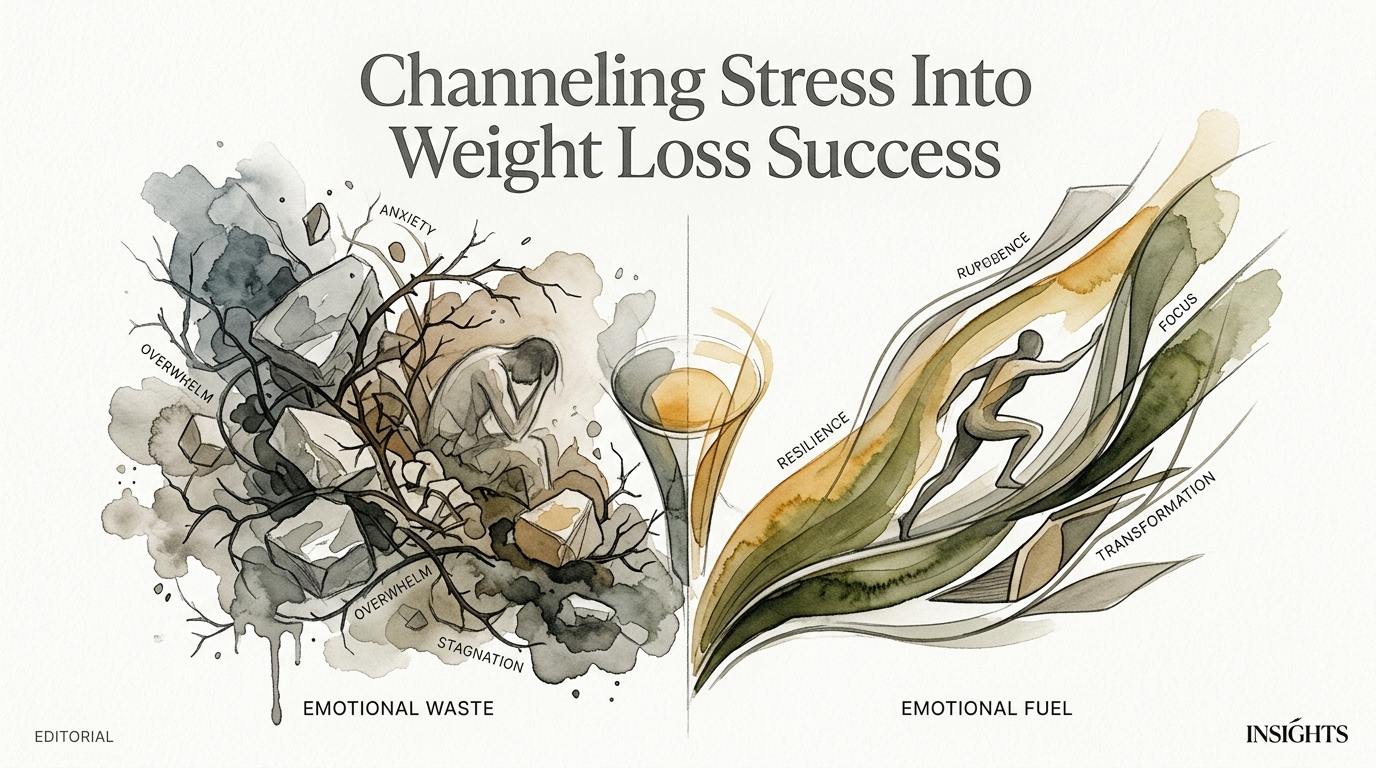
Your stress is just unspent energy waiting for a direction to go. A bad day at the office doesn’t have to end in a pint of ice cream. That cortisol spike is a survival mechanism—it’s giving you the energy to move. Learn to pivot that ‘waste’ emotion into the fuel that drives your transformation.
Most people treat stress like a heavy anchor. They feel the tension in their shoulders and the racing in their heart, then they look for a way to numb it. They sit on the couch. They scroll through social media. They reach for comfort food to quiet the chemical storm inside their bodies.
This approach turns potentially productive energy into EMOTIONAL WASTE. When you leave that stress unspent, your body stays in a state of high alert without a physical outlet. The result is often weight gain, poor sleep, and a feeling of being stuck in a cycle of burnout.
What if you saw that same stress as EMOTIONAL FUEL? Your body has just dumped a cocktail of hormones into your bloodstream designed specifically to help you survive. It has mobilized sugar and fat for immediate use. You are literally primed for performance, yet you are likely using that energy to stare at a spreadsheet.
Learning to channel this energy is the ultimate “cheat code” for weight loss. It allows you to take the hardest parts of your day and use them to power your best workouts. You aren’t just losing weight; you are training your brain to thrive under pressure.
Channeling Stress Into Weight Loss Success
Channeling stress into weight loss is the practice of using the physiological “fight-or-flight” response to drive physical activity. Instead of letting stress hormones cause internal damage, you use them as a natural pre-workout. This method turns a negative psychological state into a positive physical outcome.
Stress exists for a reason. In the wild, if a predator chased you, your body would release adrenaline and cortisol. These chemicals would increase your heart rate and break down energy stores so you could run or fight. Today, the “predator” is a demanding boss or a mountain of bills, but the chemical response remains the same.
When you sit still during a stress response, those mobilized energy stores have nowhere to go. Your body eventually stores that circulating glucose and fat, often as visceral fat around the midsection. By engaging in physical activity during or shortly after a stress event, you “complete the cycle” that nature intended.
Think of stress like steam in a pressure cooker. If you don’t have a valve to release it, the pressure builds until it damages the machine. Physical movement is that valve. It lets the steam out and uses the heat to cook the meal—or in this case, burn the fat.
The Biology of the Stress Spike
When you feel stressed, your Hypothalamic-Pituitary-Adrenal (HPA) axis activates. This system signals your adrenal glands to release cortisol and catecholamines like adrenaline. These hormones are highly effective at liberating fatty acids from your adipose tissue into your bloodstream for quick use.
This is a high-octane fuel source. If you don’t use it, high cortisol levels eventually lead to insulin resistance and increased appetite. If you do use it, you are working out with a biological advantage. Your focus is sharper, your pain tolerance is higher, and your energy levels are peaking.
How to Turn Your Stress Into a Fat-Burning Machine
Transforming stress into weight loss success requires a shift in how you react to your environment. You have to recognize the physical signs of stress as a “call to action.” This isn’t about ignoring your problems; it’s about using the energy those problems provide to improve your physical health.
Identify the Stress Signal
The first step is awareness. Most people experience stress as a vague sense of dread or irritability. You need to look for the physical indicators: a clenched jaw, a rapid heartbeat, or shallow breathing. These are not just symptoms of a bad day; they are signs that your “battery” is fully charged and ready to discharge.
As soon as you notice these signs, label them. Instead of saying, “I am so stressed,” try saying, “I have a lot of energy right now.” This simple cognitive reframe changes your perspective from being a victim of your emotions to being the commander of your resources.
Choose the Right Outlet
Not all exercise is created equal when it comes to channeling stress. Because the stress response is designed for high-intensity survival, high-intensity workouts are often the best match. Activities like boxing, sprinting, or heavy lifting allow you to “offload” that aggression and tension quickly.
If you are feeling a high-arousal stress (anger, panic, frustration), choose explosive movements. If you are feeling a low-arousal stress (worry, overthinking, anxiety), choose repetitive, rhythmic movements like rowing or a steady-state run to find your flow.
The “Five-Minute” Rule
When you are overwhelmed, the idea of a hour-long gym session feels like another chore on your to-do list. Use the five-minute rule. Tell yourself you will only do five minutes of intense movement. Usually, once you start moving and the endorphins kick in, you will want to finish the workout.
- Sprints: Find a hill or a treadmill and go all-out for 30 seconds.
- Power Lifting: Focus on compound movements like squats or deadlifts.
- Boxing: A heavy bag is the perfect target for workplace frustrations.
- HIIT: Short bursts of burpees or mountain climbers to spike the heart rate.
The Benefits of Using Stress as Fuel
The advantages of this approach go far beyond the number on the scale. When you stop resisting stress and start utilizing it, you change your relationship with challenge. You become more resilient, more focused, and more capable of handling life’s ups and downs.
Enhanced Workout Performance
Adrenaline is a powerful performance enhancer. It increases blood flow to the muscles and improves lung capacity. When you hit the gym while “stressed,” you may find that you can lift heavier weights or run faster than you do on your “calm” days. You are essentially using a natural, internal pre-workout supplement.
This leads to greater “mechanical tension” on the muscles and a higher metabolic demand. Over time, these high-intensity sessions result in more significant muscle growth and fat loss compared to workouts where you are just going through the motions.
Mental Clarity and Reframing
Physical activity increases the production of brain-derived neurotrophic factor (BDNF), which supports brain health and cognitive function. By the time you finish your workout, your perspective on your stressors will likely have shifted. The problem that seemed insurmountable at 3:00 PM often seems manageable by 5:00 PM after a hard training session.
This creates a positive feedback loop. You learn that when things get tough, you get stronger. This builds RESILIENCE, which is the most important trait for long-term weight loss success.
Improved Hormonal Balance
Regularly “burning off” your stress hormones helps maintain a healthy HPA axis. Instead of having cortisol levels that stay elevated all day (which leads to belly fat), you create a sharp spike followed by a deep drop. This “pulsatile” release of hormones is much healthier and allows for better recovery and sleep.
Challenges and Common Mistakes
While stress can be a powerful fuel, it is also a volatile one. If you don’t handle it correctly, it can lead to burnout or injury. Understanding the pitfalls is crucial for making this a sustainable part of your lifestyle.
The Trap of Emotional Eating
The biggest challenge to this method is the natural urge to eat when stressed. Cortisol increases hunger and cravings for “hyper-palatable” foods—things high in fat, sugar, and salt. Your brain wants a quick hit of dopamine to counteract the stress, and food is the easiest way to get it.
If you give in to these cravings before you move, you negate the energy-mobilization phase of the stress response. You are adding fuel to a tank that is already overflowing. The key is to move BEFORE you eat. Movement provides the same dopamine hit as the ice cream but without the caloric surplus.
Ignoring Form and Safety
Channeling anger or frustration into a workout can sometimes lead to recklessness. If you are “rage-lifting,” you are more likely to ignore proper form or push past your actual physical limits. This is how injuries happen. High energy must be tempered with high focus.
Always start with a proper warm-up to transition your mind and body. Use the first 10 minutes to “tame” the stress so you can use it precisely. Think of it like a laser—intense energy directed at a specific point, rather than a wild fire spreading everywhere.
Over-Training and Chronic Burnout
You cannot “out-train” a life that is fundamentally broken. If you are under extreme, chronic stress every single day and you try to do a high-intensity workout every single day, you will eventually crash. This can lead to “overtraining syndrome” or “adrenal fatigue,” where your body simply stops responding to the stress fuel.
Limitations: When High Intensity Isn’t the Answer
There are times when using stress as fuel is not the right move. Success in weight loss is about balance, and sometimes the best way to handle stress is to calm the system down rather than revving it up.
Sleep Deprivation
If you have only slept four hours and you are highly stressed, a high-intensity workout might do more harm than good. Lack of sleep already puts your body in a high-cortisol state. Adding more physical stress can lead to systemic inflammation and muscle breakdown. In these cases, a long walk or restorative yoga is a better choice.
High Baseline Inflammation
People struggling with certain autoimmune conditions or chronic inflammatory issues need to be careful. For these individuals, the “stress-to-strength” approach might trigger a flare-up. It is important to know your body’s baseline and respect its limits. Not every stressor needs to be met with a barbell.
The Type of Stress Matters
Acute stress—the kind that happens suddenly and ends—is perfect for fueling workouts. Chronic, low-grade stress—the kind that lingers for months—requires a more nuanced approach. If your stress is a constant background hum, you need to focus on recovery and “down-regulation” just as much as you focus on “up-regulation.”
Practical Tips for the Stress-to-Strength Playbook
Ready to start using your bad days to build a better body? Here are the best practices for implementing this strategy immediately. These tips will help you optimize your efforts and see faster results.
Use a “Stress Trigger” Workout
Design a specific, 20-minute workout that you only do when you are stressed. This creates an ANCHOR in your mind. When you start this routine, your brain knows exactly what to do with the tension. It becomes a ritual of transformation.
- The 100-Rep Challenge: Choose one movement (like kettlebell swings) and do 100 reps as fast as possible.
- The Hill Sprints: Find the steepest hill near you and conquer it five times.
- The Shadowbox Session: Set a timer for three, 3-minute rounds and move constantly.
Monitor Your HRV
Heart Rate Variability (HRV) is a measure of the variation in time between each heartbeat. It is a fantastic indicator of your nervous system’s state. If your HRV is high, you are recovered and ready to use stress as fuel. If it is low, your body is struggling to keep up, and you should opt for a lighter session.
The “Cool Down” is Mandatory
Because you are using stress to power your workout, you will finish with a lot of residual energy. You must dedicate at least 10 minutes to “down-regulating” your nervous system after the session. This tells your body that the “danger” is over and it is safe to begin the fat-burning and muscle-repair processes.
Use box breathing or slow stretching. This ensures you leave the gym feeling calm and empowered, rather than “wired and tired.” If you skip the cool-down, you may find yourself struggling to sleep or feeling irritable later in the day.
Advanced Considerations: Periodization and Recovery
For the serious practitioner, channeling stress is a skill that can be refined over years. It involves understanding the rhythm of your own life and adjusting your training intensity to match the “ebb and flow” of your external demands.
Autoregulation in Training
Autoregulation is a training strategy where you adjust your intensity based on how you feel on a given day. On high-stress days where you feel “charged,” you go for a Personal Record (PR). On days where the stress feels heavy and draining, you focus on technical work or mobility. This ensures you are always making progress without burning out.
Nutrient Timing for Stress Management
When you use stress as fuel, your body’s demand for certain nutrients increases. Magnesium, Vitamin C, and B-vitamins are all depleted during the stress response. Ensuring you are getting these through whole foods—like leafy greens, citrus, and lean proteins—will help your body recover faster and keep your metabolism high.
Also, pay attention to your carbohydrate intake. High-intensity training fueled by stress requires glycogen. If you are on a very low-carb diet, you may find that your “stress fuel” runs out quickly, leading to a “bonk” or a sudden drop in energy mid-workout.
Real-World Scenarios
How does this actually look in daily life? Let’s look at two scenarios where a person chooses between EMOTIONAL WASTE and EMOTIONAL FUEL.
Scenario A: The Office Blow-up
Imagine you just had a meeting where your project was criticized unfairly. You are fuming. You feel the heat in your face and the tension in your chest.
The Waste Choice: You go home, complain to your partner for two hours, and eat a large pizza while watching Netflix. You go to bed feeling bloated and wake up the next morning still angry and five pounds heavier.
The Fuel Choice: You head straight to the gym. You take that anger and put it into five sets of heavy deadlifts. Every time you pull the bar, you visualize yourself pulling through the frustration. You finish with 10 minutes of intense rowing. You go home, have a high-protein meal, and sleep like a baby. You wake up with a sense of accomplishment and a tighter waistline.
Scenario B: The Traffic Jam Nightmare
You are stuck in gridlock for an hour. You are late for an appointment and the anxiety is building. Your heart is racing, but you are physically trapped in a seat.
The Waste Choice: You white-knuckle the steering wheel, yell at other drivers, and arrive at your destination a nervous wreck. You spend the rest of the day “on edge” and reach for sugary snacks to stay awake.
The Fuel Choice: You recognize the cortisol spike. You do some deep “isometrics” in the car—squeezing the steering wheel or pressing your back into the seat to engage your muscles. As soon as you get home, you do 50 air squats and 20 pushups. You have successfully “spent” the energy your body mobilized during the traffic jam. Your body returns to a state of calm much faster.
Final Thoughts
Weight loss is rarely just about calories in versus calories out. It is about how you manage the energy of your life. Stress is a part of the human experience, and it isn’t going away. You can either let it consume you, or you can use it to build the body and the life you want.
Every time you feel that surge of frustration or anxiety, remember that it is a gift of energy. It is your body’s way of saying, “I am ready.” Don’t let that energy go to waste. Direct it toward a goal. Direct it toward the gym. Direct it toward your own transformation.
Start small. The next time you have a “bad” day, don’t reach for the remote. Reach for your sneakers. You will be amazed at how quickly your “problems” turn into your “power.” The journey from emotional waste to emotional fuel starts with a single step—or a single rep. Take it today.
Sources
1 ideafit.com | 2 muscleandfitness.com | 3 preventionaus.com.au | 4 manifoldapp.org | 5 psychologytoday.com | 6 r1se.co.uk | 7 carolinatotalwellness.com | 8 emetabolic.com | 9 latraumatherapists.com | 10 mfm.au | 11 weightwatchers.com | 12 thementalgame.me