

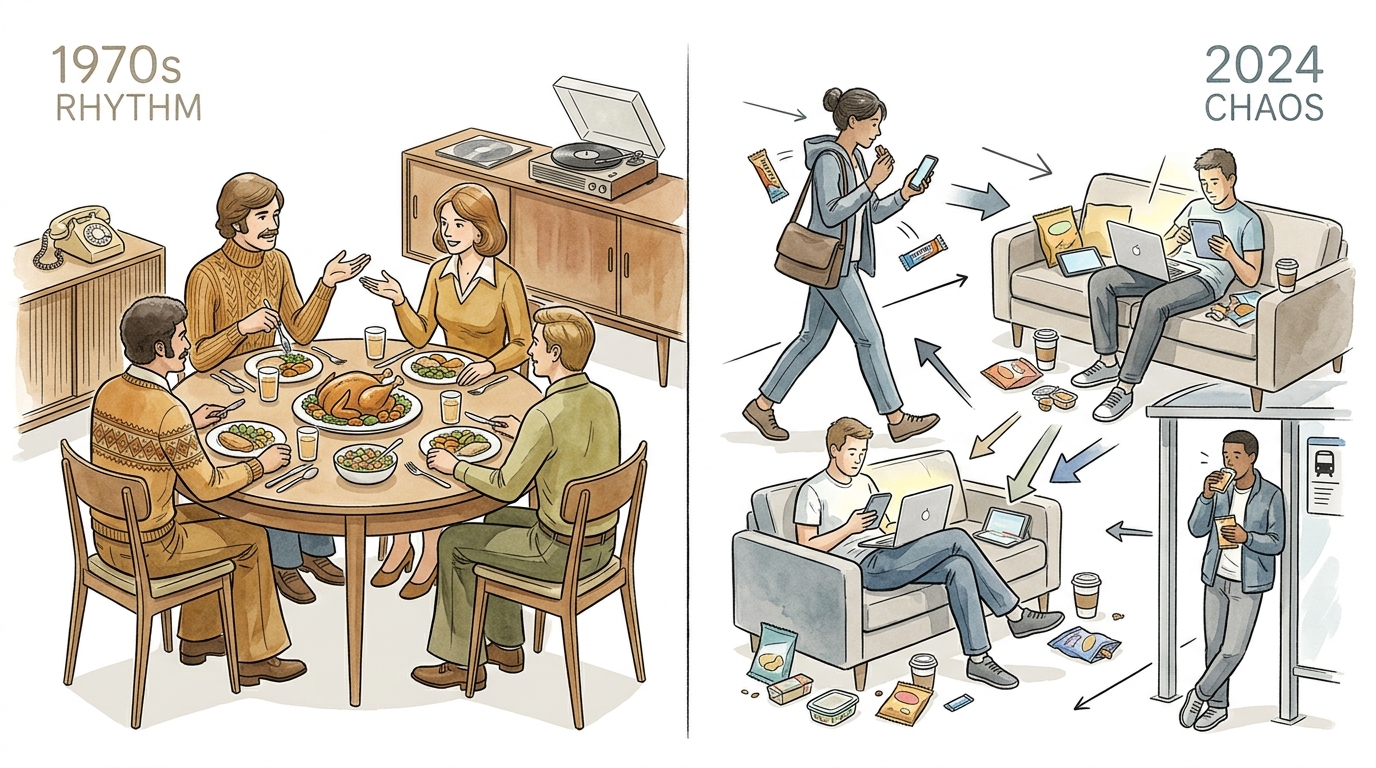
We didn’t lose our willpower; we lost our boundaries. Fifty years ago, people didn’t snack 16 times a day. There was a clear beginning and end to every meal. To fix your weight, you have to fix your timing. Bring back the ‘Then’ mindset to survive the ‘Now’ environment.
Take a look at any crowd photo from 1974. You will notice something striking. Almost everyone looks naturally lean. These people weren’t spending hours on treadmills or counting macros on a smartphone app. They lived in a world where food had a rhythm. Today, we live in a world of food chaos.
The difference isn’t about character or discipline. It is about the structure of the day. Modern life has erased the lines between “eating time” and “living time.” We eat in cars, at desks, and while standing in front of the refrigerator. If you want to regain control of your health, you must rebuild the walls that once protected our metabolism.
70s Eating Habits Vs Modern Snacking Culture
In the 1970s, eating was a discrete event. Most people followed a strict “three square meals” rule. Snacking was rare and usually reserved for children after school. Adults rarely ate between lunch and dinner. This structure created long periods of “gut rest” where the body could process energy without interference.
Statistics show a massive shift in how often we eat. In 1977, the average adult consumed about one snack per day. Today, that number has more than doubled. Over 90% of adults now snack daily, and most people consume two or more snacking occasions in addition to their meals. This constant grazing means the digestive system never truly shuts down.
The modern food environment is engineered for “anytime” consumption. Convenience stores, vending machines, and delivery apps ensure that a calorie is never more than 30 seconds away. Fifty years ago, if you were hungry at 9:00 PM, the kitchen was closed and the grocery stores were shut. Today, the kitchen never closes. This lack of a “stop” signal is the primary driver of metabolic dysfunction.
How the 70s Rhythm Reclaims Your Health
Restoring the 70s rhythm is about re-establishing the fed and fasted states. Your body exists in one of two modes. You are either storing energy (the fed state) or burning stored energy (the fasted state). When you eat constantly, you stay in the storage mode all day long.
Step 1: Define Your Windows
Pick three specific times for your meals. Ensure there is a clear gap of at least 4 to 5 hours between them. During these gaps, consume only water, black coffee, or plain tea. This allows your insulin levels to drop, signaling your body to start using body fat for fuel.
Step 2: Close the Kitchen
The 1970s had a natural “fasting window” because shops closed and television programming ended at midnight. Create an artificial boundary. Decide that after 7:00 PM or 8:00 PM, you are done. Closing the kitchen for the night is the single most effective way to improve sleep and weight management.
Step 3: Sit Down to Eat
Never eat while walking, driving, or scrolling. The “Then” mindset required a table and a plate. When you sit down and focus on your food, your brain receives the satiety signals it needs to register that a meal has occurred. Eating while distracted often leads to “phantom hunger” shortly after you finish.
Benefits of Re-Establishing Timing Boundaries
Regaining control of your timing offers benefits that go far beyond simple weight loss. When you stop the constant grazing, your hormones begin to stabilize. Insulin sensitivity improves, which reduces your risk for type 2 diabetes and metabolic syndrome.
Stable Energy Levels
Most people think snacking prevents energy crashes. The opposite is often true. Constant snacking leads to blood sugar spikes followed by inevitable crashes. By sticking to three solid meals, you train your body to access its own fat stores for steady energy throughout the afternoon.
Better Digestion
The gut needs time to perform “housekeeping.” The Migrating Motor Complex (MMC) is a wave of electrical activity that cleans the small intestine between meals. This process only happens when you are in a fasted state. Frequent snacking interrupts this cycle, which can lead to bloating and bacterial overgrowth.
Psychological Freedom
Constant snacking requires constant decision-making. Should I have a granola bar? Is it time for a latte? By removing the option of between-meal eating, you eliminate “decision fatigue.” You know exactly when you will eat next, which frees up mental energy for more important tasks.
Challenges and Common Mistakes
The transition from a “Now” environment to a “Then” mindset isn’t always easy. Our modern world fights against boundaries. You will encounter social pressure and internal cues that make you want to reach for a snack.
Mistake: The “Healthy” Snack Trap
Many people fail because they replace “junk” snacks with “healthy” ones like almonds or yogurt. While the quality of food matters, the timing matters more. Even a healthy snack triggers an insulin response. This keeps your body in storage mode. If you are trying to fix your weight, a “healthy” snack between meals is still an interruption of your metabolic rest.
Mistake: Not Eating Enough at Meals
Fear of calories often leads people to eat tiny, unsatisfying meals. This almost always leads to a snack craving 90 minutes later. To survive a 5-hour gap, your meal must be substantial. It should include protein, healthy fats, and fiber. If you find yourself starving before the next meal, your previous meal was likely too small or too high in refined carbohydrates.
Limitations: When This May Not Be Ideal
While timing boundaries work for most people, certain situations require a more flexible approach. Biological needs can vary based on activity level and medical history.
Physical laborers or elite athletes may require more frequent fueling to maintain performance. If you are burning 4,000 calories a day through intense manual labor, three meals might not be physically large enough to cover your energy needs. In these cases, a “mini-meal” structure is often more practical.
Individuals with specific medical conditions like Type 1 Diabetes or those taking certain medications must coordinate their eating with their prescriptions. Always consult a healthcare professional before making major changes to your meal frequency if you have a diagnosed metabolic condition.
Comparing the 1970s vs. 2024 Food Environment
Understanding the environmental shift helps you realize why boundaries are so necessary today.
| Feature | The 1970s “Rhythm” | The 2024 “Chaos” |
|---|---|---|
| Daily Snacking | 1.0 occasion per day average. | 2.2 to 5.0 occasions per day. |
| Standard Plate Size | 9 inches. | 11 to 12 inches. |
| Food Availability | Limited to shops and meal times. | 24/7 via apps and convenience stores. |
| Beverage Default | Water or plain coffee/tea. | High-calorie “specialty” drinks. |
| Kitchen Closing | Natural (shops and TV shut down). | Non-existent (on-demand culture). |
Practical Tips for Daily Success
Reclaiming your boundaries is a skill that improves with practice. Use these techniques to make the transition smoother and more sustainable.
- Drink Water First: Thirst is often mistaken for hunger. If you feel a “snack urge” between meals, drink a large glass of water and wait 15 minutes. Most of the time, the urge will vanish.
- Use Smaller Plates: Modern dinner plates are 20-30% larger than those used in the 70s. Switch to a salad plate for your main meals. It provides a visual cue of abundance without the excessive portions.
- The 3-Hour Rule: Finish your last bite at least three hours before you go to bed. This prevents insulin from interfering with your growth hormone production during sleep.
- Front-Load Your Calories: People in the 70s often ate a larger lunch and a more modest dinner. Eating more of your energy earlier in the day aligns better with your circadian rhythm.
Advanced Considerations: The Role of Light and Sleep
Weight management isn’t just about what you eat; it is about when your body thinks it is “daytime.” In the 1970s, the end of the day was marked by the lack of blue light. Once the sun went down and the television went off, the body prepared for rest and repair.
Modern screens keep us in a perpetual state of “alertness.” This blue light suppresses melatonin and can actually stimulate hunger hormones late at night. To truly mimic the 70s success, you should dim your lights after dinner. Reducing screen time in the evening helps reinforce the boundary that the day—and the eating—is over.
Consider your “Metabolic Sunset.” Just as the sun goes down, your ability to process glucose declines in the evening. Eating a large, carbohydrate-heavy snack at 10:00 PM is much more damaging to your weight than eating those same calories at Noon. Aligning your eating with the natural light cycle is a powerful tool for serious practitioners.
Example Scenario: The Remote Worker Transformation
Consider Mark, a 42-year-old software engineer who works from home. In the “Now” environment, Mark’s day is a blur of grazing. He has coffee with cream at 8:00 AM, a protein bar at 10:30 AM, a sandwich at 1:00 PM, chips while working at 3:30 PM, and dinner at 7:00 PM, followed by popcorn at 9:00 PM. Mark is constantly in the “fed state.” He struggles with brain fog and a slow, steady weight gain.
Mark decides to implement the “Then” mindset. He sets strict boundaries: Breakfast at 8:00 AM, Lunch at 1:00 PM, and Dinner at 6:30 PM. No snacks. No caloric drinks between meals.
In the first week, he feels “hungry” at 3:30 PM, but he realizes it is just a habit triggered by his afternoon meetings. He drinks black tea instead. By the third week, his brain fog lifts. His body has learned to switch into the “fasted state” between lunch and dinner, burning stored fat for mental energy. He no longer feels the need to graze because his insulin levels have stabilized.
Final Thoughts
Fixing your weight is not about finding a new “superfood” or a more intense workout plan. It is about restoring the structural integrity of your day. We have traded the rhythmic safety of the 1970s for the chaotic convenience of 2024, and our health has paid the price.
By re-establishing clear boundaries between meals and closing the kitchen at night, you allow your biology to function as intended. You stop fighting your willpower and start using your environment to your advantage. The “Then” mindset is the most powerful tool we have to survive the “Now” world.
Start small. Pick one boundary today. Maybe it is “no food after 8:00 PM” or “no snacking between lunch and dinner.” Once you master one wall, build the next. You will find that when you fix your timing, your body often takes care of the rest.
Sources
1 ucsd.edu | 2 youtube.com | 3 youtube.com | 4 canteen.com | 5 utswmed.org | 6 lovefood.com | 7 nichs.org.uk | 8 spins.com | 9 utah.edu | 10 lonestarcares.org | 11 itsinreach.com | 12 goodlifefitness.com | 13 youtube.com | 14 withpower.com | 15 healthstandnutrition.com