

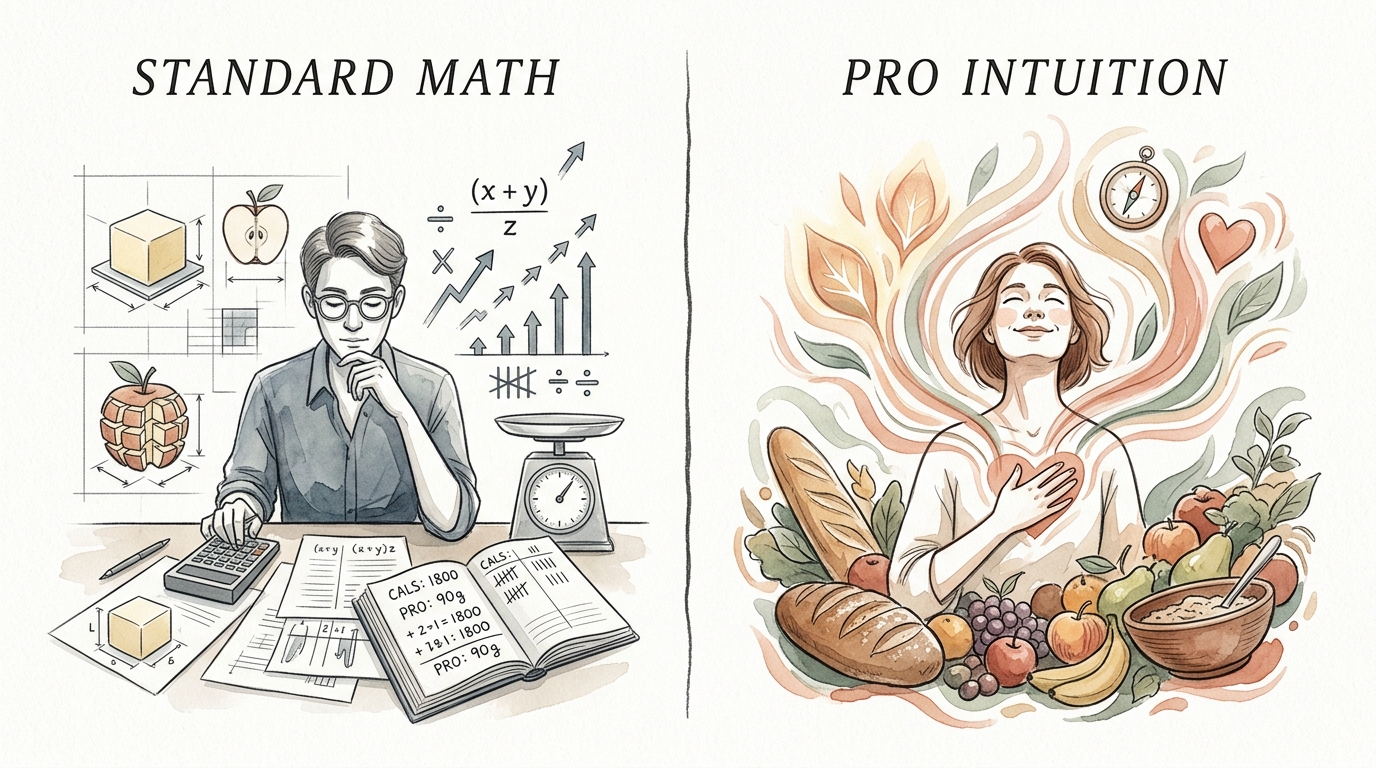
Amateurs count numbers; pros listen to signals. Counting calories is a great training wheel, but it’s a terrible way to live forever. The ‘Pro’ level of weight loss is moving from external tracking to internal mastery. When you learn to read your body’s bio-feedback, the math takes care of itself.
Most people start their health journey with an app and a kitchen scale. They weigh every almond. They log every leaf of spinach. This is helpful for a while because it builds awareness of what food actually contains. However, staying in this phase forever is like using a calculator to solve 2+2 for the rest of your life. It is exhausting and eventually leads to burnout.
Weight loss mastery isn’t about restriction. It is about communication. Your body is constantly sending you data through hormones and nervous system signals. If you don’t know how to listen, you rely on a screen to tell you if you are “allowed” to eat. The goal is to move past the screen and back into your own skin. This article will show you how to graduate from a calorie counter to a pro-level intuitive eater.
Intuitive Eating Vs Calorie Counting Mindset
The calorie counting mindset is built on external authority. You look at a database to decide if you have “room” for a snack. This creates a disconnect between your brain and your stomach. You might be starving, but because the app says you are out of calories, you ignore the signal. Conversely, you might be full, but because you “saved up” points, you eat anyway. This is a recipe for long-term failure.
Intuitive eating is the exact opposite. It relies on internal authority. You use bio-feedback to drive your decisions. Instead of counting 500 calories of chicken and rice, you pay attention to how that meal makes you feel. Does it provide sustained energy? Does it keep you full for four hours? These signals are more accurate than any app because they account for your unique metabolism, daily activity, and sleep quality.
Think of calorie counting like a budget. It is great when you are broke and need to see where your money is going. Intuitive eating is like being wealthy enough that you don’t need to check your bank balance for every coffee. You have built a system where the income and expenses balance naturally. In the world of weight loss, that “wealth” is metabolic health and high-level body awareness.
This shift in mindset changes your relationship with food. Food stops being a math problem and starts being fuel. You no longer feel like a “failure” for eating a cookie because you aren’t “breaking a rule.” You are simply responding to a desire or a signal and then adjusting your next meal accordingly. This is how pros maintain lean bodies for decades without ever opening a tracking app.
The Biological Hardware: How Your Body Talks to You
Your body has a sophisticated system of sensors designed to keep you at a healthy weight. The primary players are hormones and the vagus nerve. When you understand how these work, you can stop fighting your biology and start working with it. Mastery starts with knowing the language your body speaks.
The Satiety Hormones: GLP-1, PYY, and CCK
When you eat, your gut releases “fullness” hormones. Cholecystokinin (CCK) is one of the first to arrive. It is triggered by fat and protein entering the small intestine. CCK tells your stomach to slow down emptying so you can absorb nutrients. It also sends a signal to your brain saying, “We are receiving fuel.”
Glucagon-like peptide 1 (GLP-1) and Peptide YY (PYY) follow shortly after. These hormones are released further down the digestive tract. They are the reason you feel full for hours after a high-protein, high-fiber meal. They suppress the “hunger” centers in your brain. If you eat too fast, you “outrun” these signals. Pros eat slowly to give these hormones time to hit the bloodstream.
The Hunger Hormone: Ghrelin
Ghrelin is the loud, obnoxious alarm clock of the body. It is produced in the stomach when it is empty. Ghrelin levels rise before your usual meal times. If you have ever felt “hangry,” that is ghrelin talking. Interestingly, ghrelin levels drop significantly after you eat, but they also respond to your expectations. If you believe a meal will be satisfying, ghrelin drops faster.
The Master Regulator: Leptin
Leptin is produced by your fat cells. It tells your brain how much energy you have in storage. If you have plenty of body fat, leptin levels should be high, telling your brain to keep metabolism fast and hunger low. However, chronic overeating of processed foods can cause “leptin resistance.” Your brain stops hearing the signal, and it thinks you are starving even when you are carrying extra weight. Switching to intuitive eating helps “reset” this communication line.
The Hunger-Fullness Scale: Your New Dashboard
Since you are ditching the tracking app, you need a new way to measure your intake. The 10-point Hunger-Fullness Scale is the gold standard for pros. It moves you away from “good vs. bad” and toward “comfortable vs. uncomfortable.”
- 1: Starving: You feel weak, dizzy, or irritable. You would eat anything in sight. This is a dangerous zone because it leads to overeating later.
- 3-4: Gently Hungry: Your stomach is growling. You are thinking about food, but you are still in control. This is the “Green Zone” to start eating.
- 5: Neutral: You aren’t hungry, and you aren’t full. You are just “fine.”
- 7-8: Satisfied: You feel comfortable. You could eat more, but the “urge” is gone. You feel energized, not sluggish. This is the “Green Zone” to stop eating.
- 10: Stuffed: You feel physically ill. You have to unbutton your pants. This is the result of ignoring signals and relying on external portions.
The goal is to live your life between a 3 and a 7. When you wait until you are a 1, your brain’s “primal” centers take over. You will crave high-sugar, high-fat foods because your body thinks there is a famine. When you stop at a 7, you avoid the “food coma” that ruins your productivity. Practicing this scale daily is how you develop internal mastery.
Benefits of Graduating to Internal Mastery
Moving away from calorie counting offers more than just convenience. It fundamentally changes your physiology and psychology. Here is why the pro-level approach is superior for long-term health.
Long-Term Weight Stability: Research consistently shows that intuitive eaters have more stable weights over five and ten-year periods. Calorie counters often “yo-yo” because they cannot maintain the high level of obsession required to track forever. When the tracking stops, the weight returns. Intuitive eaters don’t have this problem because their “tracking” is built into their nervous system.
Improved Metabolic Health: By eating in response to hunger, you reduce the stress associated with dieting. Chronic dieting raises cortisol, which can lead to abdominal fat storage. Intuitive eating lowers this stress response. It also encourages a more diverse diet, which supports gut microbiome health—a key factor in maintaining a lean body.
Mental Freedom: Imagine going to a wedding or a dinner party and not worrying about the “macros” in the appetizers. This mental space allows you to focus on social connection rather than data entry. Pros understand that health includes mental well-being. A lean body isn’t worth much if you are constantly anxious about your next meal.
Challenges: Why Most People Fail the Transition
The transition from “Standard Math” to “Pro Intuition” is not a straight line. There are biological and environmental traps that can derail your progress. Recognizing these challenges is the first step to overcoming them.
The Ultra-Processed Food Trap: Modern engineering has created “hyper-palatable” foods. These are combinations of sugar, salt, and fat that do not exist in nature. These foods are designed to bypass your satiety signals. If you try to eat “intuitively” with a diet of potato chips and donuts, you will fail. Your body cannot read the signals of fake food. Pros stick to “real” food (meat, eggs, vegetables, fruit) to keep their signal lines clear.
The Fear of Weight Gain: When you stop tracking, your brain might panic. It thinks, “If I’m not controlling it, it will spiral out of control.” This fear leads many people back to the safety of the app. You must accept that there will be a “learning phase.” Your weight might fluctuate for a few weeks as your hormones recalibrate. This is normal. Trust the process.
Food Noise: If you have been dieting for a long time, you may have “food noise”—constant thoughts about what you can or cannot eat. This noise drowns out the subtle signals of hunger and fullness. It takes time for this noise to quiet down. Silencing it requires consistent, adequate nourishment so your brain knows a “famine” isn’t coming.
Limitations: When This May Not Be Ideal
While internal mastery is the ultimate goal, there are specific situations where external tracking is still necessary. A balanced understanding of these limitations prevents frustration.
Elite Athletic Performance: If you are training for a marathon or a bodybuilding competition, your energy needs are extreme. In these cases, your hunger signals might not keep up with your caloric demands. Athletes often need to “force-feed” or specifically “under-eat” to hit performance or weight-class targets. Here, math is a tool, not a training wheel.
Severe Metabolic Dysfunction: If you have advanced Type 2 diabetes or significant leptin resistance, your signals are currently “broken.” You may feel hungry all the time even if you just ate. In this scenario, a structured plan is a medical necessity until your insulin sensitivity improves. You cannot listen to a signal that is providing false data.
Active Eating Disorders: For those in recovery from restrictive eating disorders, “listening to the body” can be triggering or impossible due to suppressed hunger cues. Professional clinical guidance is required here. The goal is still internal mastery, but the path requires a bridge of structured re-feeding first.
Standard Math vs. Pro Intuition
To help you visualize the difference, look at how a beginner vs. a pro handles common scenarios. Notice the shift from “permission” to “feedback.”
| Scenario | Standard Math (Beginner) | Pro Intuition (Mastery) |
|---|---|---|
| Restaurant Meal | Searches for the menu in an app. Estimates weights. Feels guilty if they go over. | Orders based on protein and fiber. Eats slowly. Stops when “just full.” |
| Hunger at 10 PM | Checks if there are calories left. If not, drinks water and suffers. | Evaluates if it’s true hunger or boredom. If hungry, eats a small protein snack. |
| Weight Gain of 2 lbs | Panics. Lowers “limit” in the app by 300 calories. Increases cardio. | Reflects on stress, sleep, and salt intake. Trusts signals to self-correct. |
Practical Tips for the Transition Phase
You shouldn’t delete your tracking app overnight. That is a recipe for a “rebound” binge. Instead, follow this phased approach to build your intuitive muscles.
The “One Day a Week” Rule: Start by not tracking on Saturdays. Eat normally, but don’t log anything. Pay attention to how often you think about the app. If you feel anxious, that’s a sign you need to practice this more. Once Saturday feels easy, add Wednesday. Slowly expand until the app is redundant.
The Eye-Balling Technique: Use your previous tracking experience to “guess” the portions before you weigh them. This bridges the gap between math and intuition. Eventually, your “eye” will be so accurate that the scale becomes a waste of time. Pros know what 6oz of steak looks like without a tool.
The “Check-In” Pause: Halfway through your meal, put your fork down. Take a deep breath. Evaluate where you are on the 1-10 scale. Most of us eat out of habit, not hunger. This 30-second pause can prevent 500 extra calories of “mindless” eating. It is the most powerful tool in the pro’s arsenal.
Focus on Food Quality: If you want to hear your body, stop screaming at it with sugar. High-protein and high-fiber foods make your satiety signals loud and clear. If you eat a bag of chips, your brain gets confused. If you eat a steak and broccoli, your brain gets a clear “stop” signal. Mastery is easier when the food supports the biology.
Advanced Considerations: The Ecosystem of Hunger
Satiety is not just about what is in your stomach. It is about the environment your body lives in. Serious practitioners look at the bigger picture to optimize their bio-feedback.
The Circadian Rhythm of Appetite
Your hunger hormones follow a clock. Ghrelin usually peaks in the morning and evening. However, if you have an erratic sleep schedule, these hormones get out of sync. You might feel “starving” at 2 AM. Pros prioritize sleep to keep their hunger signals predictable. If you are tired, your brain will crave sugar to get a “quick fix” of energy. That isn’t hunger; that’s exhaustion.
The Stress-Cortisol Loop
Stress is a signal-killer. When cortisol is high, it blunts the effects of leptin. This is why people “stress eat.” Your brain literally cannot hear the “I’m full” signal when it’s in fight-or-flight mode. Advanced mastery involves managing stress through movement, meditation, or boundaries so that your biological signals remain clear.
The Protein Leverage Hypothesis
Recent research suggests that the body will continue to feel “hungry” until it meets a specific protein threshold. If you eat a meal high in carbs and fats but low in protein, you will likely stay at a “4” or “5” on the hunger scale. Pros prioritize protein at every meal to hit that threshold early, allowing the rest of the day to feel effortless.
Example Scenario: The Weekend BBQ
Let’s look at how a Pro Intuitive Eater handles a common social challenge. There is a table full of ribs, potato salad, chips, and beer. A beginner calorie counter is stressed. They are trying to “pre-log” the ribs but don’t know the sauce’s sugar content. They end up eating very little, feeling deprived, and then “snapping” and eating four brownies later.
The Pro arrives at the BBQ with a different plan. They look at the spread and identify the “Anchor”—the protein. They load their plate with ribs and whatever salad has the most green vegetables. They eat the ribs first, focusing on the flavor and texture. Halfway through, they check their hunger scale. They are at a 6.
They decide to have a small serving of potato salad because they genuinely want it. They eat it slowly. By the time the brownies come out, they check-in again. They are at a 7.5. They realize that while the brownie looks good, they are physically satisfied. They pass on the brownie because they know how a “9” feels—and they don’t want to feel that way tomorrow morning. They leave the party feeling energized, not guilty.
Final Thoughts
Graduating to the pro level of weight loss is about reclaiming your autonomy. Calorie counting is a useful stage, but it is not the destination. The destination is a body that regulates itself. This requires patience, a commitment to real food, and the courage to trust yourself after years of being told not to.
Start small. Listen for the subtle signals. Pay attention to the “sigh” you make when you’ve had enough. Notice how different foods change your mood and energy. As you build this awareness, the need for external tools will fade away. You will find that you can maintain your ideal weight with zero stress and total food freedom.
The math of weight loss—Calories In vs. Calories Out—never stops being true. But once you master your bio-feedback, you don’t have to do the math yourself. Your body does it for you. That is the ultimate goal of the “pro” practitioner. Experiment with these principles this week and see how much louder your body can speak when you finally start listening.
Sources
1 hootfitness.com | 2 forbes.com | 3 jeffderderian.net | 4 instituteofliving.org | 5 sarahgoldrd.com | 6 myjuniper.com | 7 wisemindnutrition.com | 8 asitisnutrition.com | 9 dietitianhannah.com | 10 katelymannutrition.com | 11 honornutritioncounseling.com | 12 alissarumsey.com | 13 nih.gov | 14 frontiersin.org | 15 semanticscholar.org | 16 cvwellbeing.com | 17 juliealedbetter.com | 18 eated.io | 19 karalydon.com | 20 allinclusive-health.com