


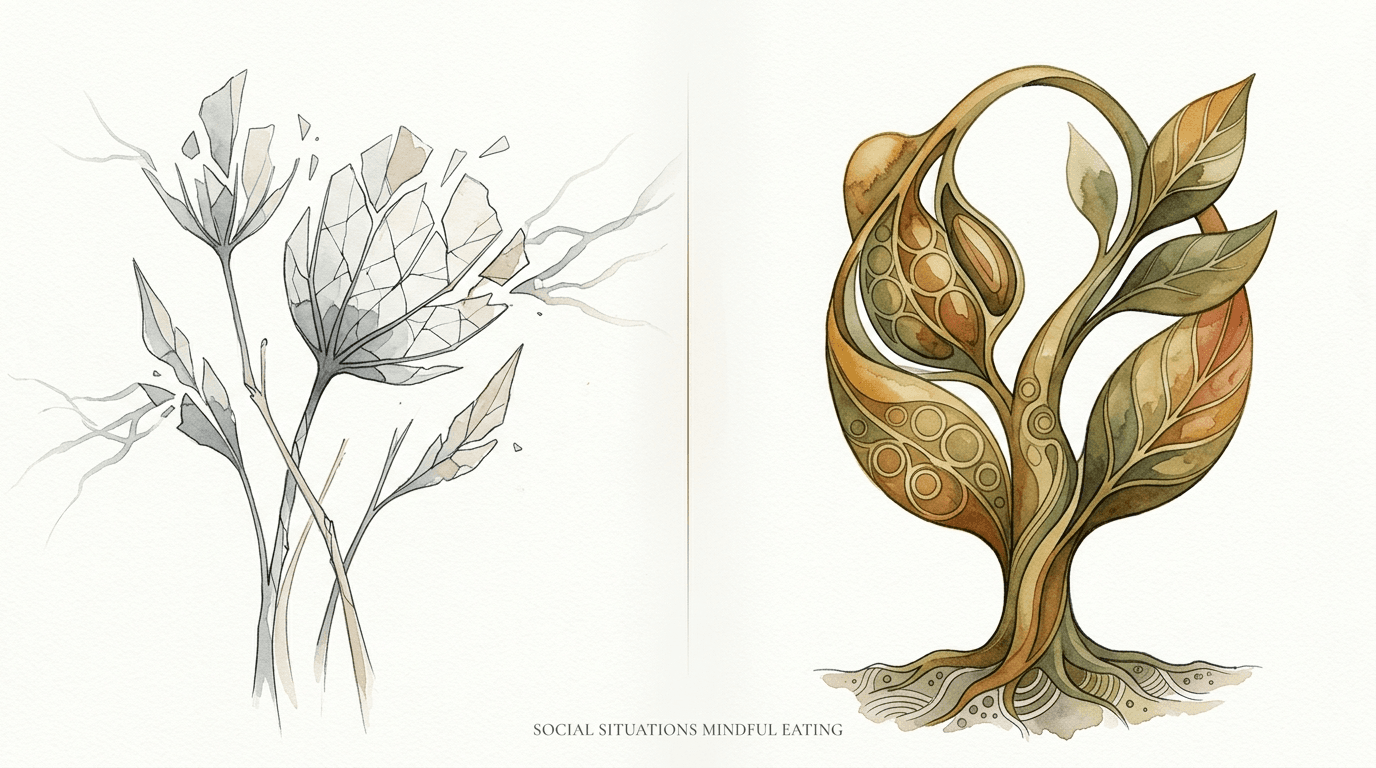
A diet that only works in your kitchen isn’t a lifestyle; it’s a prison. If you have to hide from the world to stay on track, your mindset is fragile. A resilient eater doesn’t need ‘safe’ containers; they have internal filters. They can navigate a buffet, a gala, or a pizza night because their hunger cues are stronger than the environment’s pressure.
Most people treat social events like a battlefield. They walk into a restaurant gripped by fear, terrified that one appetizer will ruin weeks of progress. This fear creates a brittle relationship with food. When you are afraid of the menu, the menu wins every single time.
Mastering social situations mindful eating is about flipping the script. It is about moving from a state of defensive restriction to a state of offensive awareness. You aren’t “avoiding” bad foods; you are actively selecting experiences that nourish you while staying tuned to your body’s biological limits.
This guide explores how to build that internal filter. We will break down the science of social pressure, the mechanics of hunger cues, and the practical steps to stay resilient in a world designed to make you overeat.
Social Situations Mindful Eating
Social situations mindful eating is the practice of maintaining awareness of your hunger and fullness cues while navigating environments rich in external food triggers. In your kitchen, you control the portion, the ingredients, and the timing. In a social setting, the environment takes the wheel.
Restaurants use lighting, music, and descriptive menu labels to encourage overconsumption. Friends and family often exert subtle pressure to “just try a bite” or “celebrate a little.” This creates a conflict between your internal physiological needs and external social expectations.
Think of it like a noise-canceling headset. The world is screaming “Eat more!” but your internal filter allows you to hear the quiet signal of your stomach saying “I’m satisfied.” It is a skill used at weddings, holiday parties, and business lunches to enjoy the event without feeling physically or mentally compromised afterward.
Researchers have found that we are “social mimics.” We tend to match the eating pace and volume of the people around us to build rapport. Mindful eating in these moments acts as a conscious override to that subconscious mimicry.
How It Works: Building Your Internal Filter
Building a resilient mindset requires a systematic approach to every social meal. You cannot rely on willpower alone because willpower is a finite resource that drains as the night goes on. Instead, use these steps to automate your awareness.
The Pre-Event Check-In
Hunger is a poor decision-maker. Arriving at a gala or a pizza night “starving” is a recipe for disaster. Biological hunger overrides the prefrontal cortex—the part of your brain responsible for logic. Eat a small, protein-rich snack an hour before you go. This ensures you arrive in a state of “moderate hunger,” which allows you to make choices based on preference rather than desperation.
The 360-Degree Survey
When you approach a buffet or a table of appetizers, do not pick up a plate immediately. Walk the entire length of the spread first. Seeing every option allows your brain to prioritize. If you start at the beginning of the line, you will likely fill your plate with the first three things you see. Surveying the scene helps you identify what you truly want versus what is just “there.”
The Small Plate Hack
Visual cues dictate our perception of fullness. A standard dinner plate makes a normal portion look small, tricking your brain into thinking you are being deprived. Using a smaller appetizer or salad plate creates the illusion of abundance. This simple shift in “Delboeuf illusion” helps satisfy the visual hunger that often leads to overserving.
Strategic Pacing
It takes roughly 20 minutes for the hormone cholecystokinin (CCK) to signal to your brain that you are full. In social settings, we often eat fast because we are talking or distracted. Make it a rule to put your fork down between every single bite. This creates a natural pause that allows your biology to keep up with your fork.
Benefits of Mindful Social Eating
Choosing this approach over rigid restriction offers measurable benefits for both your physical health and your mental well-being.
True Autonomy and Freedom
The biggest advantage is the removal of “food anxiety.” When you know you can handle a pizza night without spiraling, you regain your social life. You stop being the person who brings a Tupperware container to a wedding and start being the person who enjoys a slice of cake and stops when they are satisfied.
Improved Digestive Comfort
Overeating in social settings often leads to “the food coma”—bloating, lethargy, and regret. By stopping at the point of satisfaction rather than the point of “stuffed,” you maintain your energy levels. You leave the party feeling light and ready for the next day, rather than needing a 12-hour recovery period.
Heightened Sensory Pleasure
Mindful eating forces you to actually taste the food. When you slow down, you notice the textures, spices, and aromas that mindless eaters miss. You might find that the “famous” appetizer everyone is raving about isn’t actually that good, which makes it much easier to stop eating it.
Long-Term Weight Stability
Restriction leads to binging. By allowing yourself to navigate social foods mindfully, you prevent the “all-or-nothing” cycle. This consistency is the secret to long-term weight management. You aren’t on a diet; you are practicing a skill that works everywhere.
Challenges and Common Mistakes
Even the most prepared eaters face obstacles. Recognizing these pitfalls is the first step toward avoiding them.
The People-Pleaser Trap (Sociotropy)
Studies from Case Western Reserve University show that people-pleasers often overeat to make others feel comfortable. If a host insists you try their specialty, you might feel a “social debt” to eat it. The mistake is equating food consumption with respect. You can appreciate the host’s effort without finishing the entire portion.
The “Hidden” Calorie Illusion
Restaurants often use “buzzwords” to mask high-calorie preparation. Words like “crispy,” “smothered,” “velvety,” or “battered” usually indicate added fats and sugars. Mindless eaters see “chicken” and think healthy, ignoring the “creamy sun-dried tomato sauce” that doubles the calorie count.
Alcohol as a Disinhibitor
Alcohol is the ultimate enemy of mindfulness. It numbs your internal hunger cues and weakens your resolve. Many people stay mindful through the first course, have two drinks, and then find themselves mindlessly snacking on bread baskets for the rest of the night.
The “Clean Plate Club” Conditioning
Many of us were raised to finish everything on our plate. In a restaurant with massive portions, this childhood habit becomes a liability. A resilient eater recognizes that leaving food on the plate is better than “wasting” it inside their body as excess fat.
Limitations: When This Approach Needs Modification
While social situations mindful eating is a powerful tool, it isn’t a magic wand for every scenario.
Extreme Food Insecurity
Mindful eating assumes a baseline level of food abundance. In environments where food is scarce or highly unpredictable, the body’s survival mechanisms will naturally prioritize calorie density over “savoring the texture.” Mindfulness is a luxury of the nourished.
Competitive Environments
If you are in a situation where food is served in a “first-come, first-served” competitive manner (like a crowded family reunion or certain business events), the pressure to eat quickly can overwhelm mindful pacing. In these cases, focus more on plate composition than on timing.
Clinical Eating Disorders
For individuals struggling with specific clinical conditions like Binge Eating Disorder (BED) or Anorexia Nervosa, mindful eating should be practiced under the guidance of a professional. Sometimes, structured meal plans are necessary before a person can transition to intuitive, mindful cues.
Comparison: Fragile vs. Resilient Eating
| Feature | Fragile Eater (Mindset) | Resilient Eater (Mindset) |
|---|---|---|
| Location | Only successful in “safe” kitchens. | Successful in any environment. |
| Food Choice | Avoids “bad” foods entirely. | Selects based on hunger and joy. |
| Social Pressure | Succumbs or feels extreme stress. | Navigates with calm boundaries. |
| Internal Cues | Ignored in favor of strict rules. | The primary guide for stopping. |
| Failure Mode | One “mistake” causes a total spiral. | One indulgence is a data point. |
Practical Tips and Best Practices
Apply these techniques immediately to improve your resilience at your next event.
- The Water Barrier: Drink a full glass of water as soon as you sit down. This fills the stomach and prevents you from mistaking thirst for hunger.
- Strategic Seating: At a party, stand or sit at least six feet away from the food table. Out of sight truly is out of mind. If you have to walk to get a snack, you are less likely to do it mindlessly.
- The “2-Bite” Rule: Research shows that the first two bites of any food provide the most pleasure. After that, your taste buds experience “sensory-specific satiety.” Enjoy two perfect bites, then ask if the third will actually taste as good.
- The Napkin Signal: When you feel satisfied, place your napkin over your plate. This is a psychological and social “stop” sign that prevents you from picking at leftovers while talking.
- Focus on the “Social” in Socializing: Reframe the event. You are there for the people, not just the pizza. Spend more time asking questions than holding a fork.
Advanced Considerations: The Science of Satiety
For the serious practitioner, understanding the neurobiology of eating can help sharpen your internal filter.
Overeating in social settings is often driven by dopamine signaling. When we see a “highly palatable” food (sugar, salt, fat) in a high-energy social environment, our brain releases dopamine in anticipation. This “wanting” phase can be stronger than the “liking” phase. Mindful eating trains the brain to distinguish between the dopamine spike of seeing the food and the actual satisfaction of eating it.
Another factor is the role of the Vagus nerve. This nerve carries signals from your digestive tract to your brain. Chronic stress or rapid eating “muffles” these signals. By practicing deep breathing for 30 seconds before a meal, you can stimulate the parasympathetic nervous system, making it easier to “hear” the satiety signals coming from your gut.
Finally, consider the concept of “antifragility.” A resilient eater survives a social event; an antifragile eater uses the event to get stronger. Every time you successfully navigate a difficult menu or say “no” to an unappealing appetizer, you are reinforcing the neural pathways of self-regulation.
Example Scenario: The Office Pizza Party
Imagine a Tuesday at the office. Someone orders five large pizzas. The smell fills the room, and everyone is gathering in the breakroom.
A fragile eater might stay at their desk, feeling deprived and bitter, or they might join in, eat four slices because “everyone else is,” and then feel like a failure for the rest of the week.
A resilient, mindful eater follows a different path:
1. They drink a glass of water before heading to the breakroom.
2. They look at all the boxes first—Pepperoni, Veggie, Hawaiian.
3. They choose the one they actually want (the Veggie) and take one slice.
4. They sit down, put their phone away, and focus on the conversation.
5. They eat the slice slowly, noticing the crunch of the crust and the tang of the sauce.
6. After one slice, they pause for 5 minutes. They realize they are satisfied and the “craving” has passed.
7. They finish their conversation and return to work feeling fueled, not weighed down.
Final Thoughts
Social situations mindful eating isn’t about being perfect; it is about being present. It is the difference between being a victim of your environment and being the master of it. When you shift your focus from “what can’t I have” to “how do I actually feel,” the entire experience changes.
True health isn’t found in a restrictive meal plan that requires you to isolate yourself from the world. It is found in the ability to sit at a table with friends, enjoy a beautiful meal, and walk away with your goals and your dignity intact.
Start small. At your next dinner out, try just one of these techniques—perhaps the “fork down” rule or the “small plate” hack. Every intentional choice builds the muscle of resilience. Eventually, you won’t need a plan at all; your internal filter will be your default setting.
Sources
1 bannerhealth.com | 2 theartofmindfuleating.com | 3 kripalu.org | 4 themindfulnessapp.com | 5 thetakeout.com | 6 bodytosoulhealth.com | 7 usu.edu | 8 hope-health.org | 9 uiowa.edu | 10 news-medical.net | 11 henleynordic.com | 12 hungry-girl.com | 13 eatwellcollective.com | 14 time.com | 15 sustainabletable.org.au | 16 nih.gov | 17 nih.gov | 18 harvard.edu | 19 substack.com