


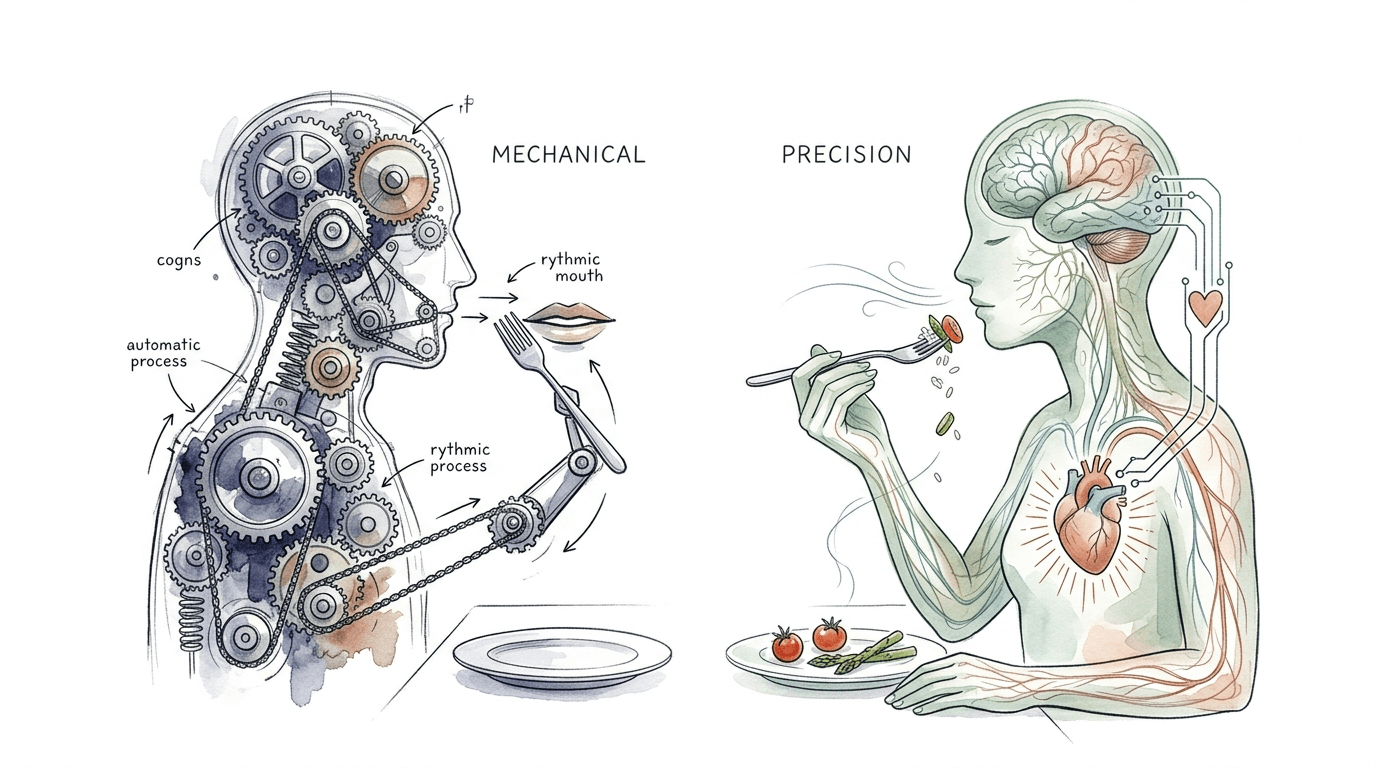
You don’t need a smaller plate; you need a sharper focus. Most overeating happens in the gap between the swallow and the signal. Mechanical eating is a standard failure of attention. Precision eating—savoring every texture and aroma—activates the satiety signals that a thousand mindless calories can’t reach. Stop eating for volume; start eating for depth.
We live in an era of nutritional noise. We track macros, obsess over ingredients, and scroll through endless meal prep hacks, yet we often miss the most critical part of the equation: the actual experience of eating. When you eat while distracted, your brain fails to register the nutrients entering your system, leaving you physically full but psychologically starving.
This gap is where mindless calories live. It is the reason you can finish a large bag of chips without remembering the taste of a single one. Precision eating is the antidote to this modern “mechanical” autopilot. It is a deliberate, high-resolution approach to nourishment that treats every bite as a data point for your nervous system.
By shifting your focus from the quantity on your plate to the quality of your attention, you unlock a biological shortcut to satiety. You aren’t just eating food; you are communicating with your brain’s hunger-regulation centers. When that communication is clear, your body naturally knows when to stop, making restriction feel like a choice rather than a chore.
Precision Mindful Eating Techniques
Precision Mindful Eating is a high-intensity focus strategy designed to synchronize your physical consumption with your brain’s chemical signaling. While traditional mindful eating is often viewed as a “relaxed” practice, precision eating is active and intentional. It is about maximizing the sensory input of every mouthful to ensure your brain receives a “loud and clear” signal that you are being fed.
In the real world, this technique is used by performance athletes, high-level executives, and anyone looking to reclaim their relationship with food. It exists because our modern environment is designed to disrupt our internal cues. Bright lights, loud music, and blue-light screens are all “satiety blockers” that prevent the brain from acknowledging the meal in front of you.
Imagine your hunger like a radio station. Mechanical eating is like listening to that station through static—you might get the gist, but you miss the details, so you keep turning up the volume (eating more) to try and hear it. Precision eating is like tuning the dial until the signal is crystal clear. You don’t need more volume; you just need to hear the music better.
This practice is used effectively in weight management clinics and by mindfulness practitioners to break the cycle of emotional and “autopilot” eating. It turns a mundane daily task into a masterclass in self-awareness. By the time you finish a meal using these techniques, you aren’t just full; you are satisfied in a way that volume alone can never achieve.
How to Practice Precision Eating: A Step-by-Step System
Mastering precision eating requires more than just “slowing down.” It involves a systematic engagement of your biological feedback loops. Follow these steps to turn a standard meal into a high-resolution sensory experience.
1. The Pre-Flight Sensory Check
Before you take your first bite, engage your visual and olfactory senses. Spend 30 seconds simply looking at the colors and arrangement of your food. Smell the steam rising from the plate. This isn’t just about appreciation; it is about priming your digestive system. Research suggests that the “cephalic phase” of digestion—where your body starts producing saliva and stomach acid—begins with the sight and smell of food.
2. The First Three Bites Rule
The first three bites of any meal are the most sensory-rich. After that, “sensory-specific satiety” kicks in, and your taste buds begin to desensitize. For the first three bites, close your eyes. Focus entirely on the temperature, the initial flavor notes, and how the texture changes as you chew. This “anchors” the meal in your consciousness, making it much harder for your brain to forget that you’ve eaten later on.
3. The 40-Chew Challenge
Mechanical eating often involves swallowing food that is still semi-solid. Precision eating demands that you chew each bite until it is essentially a liquid. Aim for 30 to 40 chews per mouthful. This does two things: it forces you to slow down, and it exposes the food to your taste buds for a longer duration, which significantly increases the “fullness” signal sent to the hypothalamus.
4. The Utensil Reset
One of the most common pitfalls is loading your fork while you are still chewing the previous bite. This creates a “conveyor belt” effect. To break this, physically put your fork, spoon, or chopsticks down on the table after every single bite. Do not pick them up again until your mouth is empty. This simple physical break creates a necessary pause for your brain to catch up with your stomach.
5. The Mid-Meal Satiety Scan
Halfway through your plate, stop completely for two minutes. Take a few deep breaths and ask yourself: “On a scale of 1 to 10, how hungry am I right now?” Often, we continue eating simply because there is food left on the plate, not because we are still hungry. This scan breaks the “clean your plate” momentum and gives your satiety hormones (like leptin and CCK) time to travel through your bloodstream to your brain.
The Measurable Benefits of Precision Eating
The transition from mechanical to precision eating offers immediate physiological and psychological rewards. It is not just a “feel-good” practice; it is a metabolic intervention.
- Improved Digestion: Digestion begins in the mouth. By chewing thoroughly and activating saliva enzymes, you reduce the workload on your stomach and intestines, leading to less bloating and better nutrient absorption.
- Natural Calorie Reduction: Studies show that people who eat slowly and mindfully consume 200 to 300 fewer calories per day without feeling deprived. Over a month, this can lead to significant, sustainable weight loss.
- Stable Insulin Levels: Fast eating causes a rapid influx of glucose, leading to insulin spikes. Precision eating allows for a more gradual rise in blood sugar, which helps prevent energy crashes and reduces fat storage.
- Enhanced Flavor Perception: When you stop eating for volume, you start tasting the nuances of your food. High-quality, whole foods become more satisfying, while hyper-processed, “plastic” foods often lose their appeal because their chemical aftertaste becomes more apparent.
- Stress Reduction: Focusing on the sensory details of a meal acts as a form of meditation. It lowers cortisol levels, which is the primary hormone responsible for abdominal fat storage and “stress eating.”
Challenges and Common Pitfalls
Even with the best intentions, the “mechanical” habit is hard to break. Our environment is rigged against us. Awareness of these common mistakes is the first step toward avoiding them.
The Distraction Trap: The most frequent error is “the screen swallow.” If you are watching TV, scrolling through social media, or answering emails while eating, you are effectively muting your satiety signals. Your brain is too busy processing information to process the meal. The result? You finish the food and feel like you “never even ate.”
The “Clean Your Plate” Ghost: Many of us were raised with the rule that wasting food is a sin. This leads to mechanical eating past the point of fullness. You must realize that “wasting” the food into your body when you don’t need it is just as wasteful as leaving it on the plate—if not more so, because it actively harms your health.
Rushing the Clock: We treat eating like a task to be checked off a list. We eat in the car, at our desks, or standing over the sink. This “survival mode” eating keeps your nervous system in a sympathetic (fight-or-flight) state, which shuts down effective digestion and suppresses the hormones that make you feel full.
Limitations: When This May Not Be Ideal
Precision eating is a powerful tool, but it is not a universal solution for every situation. There are specific contexts where this high-focus approach might need to be adjusted or temporarily set aside.
In the early stages of recovery from certain eating disorders, the high level of focus on food and bodily sensations can sometimes trigger obsessive thoughts. In these cases, “Mechanical Eating”—following a strict, timed schedule regardless of cues—is often the safer, clinically recommended path to stabilize the body’s metabolism before moving toward mindful techniques.
Furthermore, if you are in a state of extreme caloric deficit or “starvation” hunger (for instance, after a 24-hour fast or an incredibly intense athletic event), the biological drive to eat quickly can override your ability to be “precise.” In these moments, your body is prioritizing immediate survival over sensory nuance. The goal should be to return to precision eating as soon as that initial “emergency” hunger has subsided.
Finally, social environments can pose a challenge. A high-resolution focus on every chew can feel isolating during a celebratory dinner or a business lunch. In these settings, the goal shouldn’t be “perfection” but rather “tethered awareness”—using a few key techniques (like the first three bites) while remaining present with your company.
Comparing Eating Modalities
Understanding where Precision Eating fits in the spectrum of consumption habits helps you choose the right tool for your current goals. Below is a comparison of the three most common eating “modes.”
| Feature | Mindless (Mechanical) | Precision (Mindful) | Intuitive |
|---|---|---|---|
| Primary Trigger | Habit, Boredom, Screens | Intentional Awareness | Internal Hunger Cues |
| Eating Speed | Rapid / Autopilot | Slow / Controlled | Natural / Variable |
| Satiety Focus | “Stuffed” or “Empty Plate” | “Satisfied” and “Nourished” | “Comfortably Full” |
| Environment | Highly Distracted | Controlled / Quiet | Social / Flexible |
Practical Tips for Immediate Application
You don’t need to change your entire life to start seeing results. Use these small, punchy “micro-habits” to inject precision into your next meal.
- The 20-Minute Timer: Set a timer on your phone for 20 minutes before you start eating. Challenge yourself to still have food on your plate when the timer goes off. Most people finish a “large” meal in under 8 minutes; doubling that time changes everything.
- The Non-Dominant Hand Hack: If you find it impossible to slow down, switch your fork to your non-dominant hand. The lack of coordination forces your brain out of its habitual “scoop-and-swallow” loop and makes you more aware of the physical act of eating.
- Drink Water Between Bites: Take a sip of water every few mouthfuls. This not only aids digestion but also forces a physical pause, giving your stomach time to expand and send fullness signals.
- Start with “Crunch”: Foods that require high jaw action—like raw carrots, apples, or nuts—naturally slow you down. Starting your meal with a high-texture appetizer “wakes up” your jaw and primes your brain for more attentive eating.
Advanced Considerations for Practitioners
For those looking to go deeper, precision eating can be optimized by understanding the neurobiology of taste. Your tongue has different “neighborhoods” for sweet, sour, salty, bitter, and umami. When you eat, try to identify which part of your tongue is reacting to each ingredient. This level of granular analysis is the “pro level” of precision eating.
Another advanced technique is the use of “pre-meal breathing.” Engaging in three minutes of “box breathing” (inhale for 4, hold for 4, exhale for 4, hold for 4) before you eat switches your nervous system from the sympathetic “alert” state to the parasympathetic “rest and digest” state. This ensures that your body is biologically ready to receive and process the nutrients you are about to provide.
Finally, consider the concept of “volume vs. density.” Precision eaters often find they prefer “density”—rich, high-flavor, nutrient-dense foods—over “volume”—large amounts of bland, low-nutrient food. This shift is a sign that your body’s “hedonic” hunger (eating for pleasure) and “homeostatic” hunger (eating for energy) are finally coming into alignment.
Real-World Example: The “Office Lunch” Transformation
Let’s look at a common scenario: The Desk Lunch. Scenario A (Mechanical): Mark sits at his computer, eating a sandwich while answering emails. He takes large bites, barely chews, and finishes the entire sandwich in 6 minutes. Half an hour later, he feels hungry again and reaches for a bag of pretzels. He consumed 600 calories, but his brain never “clocked” the meal.
Scenario B (Precision): Mark closes his laptop. He spends 30 seconds looking at his sandwich, noticing the texture of the bread and the smell of the ingredients. He takes a bite, puts the sandwich down, and chews 30 times. He focuses on the crunch of the lettuce and the saltiness of the turkey. He takes a sip of water. He repeats this process. After 15 minutes, he has eaten only half the sandwich and feels remarkably satisfied. He saves the other half for later. He consumed 300 calories, but his satiety signal is twice as strong as in Scenario A.
Final Thoughts
The secret to weight management and food freedom isn’t found in a complicated app or a restrictive list of “forbidden” foods. It is found in the quality of your attention. Precision eating is a skill that anyone can develop with practice. It turns the act of nourishing your body into an act of self-respect.
When you stop eating for volume and start eating for depth, you stop fighting your body and start working with it. You’ll find that you need less food to feel more satisfied, and the “willpower” you used to need to stop eating naturally disappears. Your body is incredibly smart; it just needs you to listen.
Start with your very next meal. Put the phone away. Put the fork down between bites. Listen for the signal. The gap between the swallow and the satiety signal is where your health is won or lost. Close that gap, and you’ll change your life one bite at a time.
Sources
1 glendalecherrycreek.com | 2 healthline.com | 3 fitnessnetwork.com.au | 4 tricare.mil | 5 bostonheartdiagnostics.com | 6 nchpad.org | 7 psychologytoday.com | 8 website-files.com | 9 msaweightloss.com | 10 eatingdisorders.org.au | 11 medicalhealthsolutionsllc.com | 12 corelifemd.com | 13 changecreateschange.com | 14 webmd.com | 15 mogrendental.com | 16 vasseydentalpartners.com