


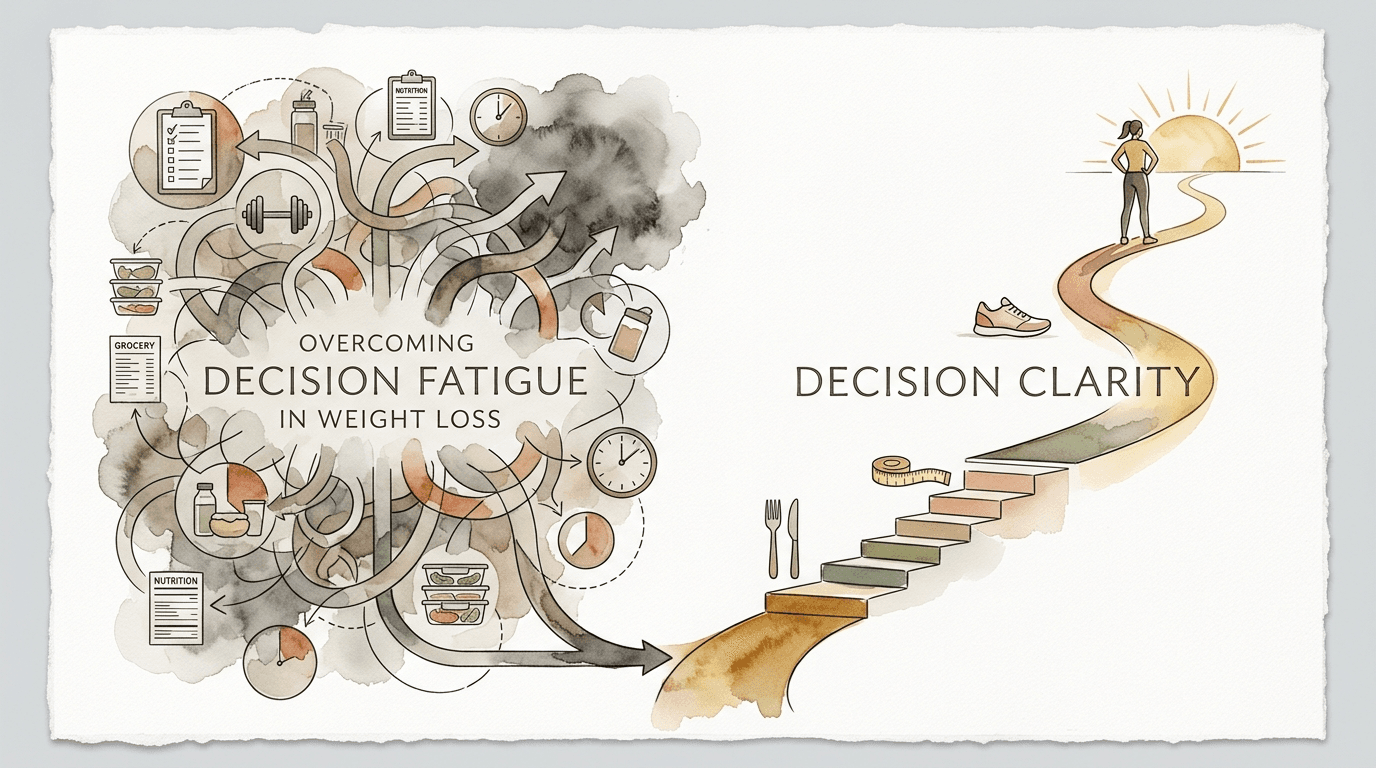
A cluttered kitchen creates a cluttered mind, and a cluttered mind chooses the easiest snack. Chaos in your environment leads to ‘Decision Fatigue.’ When you’re tired, your brain defaults to the easiest, most processed option. Bringing ‘Order’ to your kitchen and your meal choices removes the mental friction that leads to relapses. Clarity is the foundation of freedom.
Most people approach weight loss as a test of willpower. They believe if they just try harder, they will succeed. Research suggests otherwise. Human beings make roughly 35,000 conscious decisions every day, with approximately 226 of those revolving solely around food. This constant mental processing drains your cognitive battery.
When that battery runs low, you lose the ability to say “no” to the cookie and “yes” to the kale. This is not a personal failure. It is a biological reality. Strategic environment design shifts the burden from your willpower to your surroundings. You can stop fighting your kitchen and start letting it guide you toward your goals.
Overcoming Decision Fatigue In Weight Loss
Decision fatigue is the psychological phenomenon where the quality of your choices deteriorates after a long session of decision-making. Think of your willpower as a smartphone battery. Every time you decide what to wear, how to answer an email, or whether to take the stairs, you lose a few percentage points. Late in the evening, your battery is in the “red zone.”
This exhaustion explains why you might start your day with a green smoothie but end it with a pint of ice cream. Your brain is looking for the path of least resistance. Processed foods are designed to be that path. They are easy to eat, high in calories, and provide an immediate hit of dopamine.
In the real world, decision fatigue is used against you. Supermarkets place candy at eye level near the checkout because they know you have already made dozens of choices while navigating the aisles. You are mentally depleted and more likely to make an impulsive purchase.
Overcoming this requires a transition from “Decision Fatigue” to “Decision Clarity.” Clarity occurs when you have pre-determined your choices. If you don’t have to choose, you cannot suffer from fatigue. A well-organized environment acts as a permanent set of “default” choices that keep you on track even when your mental energy is at zero.
The Science of Your Surroundings
Research from the Cornell Food and Brand Lab has shown that a messy kitchen directly influences how much you eat. One study placed women in two different environments: a clean, organized kitchen and a cluttered, chaotic one with newspapers and dirty dishes. The women in the chaotic kitchen consumed twice as many cookie calories as those in the tidy space.
Chaos signals to the brain that the world is out of control. When you feel out of control, you are less likely to regulate your intake. The brain thinks, “If everything else is a mess, why should my diet be any different?” This subconscious link between physical order and internal discipline is the key to sustainable weight loss.
Visibility is another critical factor. The “Visibility Rule” states that you are most likely to eat what you see first. If a bowl of fruit is on the counter, your fruit consumption increases. If a box of crackers is visible, you will graze on them. Your eyes send signals to the appetite centers of your brain before you even feel physiological hunger.
Designing Your Kitchen for Success
Transforming your kitchen is about more than just cleaning. It is about “choice architecture.” You are the architect of your environment. You can build a space that makes healthy choices effortless and unhealthy choices difficult.
Start with the “Prime Real Estate” in your kitchen. This includes the countertop, the middle shelves of the refrigerator, and the pantry shelves at eye level. These areas should be reserved exclusively for foods that align with your goals.
Clear containers are your best friend. Use them to store pre-cut vegetables, washed berries, and cooked proteins in the fridge. Seeing the vibrant colors of fresh produce makes them more appetizing. It also reminds you that the food is available and ready to eat, reducing the “prep friction” that often leads to ordering takeout.
Opaque containers or high shelves should be used for “trigger foods.” If you choose to keep treats in the house, store them in a way that requires effort to reach. Hide them in a high cabinet or behind other items in the pantry. Increasing the number of steps required to access a food item significantly decreases the likelihood of you eating it impulsively.
The One-Decision Framework
The One-Decision Framework is a strategy where you make one big choice today to eliminate a hundred small choices later. Instead of deciding what to eat for lunch every morning, you decide once on Sunday that lunch will always be a salad with lean protein.
This eliminates the “mental spin” that happens when you’re hungry and trying to be healthy. When you are tired, the “good enough” option should already be decided. You can apply this to your grocery shopping, too. Make a “Standard Grocery List” of staple items that you never have to think about.
Stocking your kitchen with these staples ensures you always have the ingredients for a 10-minute healthy meal. This acts as an “Emergency Protocol” for those nights when work runs late and you are tempted by fast food. A frozen bag of vegetables and a pre-cooked chicken breast can be ready faster than a delivery driver can reach your door.
Benefits of Environmental Mastery
The primary benefit of an organized kitchen is the preservation of mental energy. You save your willpower for the things that actually matter—like your career, your family, or your workouts. You no longer have to “battle” yourself every time you open the fridge.
Consistency becomes much easier to maintain. Most weight loss plateaus happen because of “hidden calories” and “mindless grazing.” When your snacks are hidden and your healthy meals are prominent, those accidental calories disappear. You create a caloric deficit through design rather than deprivation.
Stress levels also drop significantly. Walking into a clean, organized kitchen provides a sense of calm and competence. This mental state is conducive to mindful eating. You are more likely to sit down, chew slowly, and listen to your body’s fullness signals when your environment isn’t screaming for your attention.
Challenges and Common Mistakes
The most common mistake is trying to be “perfect” instead of “functional.” You don’t need a Pinterest-perfect kitchen with matching labels to lose weight. You need a system that works for your life. Over-complicating the organization process can actually lead to more decision fatigue.
Another pitfall is “The Visibility Trap.” Sometimes people put too many healthy options out at once. If your counter is covered in five different fruit bowls, it can still feel cluttered. Focus on the 2 or 3 items you want to consume most that day. Keep the rest tucked away but accessible.
People often forget about the “Social Friction” in the kitchen. If you live with others who do not share your goals, their food choices might be visible. The solution is to designate “Health Zones.” Have one shelf in the pantry or one drawer in the fridge that is yours. Respecting those boundaries helps maintain your decision clarity in a shared environment.
Limitations of Environment Design
Environment design is a powerful tool, but it is not a magic wand. It cannot fix deep-rooted emotional eating habits or metabolic disorders on its own. It is a support system, not a replacement for a balanced diet and regular movement.
Social environments are often outside of your control. When you are at a restaurant, a party, or the office, you cannot reorganize the room to suit your needs. In these cases, you must rely on the “One-Decision” habits you’ve built at home. If your home environment is strong, you will have more “battery” left to navigate these tougher external spaces.
Travel and vacation also present challenges. Your routines are disrupted, and your familiar “Order” is gone. The key here is “Environmental Adaptation.” Learn to scan new environments for the healthiest “default” options as soon as you arrive.
Decision Fatigue vs. Decision Clarity
Understanding the difference between these two states is the difference between struggling and succeeding. Fatigue is reactive; Clarity is proactive. Fatigue happens when you are a victim of your surroundings. Clarity happens when you are the master of them.
| Feature | Decision Fatigue | Decision Clarity |
|---|---|---|
| Food Choice | Impulsive, based on cravings | Pre-planned, based on goals |
| Willpower Usage | High (constant resistance) | Low (automatic actions) |
| Environment | Cluttered, chaotic | Organized, intentional |
| Stress Level | High (choice overload) | Low (predictable outcomes) |
Practical Tips for Immediate Action
Clean your kitchen counters tonight. Remove anything that isn’t a healthy food or a tool you use daily. A clear physical space creates the mental “bandwidth” you need for tomorrow’s decisions.
Apply the “Eye-Level Rule” to your refrigerator. Move the crisper drawer contents—your vegetables and fruits—to the middle shelf where you can see them immediately. Put the condiments and less-healthy items in the drawers or on the bottom.
Invest in a set of glass storage containers. Use them to meal prep at least one component of your diet, such as grilled chicken or roasted sweet potatoes. Knowing that a portion of your meal is “ready to go” reduces the cognitive load of cooking from scratch after a long day.
Create a “Go-To” meal list. Write down five simple meals that you enjoy and that fit your nutrition plan. Post this list on the inside of a cabinet door. When you are too tired to think, simply pick one from the list and follow the “default.”
Advanced Considerations: The Neurobiology of Habit
Serious practitioners should understand that environment design is actually a form of neurological rewiring. When you repeat an action in a specific environment, your brain builds a “habit loop.” The kitchen becomes a cue for healthy eating rather than a cue for stress and snacking.
Dopamine plays a major role in this. Your brain releases dopamine not just when you eat, but when you *anticipate* eating. If your kitchen is full of visual triggers for sugar, you are constantly fighting a dopamine-driven urge. Removing those triggers “quiets” the brain.
Over time, this leads to a reduction in “food noise.” This is the internal chatter that constantly reminds you of the cookies in the pantry. When the environment is clear, the noise fades. You regain the ability to distinguish between true physiological hunger and environmental cravings.
Examples of Environment Design in Practice
Consider the “After-Work Test.” Imagine two people returning home after a stressful eight-hour shift. Person A enters a kitchen where the counters are covered in mail, the sink is full of dishes, and the only visible food is a bag of chips. Person A is exhausted and has high decision fatigue. They eat the chips and order a pizza.
Person B enters a kitchen with clean counters. A bowl of apples sits on the island. Inside the fridge, a glass container holds pre-washed spinach and a pre-cooked salmon fillet. Person B is also exhausted, but the “path of least resistance” in their kitchen is the salmon salad. They eat the healthy meal and feel a sense of accomplishment.
The difference isn’t willpower. The difference is the “Choice Architecture” created days in advance. Person B used their high-energy moments (Sunday afternoon) to protect their low-energy moments (Tuesday evening).
Final Thoughts
Weight loss is not a battle of the mind; it is a design of the environment. By reducing the number of daily decisions you have to make, you protect your willpower for when you truly need it. Clarity replaces chaos, and order replaces overwhelm.
Start small. You don’t need to renovate your kitchen to see results. Clean one counter, move your vegetables to eye level, and hide one trigger food. These tiny “nudges” accumulate into a powerful system that works for you, even when you are too tired to work for yourself.
Consistency is the result of a frictionless life. When you bring order to your kitchen, you bring order to your mind. That order is the foundation upon which your new, healthier life is built. Experiment with these strategies and discover the freedom that comes from a life designed for success.
Sources
1 thislifeuncluttered.com | 2 qubit.fit | 3 theonlinegp.com | 4 offadiet.com | 5 imanitribe.com | 6 stvincents.org | 7 myfitnesspal.com | 8 medicaldaily.com | 9 integrativenutrition.com | 10 lesliebeck.com | 11 dwellora.info | 12 tucson.com