


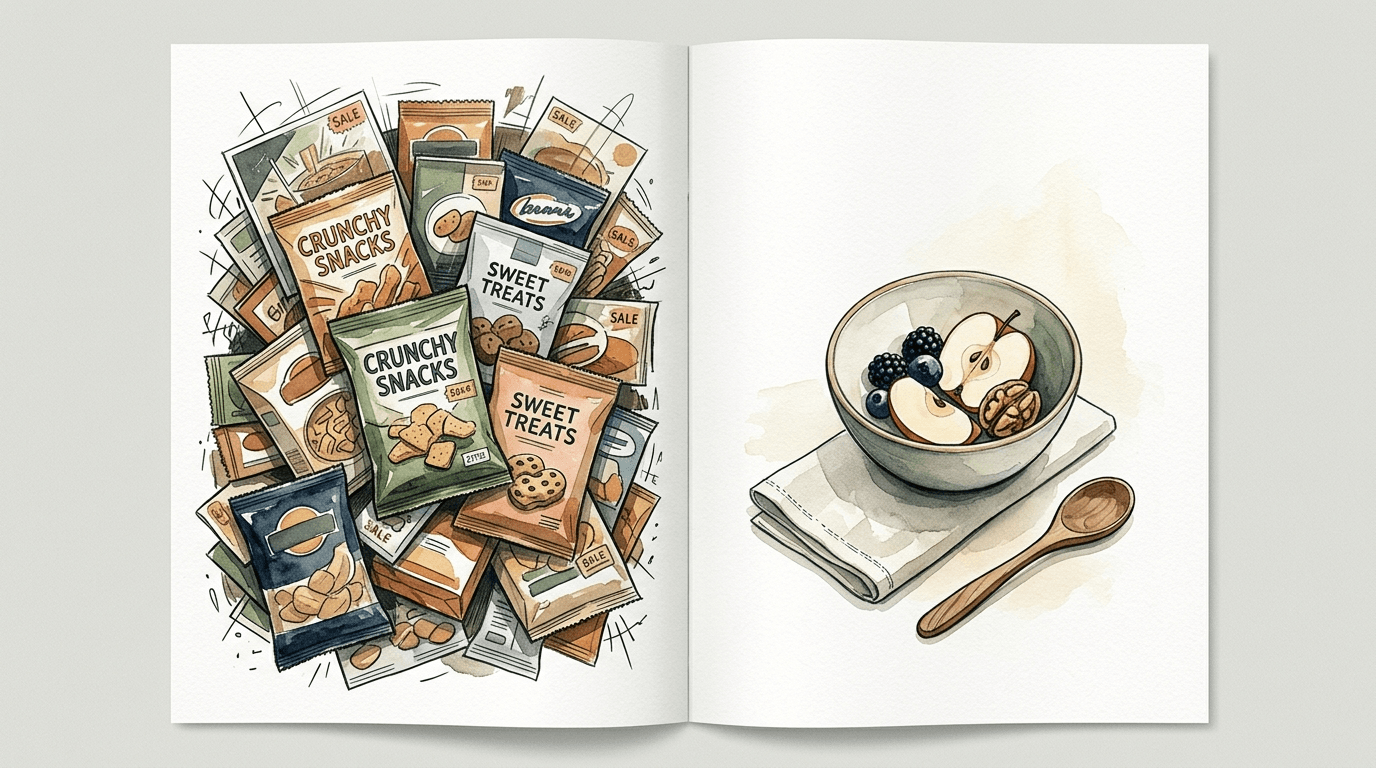
If you don’t protect your attention, the food industry will steal your appetite. We are “Exposed” to thousands of food triggers every day, from billboards to phone pings. Food freedom requires a “Sheltered” space—a place where the only thing that matters is the connection between you and your plate. Reclaim your table; reclaim your health.
The modern world is a 24/7 commercial for hyper-palatable calories. Everywhere you look, high-definition images of melting cheese and fizzing sodas battle for your focus. This constant Marketing Barrage isn’t just annoying; it is biological warfare. It targets your brain’s reward centers, making you feel hungry even when your stomach is full.
Living in a state of constant exposure turns eating into a reflex rather than a choice. You grab a snack because you saw an ad, not because you need fuel. To break this cycle, you must build a Sacred Space. This is an intentional environment designed to protect your biology from outside manipulation. It is the foundation of true food sovereignty.
Mindless Snacking Vs Intentional Eating
Mindless snacking is a state of “autopilot” consumption driven by external cues rather than internal needs. It usually happens when your attention is split between food and a secondary stimulus, like a television show or a work email. In this state, your brain fails to register the sensory properties of the food. You might finish an entire bag of chips without truly tasting a single one.
Intentional eating is the direct opposite. It is a deliberate act of choosing what, when, and how you eat based on your body’s actual requirements. It moves the decision-making process from the impulsive reward centers of the brain back to the rational prefrontal cortex. When you eat intentionally, you are fully present with the flavors, textures, and aromas of your meal.
Real-world situations often blur these lines. Think about the “movie popcorn” effect. You aren’t hungry, but the smell of the lobby and the darkness of the theater trigger a learned response. Before the previews are over, the bucket is empty. This is mindless snacking in its purest form. Intentional eating would involve checking in with your stomach and deciding if you actually want the popcorn or if you are just following a script.
The transition from mindless to intentional requires a shift in environment. If your kitchen is filled with open packages and visual triggers, you are fighting a losing battle against your own biology. Intentional eating thrives in a “Sheltered” space where the distractions are stripped away. This allows your natural hunger and fullness signals to finally be heard above the noise.
How the Sacred Space Works: Designing for Intention
Creating a sheltered space is about more than just cleaning your kitchen. It is about choice architecture. You are designing a physical environment that makes healthy, intentional decisions the “path of least resistance.” If you have to work hard to find a snack, you are less likely to grab one out of boredom.
Start with visual decluttering. Clear your counters of all food except for a bowl of fresh fruit. Research shows that people who keep cereal boxes or snacks on their counters weigh significantly more than those who don’t. The simple act of seeing food triggers a dopamine release that mimics actual hunger. By hiding the triggers, you silence the “wanting” system in your brain.
Lighting and sound are equally important. Bright, harsh lighting and loud, fast-paced music are common tactics in fast-food restaurants. These elements increase your heart rate and encourage you to eat faster. In your sacred space, use warm, soft lighting and keep the room quiet. This signals to your nervous system that you are safe, allowing your body to enter a “rest and digest” state.
The table itself should be a destination. Use actual plates and silverware, even for small snacks. This creates a psychological boundary between “eating” and “doing.” When you eat directly from a box or bag, your brain loses track of volume. Plating your food forces you to acknowledge the quantity and quality of what you are about to consume.
The Science of the Marketing Barrage
The food industry employs “Bliss Point” engineering to ensure you stay in a state of mindless consumption. Coined by psychophysicist Howard Moskowitz, the Bliss Point is the precise mathematical ratio of salt, sugar, and fat that maximizes pleasure without triggering Sensory Specific Satiety. Normally, your brain gets “bored” of a flavor after a few minutes, signaling you to stop. Ultra-processed foods are designed to bypass this safety switch.
Dopamine plays a starring role in this process. When you see a high-definition image of a burger on social media, your brain releases dopamine in anticipation of a reward. This creates a “craving” state that feels like physical hunger. Because these images are everywhere—from your phone pings to giant billboards—your dopamine levels are constantly spiked. You are living in a permanent state of “wanting.”
Distracted eating further complicates this by disrupting your hormones. When you watch a screen while eating, your brain is too busy processing the visual data to listen to Leptin, the hormone that tells you when you are full. At the same time, the stress of modern media can spike Ghrelin, the hunger hormone. This creates a biological “unholy trinity”: you are more hungry, less satisfied, and constantly triggered.
Reclaiming your appetite means understanding these mechanisms. You aren’t “weak-willed” for wanting junk food; you are responding to highly sophisticated neurobiological traps. The only way to win is to stop playing the game. By creating a sheltered space, you cut off the sensory cues that the industry uses to hijack your dopamine pathways.
Benefits of Reclaiming Your Table
The most immediate benefit of intentional eating is improved digestion. When you eat in a calm, sheltered environment, your body activates the parasympathetic nervous system. This increases the production of saliva and digestive enzymes, ensuring that nutrients are broken down efficiently. Mindless eating often leads to bloating and discomfort because the body is stuck in a “fight or flight” mode.
Mental clarity is another significant advantage. Constant snacking on high-sugar “bliss point” foods causes massive spikes and crashes in blood glucose. This leads to “brain fog” and irritability. Intentional eating focuses on stable energy sources, providing a steady stream of fuel for your brain. You will find that your focus improves when you aren’t constantly distracted by the next dopamine hit.
There are also long-term metabolic benefits. By learning to recognize true satiety cues, you naturally regulate your caloric intake without the need for restrictive dieting. This fosters a healthier relationship with food. Instead of seeing food as an enemy or a source of guilt, you begin to see it as a source of nourishment and genuine pleasure.
- Enhanced Flavor Perception: When you aren’t distracted, you actually taste your food. You may find you need less salt or sugar to feel satisfied.
- Reduced Stress: Using mealtime as a sacred, unplugged break acts as a daily meditation, lowering overall cortisol levels.
- Weight Regulation: Most people naturally gravitate toward their ideal weight when they stop eating in response to external marketing triggers.
- Better Social Connection: Sharing a meal in a sheltered space without phones fosters deeper conversations and stronger relationships.
Challenges: Why Your Brain Loves the Trap
The biggest challenge is your own evolutionary biology. For most of human history, calories were scarce. Our brains are hardwired to seek out salt, fat, and sugar whenever they are available. The food industry simply takes this survival mechanism and turns it against us. Your brain thinks it is “winning” by securing high-calorie fuel, even though that fuel is now making us sick.
Social pressure is another major hurdle. Snacking is often a social activity, and “mindful” choices can sometimes make others feel uncomfortable. If everyone at the office is grabbing doughnuts from the breakroom, standing your ground requires significant mental energy. We are social creatures, and the desire to fit in often overrides our desire for health.
Digital addiction is perhaps the most modern challenge. We have become conditioned to require “entertainment” while we eat. The thought of sitting in silence with a plate of food can feel boring or even anxiety-inducing to a brain used to constant scrolling. Breaking the link between screens and snacks is a physiological process that takes time and patience.
Limitations: When Intentionality Isn’t Enough
Environment design is powerful, but it isn’t a cure-all. For individuals living in “food deserts,” the availability of fresh, whole foods is a systemic barrier that personal intention cannot always overcome. If the only available options are ultra-processed “bliss point” products, creating a sacred space becomes much more difficult.
Certain clinical conditions, such as binge eating disorder or severe hormonal imbalances, may require professional medical intervention. While intentional eating strategies are helpful, they should be used as a complement to, not a replacement for, clinical care. In cases of deep-seated trauma related to food, simply changing the kitchen lighting won’t address the root cause.
Time is also a practical boundary. A “Sheltered” meal requires preparation and presence. In a society that rewards speed and productivity, taking 30 minutes to sit and eat without a phone can feel like a luxury that many believe they cannot afford. This trade-off between “efficiency” and “health” is a constant struggle for many busy professionals.
The Two Worlds: Exposed vs. Sheltered
To understand the difference, we can compare the typical modern eating environment with the intentional sacred space. The differences in complexity and long-term cost are striking.
| Feature | The Exposed Environment (Marketing Barrage) | The Sheltered Environment (Sacred Space) |
|---|---|---|
| Primary Triggers | Ads, pings, open packages, bright colors. | Internal hunger cues, aromas, natural light. |
| Neurochemistry | High dopamine spikes, low leptin sensitivity. | Balanced hormones, high serotonin/oxytocin. |
| Eating Speed | Fast, often standing or multitasking. | Slow, seated, and focused on texture. |
| Digestive State | Sympathetic (Fight or Flight). | Parasympathetic (Rest and Digest). |
| Long-term Outcome | Metabolic fatigue, weight gain, brain fog. | Metabolic flexibility, stable energy, clarity. |
Practical Tips for Designing Your Space
You can begin transforming your environment today with a few simple adjustments. These steps are designed to reduce the friction of intentional eating while increasing the friction for mindless snacking.
- The 20-Second Rule: Make unhealthy snacks take at least 20 seconds to access. Put them on a high shelf, in an opaque container, or in a different room entirely.
- The Digital Kitchen: Establish a “no-phone zone” in your dining area. Charge your phone in another room during meals to prevent the urge to scroll.
- Color Psychology: Use blue or green plates. These colors are known to be calming and may naturally curb overactive appetites, unlike red or yellow.
- Sensory Rituals: Before the first bite, take three deep breaths. This simple act resets your nervous system and prepares your body for digestion.
- The Clear Counter Policy: If it’s on the counter, it’s in your mouth. Keep only non-food items or fresh produce visible.
Invest in high-quality, heavy cutlery. Studies suggest that the weight of the utensils can influence how much you enjoy and value your food. Heavier forks and spoons lead to a higher perceived quality of the meal, making you more likely to slow down and savor the experience.
Advanced Considerations for Serious Practitioners
For those who want to go deeper, the field of Neuro-gastronomy offers fascinating insights into how our brains construct the flavor of food. Flavor isn’t just in the tongue; it is a multi-sensory experience involving the nose, eyes, and even ears. You can use this to your advantage by enhancing the “aromatic profile” of your meals with fresh herbs, which increases satiety without adding calories.
Consider the role of the Vagus Nerve. This is the main highway of communication between your gut and your brain. You can “tone” your vagus nerve through cold exposure or deep diaphragmatic breathing. A healthy vagal tone allows for much faster and more accurate transmission of fullness signals, making intentional eating feel almost effortless over time.
Finally, think about the “Microbiome-Brain Axis.” Ultra-processed foods are designed to be absorbed quickly in the upper gut, starving the beneficial bacteria in your lower colon. These bacteria actually produce neurotransmitters like serotonin. When you eat fiber-rich whole foods in a sheltered space, you are literally feeding the part of your biology that keeps you calm and happy.
Real-World Scenario: The Office Breakroom
Imagine you are at work. It is 3:00 PM—the “witching hour” for cravings. You walk into the breakroom to get water and see a box of glazed doughnuts. Your brain immediately enters the Exposed state. You smell the sugar, see the bright branding, and remember the “high” of previous snacks.
In a mindless state, you would grab a doughnut while walking back to your desk and eat it while reading emails. You wouldn’t even remember eating it five minutes later, but your insulin would spike, and you would be hungry again by 4:00 PM.
An intentional approach looks different. You acknowledge the trigger: “I am seeing a doughnut, and my brain is releasing dopamine.” You check in with your stomach: “Am I actually hungry, or am I just stressed from that meeting?” If you decide you aren’t hungry, you leave. If you decide you truly want the doughnut, you take it to a quiet spot, sit down, and eat it without a screen. You enjoy every bite, feel the sweetness fully, and stop when you are satisfied. You’ve reclaimed the experience.
Final Thoughts
Reclaiming your table is an act of rebellion against an industry that profits from your distraction. By moving from an “Exposed” state to a “Sheltered” one, you protect your biology and your peace of mind. This isn’t about restriction; it is about freedom. It is the freedom to enjoy food on your own terms.
The journey from mindless snacking to intentional eating doesn’t happen overnight. Your brain needs time to rewire its reward pathways and recalibrate its hormone signals. Start by changing one thing in your environment today. Perhaps it is clearing the counters or committing to a phone-free dinner.
Small, consistent shifts in your environment create a powerful cumulative effect. As you build your sacred space, you will find that the marketing barrage loses its power. You will rediscover the genuine joy of a well-cooked meal and the profound health that comes from being truly present at your own table. Reclaim your attention, and your health will follow.
Sources
1 indiatvnews.com | 2 msaweightloss.com | 3 plantbaseddrjules.com | 4 hindustantimes.com | 5 eufic.org | 6 zabeliciouslife.com | 7 atemate.com | 8 mosslifestyle.com | 9 geliheimann.com | 10 sustainability-directory.com | 11 nchpad.org | 12 uada.edu | 13 wisecode.ai | 14 optimisingnutrition.com | 15 foodtimes.eu | 16 thinkvida.com | 17 stanford.edu | 18 healthline.com | 19 tandfonline.com | 20 anfponline.org | 21 tastewise.io | 22 nfpt.com | 23 alittlenutrition.com | 24 psychologytoday.com