


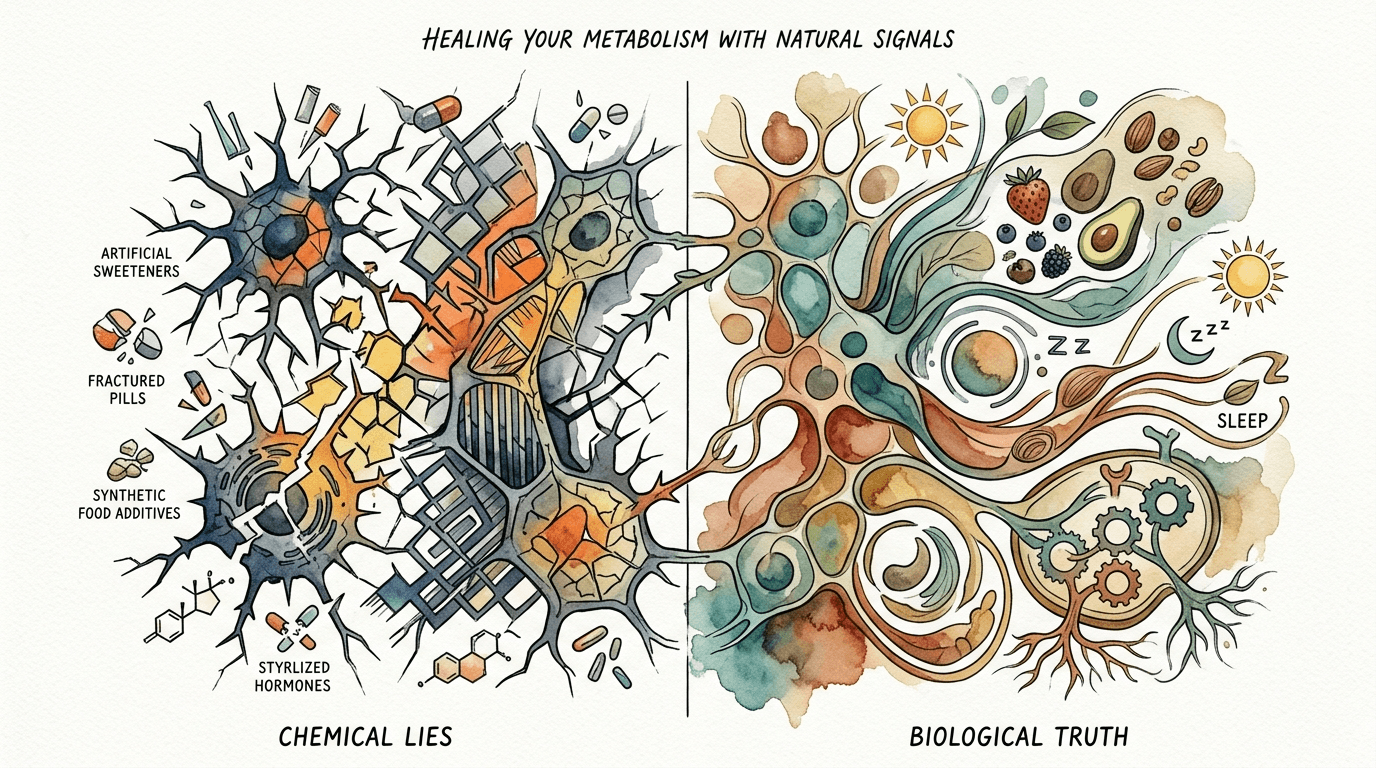
Your brain can’t find satisfaction in a lab-grown flavor profile. The diet industry loves ‘synthetic’ solutions because they keep you in a loop of chasing sweetness without ever finding satisfaction. When you switch to ‘natural’ biological signals, your body finally recognizes the fuel and turns off the hunger alarm. Stop lying to your brain.
Modern food engineering has created a world of hyper-palatable decoys. These products look like food and taste like food, but they lack the biological depth required to trigger satiety. Your tongue may be fooled for a few seconds, but your gut knows the truth. Every time you consume a chemical substitute, you create a metabolic mismatch that leaves your systems confused and your appetite screaming for more.
Biological truth is about restoring the communication lines between your digestive tract and your brain. It is about moving away from “diet” versions of junk and returning to the complex nutrient structures your DNA actually understands. This shift isn’t just about weight; it is about reclaiming the energy and clarity that vanish when your metabolism is buried under a mountain of synthetic additives.
Healing Your Metabolism With Natural Signals
Healing your metabolism starts with understanding that your body is a sophisticated sensory machine. Every time you swallow, a cascade of sensors in your stomach and intestines begins scanning for specific molecules. They are looking for amino acids, fatty acids, and glucose. When they find them, they send a “hormonal handshake” to your brain through the vagus nerve.
Natural signals are the internal messages sent by your hormones and nervous system when they detect real nutrients. These include cholecystokinin (CCK) for fat and protein, and glucagon-like peptide-1 (GLP-1) for carbohydrates. These hormones are the “off switches” for hunger. Without them, you are essentially a car with a broken gas gauge, constantly stopping to refuel because you don’t know how much is left in the tank.
The diet industry has spent decades trying to bypass these signals with non-caloric sweeteners and modified fats. These “chemical lies” provide the sensation of taste without the delivery of energy. In the real world, this is a disaster. Your brain registers the sweetness and prepares for a massive influx of fuel. When that fuel never arrives, the hypothalamus—your brain’s metabolic control center—ramps up hunger signals to compensate for the missing energy.
Healing involves removing these confusing decoys and replacing them with whole-food matrices. A whole-food matrix is the natural structure of a food, where fiber, vitamins, and minerals are bound together. This structure slows down digestion and ensures that your sensors have plenty of time to recognize the incoming fuel. This is why an apple is more satisfying than apple-flavored candy, even if the calorie counts were identical.
The Science of Satiety: How It Works
Restoring your metabolic health requires a deep dive into the gut-brain axis. This is the two-way highway that connects your enteric nervous system (the “second brain” in your gut) to your central nervous system. This network uses over 600 million neurons and dozens of hormones to manage your energy levels and mood.
The Nutrient-Sensing Mechanism
Your gut is lined with specialized cells called enteroendocrine cells. These act like tiny chemical labs, testing everything that passes through. When you eat a protein-forward meal, these cells detect the breakdown of amino acids. In response, they release CCK, which slows down gastric emptying and signals the brainstem that you are full.
Synthetic sweeteners fail here. Studies from the Keck School of Medicine show that sucralose and other artificial sweeteners can light up the hypothalamus like a pinata, but they don’t trigger the release of GLP-1 or insulin in the same way real sugar does. This creates a state of “metabolic ghosting.” Your brain feels the “promise” of energy but never gets the “payoff.” The result is a lingering hunger that can stay active for up to 35 minutes after you finish eating.
The Role of the Vagus Nerve
The vagus nerve is the primary conduit for satiety signals. It carries information about the physical stretch of your stomach and the chemical composition of your food. When you eat high-volume, fiber-rich foods, the mechanical stretch alone triggers the vagus nerve to tell the brain to slow down.
Chemical-laden processed foods are designed to be “soft” and “pre-digested.” They offer very little mechanical stretch and enter the bloodstream too quickly. This bypasses the natural “speed bumps” of the digestive process. By the time your brain realizes you’ve eaten, you have already consumed double the energy you actually needed.
Benefits of Switching to Biological Truth
Choosing biological truth over chemical lies provides more than just a smaller waistline. It transforms how you experience your day from the inside out. When your metabolism is running on natural signals, you stop being a slave to the next snack.
- Stable Energy Levels: Whole foods prevent the massive insulin spikes and subsequent crashes caused by refined starches and sugars. This means no more “afternoon slumps.”
- Reduced Cravings: When your brain finally receives the nutrients it is looking for, the constant “search” for more food stops. Cravings for sugar and salt often vanish within a few weeks of consistent whole-food eating.
- Improved Mental Clarity: Your brain is the most energy-demanding organ in your body. Providing it with steady, reliable fuel from natural sources improves focus and reduces brain fog.
- Better Digestive Health: Whole foods come with the fiber and “nutritional dark matter” that feed your gut microbiome. A healthy microbiome is essential for producing neurotransmitters like serotonin.
One of the most measurable benefits is the restoration of leptin sensitivity. Leptin is the hormone produced by your fat cells that tells your brain how much energy you have in storage. In a metabolism broken by “chemical lies,” the brain becomes deaf to leptin. You can have plenty of body fat but still feel like you are starving. Switching to natural signals helps “re-tune” the brain to hear the leptin signal again.
Challenges and Common Pitfalls
The path to metabolic healing is not always smooth. We live in a world designed to keep us hooked on synthetic flavor profiles. Understanding the roadblocks can help you stay the course when things get difficult.
The “Flavor Detox” Period
Your taste buds have likely been hijacked by hyper-palatable engineering. Natural foods may taste “bland” for the first 10 to 14 days. This is because your receptors are desensitized by the extreme levels of salt, sugar, and monosodium glutamate (MSG) found in processed foods. Persistence is key during this window. Your taste buds actually regenerate every two weeks; given time, a plain strawberry will eventually taste like the “explosion of flavor” it was meant to be.
The Convenience Trap
Diet culture has convinced us that we need “diet” bars, shakes, and pre-packaged meals to be healthy. Most of these products are just processed junk with a “healthy” label. They are still full of emulsifiers, gums, and synthetic sweeteners that disrupt the gut barrier. True biological signaling happens best when you prepare simple, single-ingredient foods.
Social Pressure and “Food Deserts”
Eating for biological truth can be socially isolating in a world of fast-food culture. Many people also struggle with access to fresh produce or high-quality proteins. Avoiding the “all-or-nothing” mentality is vital. Even choosing the least processed option at a restaurant or using frozen vegetables instead of canned can make a difference in your metabolic signaling.
Limitations: When Natural Signals Need More Time
Biological truth is a powerful tool, but it is not an overnight fix for decades of metabolic damage. Some individuals may have unique constraints that require a more nuanced approach.
Severe insulin resistance or Type 2 Diabetes can blunt the body’s ability to respond to natural signals immediately. In these cases, even “natural” sugars from fruit might need to be temporarily restricted to allow the system to reset. Your body didn’t break in a day, and the hormonal receptors won’t heal in a day.
Environmental toxins and chronic stress can also override your satiety signals. If your cortisol is constantly high, your body will stay in “fat storage mode” regardless of how many whole foods you eat. High stress makes the brain crave quick energy (sugar), making it much harder to listen to the subtle cues of protein and fiber. Healing your metabolism often requires healing your lifestyle as a whole, including sleep and movement.
Chemical Lies vs. Biological Truth
| Feature | Chemical Lies (Synthetic) | Biological Truth (Natural) |
|---|---|---|
| Satiety Signal | Delayed or non-existent | Rapid and long-lasting |
| Nutrient Density | Empty or isolated calories | Full food matrix |
| Brain Response | Hypothalamic confusion | Hormonal satisfaction |
| Gut Health | Promotes dysbiosis | Supports diverse microbiome |
| Long-term Cost | High (healthcare, medications) | Low (prevention, vitality) |
Practical Tips for a Metabolic Reset
Immediate changes can start today. You don’t need a PhD in biochemistry to start listening to your biological signals. Follow these steps to begin the transition away from lab-grown profiles.
- Prioritize Protein at Breakfast: Eating at least 20-30 grams of protein within an hour of waking signals your body that fuel is abundant. This sets a stable metabolic tone for the rest of the day.
- The “One Ingredient” Rule: Aim to have 80% of your cart consist of foods that only have one ingredient (e.g., eggs, broccoli, beef, oats). If it has a paragraph of chemical names, it’s a decoy.
- Hydrate with Minerals: Plain water is good, but adding a pinch of sea salt or lemon provides the electrolytes your cells need for energy production. Chronic dehydration is often mistaken for hunger.
- Chew Thoroughly: Digestion starts in the mouth. Chewing your food 20-30 times per bite allows your lingual taste receptors to communicate with your gut before you’ve even swallowed.
- Eliminate Liquid Calories: Whether it’s soda or “diet” tea, liquid calories bypass almost all satiety signals. Eat your fruit; don’t drink it.
Focusing on fiber is another critical move. Fiber adds volume to the stomach and slows the absorption of nutrients in the small intestine. This ensures a steady release of energy rather than a chaotic spike. Think of fiber as the “governor” on an engine, preventing it from revving too high and burning out.
Advanced Considerations: Nutritional Dark Matter
For those looking to optimize even further, we must consider what scientists call “Nutritional Dark Matter.” Standard nutrition labels only track about 150 well-known compounds like protein, vitamin C, and calcium. However, recent research suggests that the human diet contains over 26,000 distinct bioactive compounds.
These compounds—such as urolithins from nuts or catechins from tea—interact with your mitochondria and your DNA. They perform tasks like repairing cellular damage and improving insulin signaling that “synthetic” versions simply cannot replicate. When you eat a “vitamin-fortified” processed snack, you are missing out on thousands of these secondary metabolites that protect your health.
Mitochondrial health is the ultimate goal of metabolic healing. Your mitochondria are the “power plants” inside your cells. They thrive on the synergistic nutrients found in whole foods. Synthetic additives and high-fructose corn syrup can cause “mitochondrial uncoupling,” where your cells become inefficient at producing energy. This makes you feel tired even when you’ve eaten plenty of calories.
Examples: Real-World Scenarios
Consider two different lunch options to see how biological signals work in practice.
Scenario A: The “Diet” Lunch. You have a 400-calorie “diet” microwave meal with a zero-calorie soda and a “protein” bar. The meal is high in sodium and contains thickeners like carrageenan. The soda uses sucralose. Your tongue tastes sweetness and saltiness, but your gut sensors find very little actual protein or fiber. Within an hour, your brain detects the “missing” energy promised by the sweet soda. Your insulin levels may fluctuate due to the refined starches. By 3:00 PM, you are raiding the office snack drawer.
Scenario B: The “Biological Truth” Lunch. You have a 600-calorie meal consisting of a grilled chicken breast, half an avocado, and a large pile of sautéed spinach and peppers. You drink plain sparkling water with lime. As you chew the chicken, your lingual umami receptors trigger the release of gastric juices. The healthy fats in the avocado cause the release of CCK, telling your brain you are full. The fiber in the vegetables slows down the glucose release from the peppers. Your energy remains stable for four to five hours. You don’t even think about food until dinner time.
The second scenario actually contains more calories, but it leads to better weight management and higher energy. It is the quality of the signal, not just the quantity of the fuel, that determines your metabolic success.
Final Thoughts
Restoring your metabolism is a journey back to your biological roots. It requires a conscious rejection of the engineered hyper-palatability that surrounds us. By choosing whole food structures and natural nutrient profiles, you allow your body’s innate wisdom to take over the controls.
Stop fighting against your hunger and start listening to what it’s actually asking for. Your brain isn’t looking for “flavor”; it’s looking for the fundamental building blocks of life. Once you provide those building blocks consistently, the “hunger alarm” that has been ringing for years will finally fall silent.
Experiment with these principles for just thirty days. Pay attention to your energy, your mood, and your focus. You will likely find that the most powerful “metabolic booster” isn’t a pill or a lab-grown chemical—it’s the simple, profound truth of real food.
Sources
1 mysymbios.com | 2 usc.edu | 3 superage.com | 4 thesaanchishetty.com | 5 emetabolic.com | 6 physiology.org | 7 nih.gov | 8 nih.gov | 9 nih.gov | 10 diabetesjournals.org | 11 news-medical.net | 12 noblenaturopathic.com | 13 scitechdaily.com