


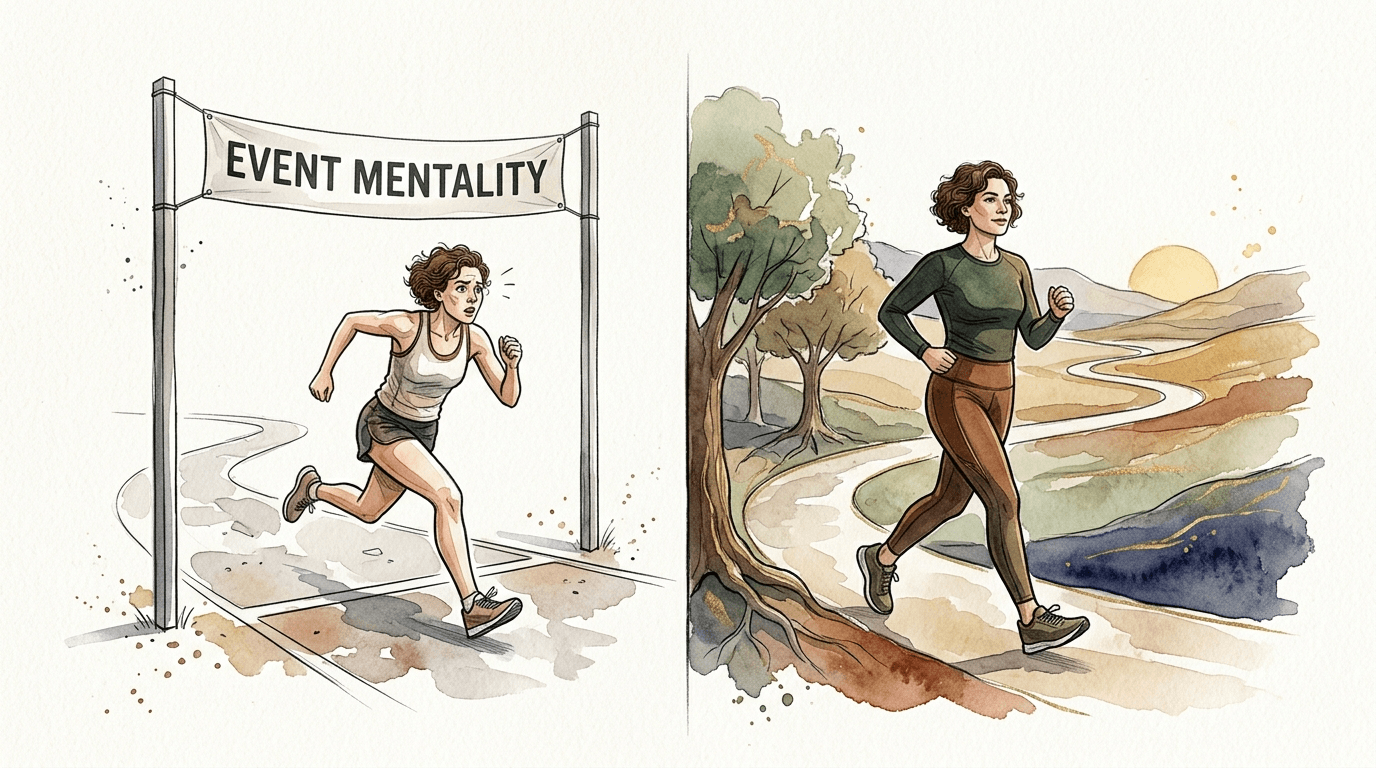
Stop dieting for a date and start living for a dynasty. If your weight loss goals have an expiration date, so will your progress. Building a legacy identity means every choice you make today is a brick in the home you will live in forever. You aren’t fixing a body; you’re building a lineage of health.
Most people approach weight loss like a sprint to a single finish line. They want to look good for a wedding, a vacation, or a high school reunion. This is the Event Mentality, and it is the primary reason why short-term success usually leads to long-term failure. When the event passes, the motivation evaporates.
Real transformation requires a shift in who you believe you are. It demands moving from a “temporary fix” to a Legacy Identity. This isn’t just about your waistline; it’s about the metabolic inheritance you leave for your children and grandchildren.
Why Destination Mindsets Fail In Weight Loss
The destination mindset is the belief that happiness and health exist only at a specific weight or date. It creates a psychological “cliff” that most people fall off once they reach their goal. Research shows that more than 80% of individuals who lose significant weight regain it within five years.
This happens because the brain views the diet as a prison sentence. You are doing the time just to get the reward at the end. Once the “sentence” is over, you return to the behaviors that created the problem in the first place. You aren’t changing your life; you are just holding your breath.
Destination mindsets also rely on extrinsic motivation. You are doing it for the photos, the comments, or the dress size. Extrinsic motivation is fragile. The moment you hit a plateau or life gets stressful, the external reward no longer feels worth the internal struggle.
Finally, this mindset ignores the physiological reality of weight loss. Your body doesn’t know you want to look good for a beach trip. It interprets rapid, event-based weight loss as a period of famine. It responds by slowing your metabolism and increasing hunger hormones, making maintenance nearly impossible once the event is over.
How to Shift to a Legacy Identity
Building a legacy identity requires you to stop asking “How do I lose 20 pounds?” and start asking “What would a healthy person do?” This is identity-based habit formation. Every action you take is a vote for the person you wish to become.
Start by defining your Core Values. Are you a person who values vitality? Are you a person who honors their commitments to themselves? When you align your eating and movement with these values, the “diet” stops feeling like a chore and starts feeling like an expression of your character.
Focus on Small Wins. You don’t need to overhaul your entire life in twenty-four hours. A legacy is built brick by brick. Choosing water over soda today isn’t just a calorie-saving move; it is a declaration that you are a person who prioritizes hydration and health.
Systems are more important than goals. A goal is a destination, but a system is a recurring process. If your system is “I walk for 30 minutes every morning,” you win every single day. You aren’t waiting for the scale to tell you if you succeeded; your consistency is the success.
The Generational Benefits of Legacy Health
The most profound benefit of a legacy identity is epigenetic impact. Recent science shows that your lifestyle choices can actually “turn on” or “turn off” certain genes. This means the way you eat and move today creates a biological blueprint that can be passed down to your children.
Studies in the field of epigenetics suggest that a parent’s metabolic health before and during pregnancy influences the child’s predisposition to obesity and diabetes. By choosing a legacy identity, you are literally giving your future lineage a head start on health. You are breaking cycles of chronic illness before they even begin.
Beyond biology, you are providing a Behavioral Roadmap. Children don’t do what you say; they do what you do. If they grow up in a home where movement is celebrated and whole foods are the norm, they won’t have to “learn” how to be healthy. It will be their default setting.
You also gain Metabolic Flexibility. Long-term, sustainable habits allow your body to maintain a stable weight without constant restriction. Your hormones balance out, your energy levels stabilize, and you move away from the “yo-yo” cycle that wreaks havoc on your internal systems.
Challenges and Common Pitfalls to Avoid
The biggest challenge to a legacy identity is the Cult of Instant Gratification. We live in a world of 24-hour delivery and “lose 10 pounds in 10 days” headlines. Staying focused on a twenty-year vision when everyone else is looking for a twenty-day fix is difficult.
Watch out for the All-or-Nothing Trap. People often think that if they “ruin” a meal, they’ve ruined the day. In a legacy mindset, one meal is just one data point in a lifetime of choices. You don’t burn down your house because a single brick is chipped.
Social pressure is another major hurdle. Friends and family might not understand why you aren’t “joining in” on the binge-eating or the sedentary lifestyle. They may feel threatened by your change because it shines a light on their own lack of progress.
Finally, avoid Comparisonitis. Your legacy is yours alone. Comparing your Chapter 1 to someone else’s Chapter 20 is a recipe for discouragement. Focus on being 1% better than you were yesterday, not on being better than the person on your social media feed.
Limitations and Realistic Constraints
While a legacy identity is the most effective way to manage health, it is not a magic wand. You must still account for Biological Baselines. Genetics do play a role in your starting point and your body’s natural shape. A legacy identity optimizes your unique biology; it doesn’t replace it.
Environmental limitations are real. If you live in a food desert or work three jobs, “perfect” health choices may not be available. In these cases, the legacy identity is about making the best possible choice within your constraints, rather than giving up entirely.
Medical conditions and medications can also influence weight loss and maintenance. Hormonal imbalances or thyroid issues require clinical intervention alongside mindset shifts. A legacy identity includes the wisdom to seek professional help when the “lifestyle” side of the equation isn’t enough.
Psychological trauma can also act as a barrier. If your relationship with food is rooted in deep-seated emotional pain, you may need therapy to address the root cause. Mindset shifts are powerful, but they work best when combined with a holistic approach to mental health.
Event Mentality vs. Legacy Identity
| Feature | Event Mentality | Legacy Identity |
|---|---|---|
| Primary Focus | Specific Date or Weight | Daily Values and Character |
| Motivation Type | Extrinsic (How I look) | Intrinsic (Who I am) |
| Duration | Temporary / Seasonal | Permanent / Lifelong |
| Impact | Surface Level (Self) | Generational (Lineage) |
| Flexibility | Rigid and Fragile | Adaptive and Resilient |
Practical Tips for Sustainable Success
Start by Auditng Your Environment. Your surroundings often dictate your behavior more than your willpower. Clear the “trigger foods” from your pantry and put your workout clothes where you can see them. Make the healthy choice the easy choice.
Practice Habit Stacking. Attach a new, healthy behavior to an existing one. If you already drink coffee every morning, use that time to write down one thing you are grateful for or to take your vitamins. This uses the brain’s existing neural pathways to build new ones.
Focus on Non-Scale Victories (NSVs). The scale is a lagging indicator of health. It doesn’t tell you about your improved sleep, your increased energy, or the fact that you can now play with your kids without getting winded. These victories are the real evidence of your identity shift.
Prioritize Protein and Fiber. From a nutritional standpoint, these two components are the “cheat codes” for satiety. They keep you full longer and help maintain muscle mass, which is the engine of your metabolism. Building a legacy body requires high-quality fuel.
Advanced Considerations for Serious Practitioners
If you want to go deeper, look into Circadian Alignment. Your body’s internal clock regulates everything from hunger hormones to fat storage. Eating your meals during daylight hours and prioritizing high-quality sleep can significantly amplify the results of your healthy habits.
Understand the role of Cortisol and Stress. You can have the “perfect” diet and exercise routine, but if you are chronically stressed, your body will cling to fat as a survival mechanism. Learning to manage your nervous system is just as important as learning to track your macros.
Consider the Microbiome Connection. The bacteria in your gut influence your cravings, your mood, and your metabolic efficiency. A legacy identity involves feeding your “good” bacteria with a wide variety of plant fibers and fermented foods to ensure your internal ecosystem is thriving.
Master the art of Psychological Anchoring. Create “triggers” that put you in a state of focus and discipline. This could be a specific song you play before a workout or a ritual you perform before sitting down to eat. These anchors help you maintain your identity even when your motivation is low.
Real-World Scenarios: The Bride vs. The Matriarch
Imagine Sarah, who is getting married in four months. She goes on a 1,200-calorie “shred” diet and spends two hours a day in the gym. She loses the weight, fits into the dress, and looks great in the photos. But on the honeymoon, she stops exercising and starts eating “normally.” Within six months, she has gained back all the weight plus an extra five pounds. This is the Event Mentality.
Now imagine Maria, who decides she wants to be a “Matriarch of Health.” She starts by walking twenty minutes a day and adding a vegetable to every dinner. She doesn’t have a “deadline.” Over two years, she slowly loses 40 pounds. More importantly, she teaches her daughter how to cook healthy meals and makes weekend hikes a family tradition. Her weight stays stable because her life has changed, not just her diet. This is the Legacy Identity.
Maria’s approach didn’t just change her body; it changed the trajectory of her entire family. She isn’t worried about “regaining” the weight because there is no “old self” to go back to. She has become a new person entirely.
Final Thoughts
Building a legacy identity is the ultimate act of self-love and family service. It moves the focus away from the mirror and onto the future. When you realize that your choices are the “bricks” in the home your descendants will live in, the temptation of the quick fix fades away.
Stop looking for a finish line that doesn’t exist. Embrace the process of becoming the person you were meant to be. This is a journey with no expiration date because health is not a destination; it is a way of walking through the world.
Start today by making one choice that your future self—and your future children—will thank you for. Whether it is a long walk, a nutritious meal, or a commitment to better sleep, every brick counts. You are building a dynasty. Make it a strong one.
Sources
1 tryshed.com | 2 forbes.com | 3 nih.gov | 4 bethanyworks.com | 5 stressmanagementclinic.com | 6 ornish.com | 7 physoc.org | 8 mindfuleating.org.uk | 9 rowlandspharmacy.co.uk | 10 justinthomasmiller.com | 11 maxapress.com | 12 nexofit.com | 13 tandfonline.com | 14 nih.gov | 15 realappeal.com | 16 forgept.com