


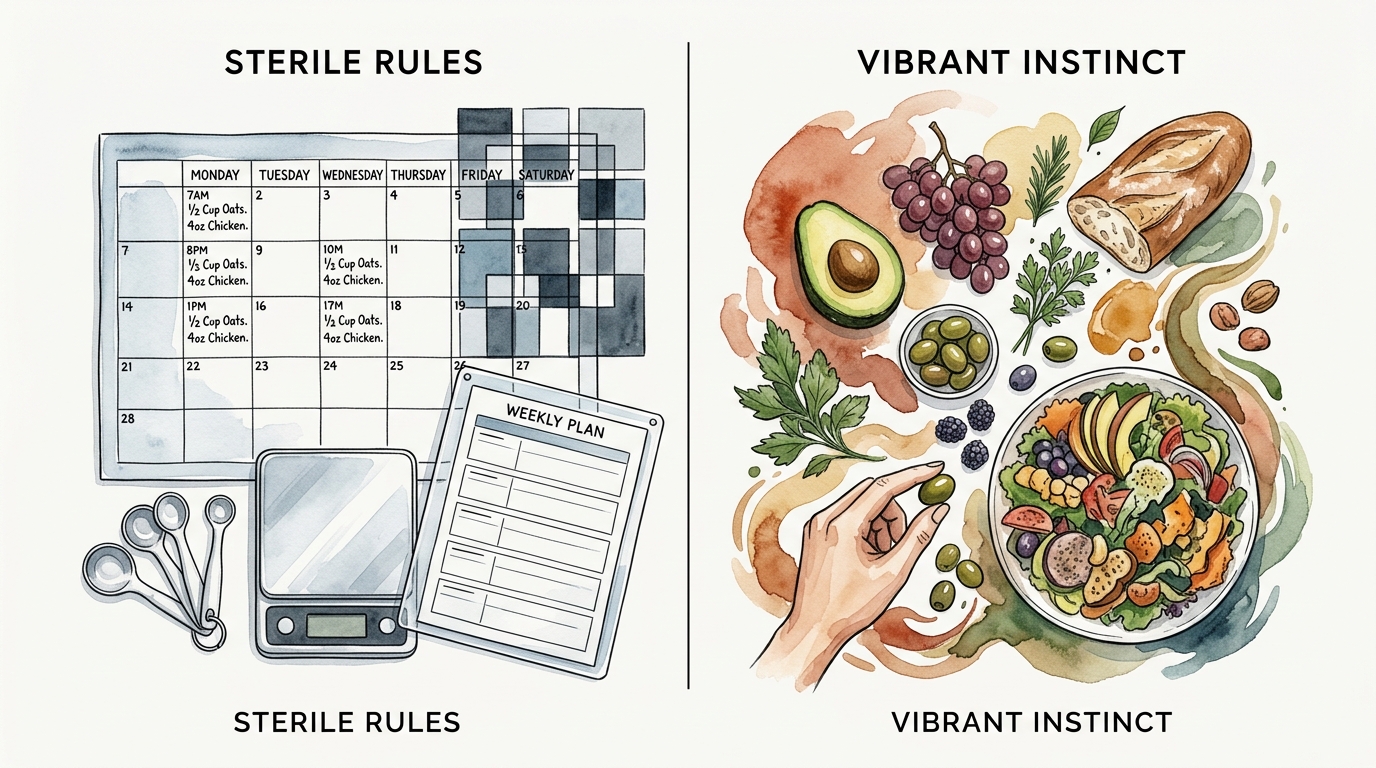
Why are you following a dead schedule when your body is a living, breathing system? A rigid meal plan is a static document trying to control a dynamic organism. Your body changes every day based on sleep, stress, and movement. Stop trying to fit your life into a dead spreadsheet and start listening to the living signals your body is sending you right now.
The human body is not a machine that performs identically every 24 hours. It is a complex, adaptive ecosystem that reacts to every environment, emotion, and hour of rest. Relying on a fixed paper plan is like using a map from 1950 to navigate a city that is being rebuilt in real-time. It ignores the nuance of your internal chemistry.
True health comes from shifting away from sterile rules and moving toward vibrant instinct. This article explores why the “perfect” meal plan usually ends in frustration and how you can reclaim your natural ability to fuel yourself with precision and ease.
Why Meal Plans Fail Long Term
Meal plans fail because they are built for a version of you that doesn’t actually exist—the “perfect” version who never gets stuck in traffic, never has a stressful meeting, and always gets eight hours of sleep. These plans are external scripts that outsource your decision-making to a piece of paper. When life deviates from the script, the plan collapses.
Psychological research highlights a phenomenon known as “restraint theory.” When you follow rigid rules, you often lose touch with internal hunger and fullness cues. This creates a psychological environment where one small “slip” leads to the “what the hell effect,” where a person gives up entirely and overindulges because they broke the rules.
Most meal plans are designed for short-term compliance rather than long-term skill building. They tell you what to eat, but they never teach you how to adjust when the kitchen is empty or when you are traveling. This lack of adaptability is the primary reason why up to 95% of traditional diets fail over a multi-year period.
The Biology of the Living System: Why Needs Shift Daily
Your nutritional requirements are moving targets. They are influenced by a cascade of hormones that respond to your lifestyle. A static meal plan cannot account for these biological fluctuations, leading to a constant battle between your willpower and your chemistry.
The Impact of Sleep Deprivation
Sleep is the silent architect of your appetite. Research shows that sleeping less than seven hours a night can increase levels of ghrelin, the hormone that signals hunger, and decrease levels of leptin, the hormone that signals fullness. A single night of poor sleep can leave you feeling significantly hungrier the next day, regardless of what your meal plan says you “should” eat.
The Role of Cortisol and Stress
Chronic stress elevates cortisol, which has a direct impact on your cravings and glucose management. High cortisol levels often drive a desire for “energy-dense” comfort foods—those high in fat and sugar. If your meal plan prescribes grilled chicken and steamed broccoli during a high-stress week, you are fighting a biological urge for survival energy that is hard-coded into your DNA.
Movement and Metabolic Flex
Activity levels vary. Some days you might hit 15,000 steps and a heavy gym session; other days you might be glued to a desk. Your body’s demand for carbohydrates and total energy scales with this movement. A rigid plan that provides the same calories every day will leave you under-fueled on active days and potentially over-fueled on sedentary ones.
Interoception: The Secret Sense of Vibrant Instinct
Interoception is often called the “eighth sense.” It is your ability to perceive the internal state of your body, including hunger, thirst, heart rate, and even the need to use the bathroom. People with high interoceptive awareness are naturally better at self-regulating their food intake because they “hear” their body’s signals more clearly.
Traditional dieting often silences this sense. By following external rules, you learn to ignore a growling stomach or a feeling of stuffed discomfort. Reclaiming this instinct is the key to sustainable health. It allows you to move from “sterile rules”—where you eat because the clock says so—to “vibrant instinct,” where you eat because your system requires fuel.
Improving this awareness requires a shift in focus. Instead of looking at a tracking app, you look inward. You start asking: “What does my body actually need right now?” This isn’t just about “eating whatever you want”; it is about sophisticated self-calibration.
How to Transition: From Macros to Intuitive Awareness
Moving away from a rigid plan doesn’t mean you stop caring about nutrition. It means you change the source of the data. Use these steps to bridge the gap between tracking everything and trusting yourself.
- Phase 1: The Awareness Week. Keep eating what you usually do, but stop tracking numbers. Instead, journal how you feel before and after each meal. Are you actually hungry? Do you feel energized or sluggish an hour later?
- Phase 2: Introduce “Gentle Nutrition.” Start making choices based on how food makes you feel. If you notice that a high-sugar breakfast leads to a mid-morning crash, use that data to choose a high-protein option next time. This is instinct fueled by experience.
- Phase 3: The Hunger-Fullness Scale. Use a scale of 1 to 10. Aim to start eating when you are at a 3 (hungry but not starving) and stop when you are at a 7 (satisfied but not stuffed).
- Phase 4: Remove Moral Labels. Stop calling foods “good” or “bad.” Labeling a food as “bad” only increases its psychological power over you. See food as fuel with different levels of density and nutrient value.
This process takes time. If you have spent years following strict plans, your internal compass might be slightly “rusty.” Patience is required as your brain and body relearn how to communicate.
Benefits of the Adaptive Approach
Choosing an adaptive, instinct-based approach offers measurable advantages over the spreadsheet-led life. It creates a level of resilience that a rigid plan simply cannot match.
- Reduced Stress: You no longer have to worry about “ruining” your day with one unplanned snack. The plan is the response, not the rule.
- Better Social Health: You can enjoy dinner with friends or a slice of cake at a birthday without the crushing weight of guilt.
- Improved Metabolism: By eating in response to hunger and stopping at fullness, you avoid the chronic over-restriction that can lead to metabolic slowdown.
- Long-Term Sustainability: Because this approach fits your life rather than forcing your life to fit it, you can maintain it for decades, not just weeks.
Challenges and Common Mistakes
The transition from rules to instinct is rarely a straight line. Many people fall into common traps that make them believe they “can’t” eat intuitively.
Treating Intuitive Eating as the “Hunger-Fullness Diet.” This happens when you turn internal cues into another rigid rule. If you feel guilty for eating when you aren’t perfectly hungry, you are still stuck in a diet mindset. True instinct allows for eating for pleasure, social connection, and convenience occasionally.
Ignoring Nutrition Completely. Some people think “no rules” means “only junk food.” This is a misunderstanding. Your body has a vibrant instinct for health. If you truly listen, your body doesn’t want to feel sluggish from processed sugar all day. It wants energy, fiber, and vitality.
Expecting Immediate Weight Loss. Intuitive eating is about healing your relationship with food. Your weight might go up, down, or stay the same as your body finds its natural set point. Focusing on the scale during this transition can trigger the very restrictive behaviors you are trying to escape.
Limitations: When a Plan Might Actually Help
Vibrant instinct is the goal, but there are specific situations where a more structured approach serves as a necessary scaffold. Recognizing these exceptions builds credibility and ensures safety.
Medical conditions like Type 1 Diabetes require precise carbohydrate counting to manage insulin dosages. In these cases, “rules” are life-saving tools. Similarly, elite athletes preparing for a specific weight-class competition (like wrestling or bodybuilding) often need temporary, high-level precision to meet extreme performance demands.
Severe disordered eating history can also make initial intuitive cues unreliable. If the “hunger signal” has been broken by years of restriction or binge cycles, a person might need a “recovery plan” to normalize eating patterns before they can trust their internal signals again.
Comparing Sterile Rules vs. Vibrant Instinct
Understanding the fundamental differences helps you decide which path aligns with your long-term goals.
| Feature | Sterile Rules (Rigid Plans) | Vibrant Instinct (Adaptive) |
|---|---|---|
| Primary Guide | External Spreadsheet / App | Internal Biofeedback |
| Flexibility | Low (All-or-Nothing) | High (Fluid / Responsive) |
| Mental Load | High (Constant Math) | Moderate (Mindful Check-ins) |
| Sustainability | Short-Term (3-6 months) | Long-Term (Lifetime) |
| Focus | Compliance & Numbers | Sensation & Performance |
Practical Tips for Daily Calibration
Applying these concepts doesn’t have to be complicated. Start with small, immediate adjustments to your daily routine to sharpen your internal awareness.
Practice Mindful Bites. For the first three bites of every meal, put down your fork. Notice the texture, the smell, and the flavor. This small act of presence “wakes up” your satiety hormones.
Check Your “Real” Hunger. Before eating, ask if you are physically hungry or emotionally “empty.” If you are stressed or bored, food will not fix the problem. If you are physically hungry, your stomach will feel empty or your energy will dip.
Use the “One-Hour Check-In.” Set a timer for 60 minutes after you eat. Rate your energy. If you feel like taking a nap, your meal might have been too heavy in processed carbs or too large in volume. Use this as a data point for your next choice.
Advanced Considerations: Biofeedback and Scaling
For those who want to take their health to the next level, combining instinct with data can be powerful. This is “Informed Intuition.” You use tools to gather data, but you let your body make the final call.
Wearable technology that tracks HRV (Heart Rate Variability) and sleep quality can provide a “readout” of your recovery. If your HRV is low, your body is in a stressed state. On these days, an advanced practitioner might intuitively increase their intake of magnesium-rich foods and complex carbohydrates to support the nervous system.
Continuous Glucose Monitors (CGMs) are another tool used by serious practitioners. Instead of following a “low carb” rule, they see exactly how their body reacts to a sweet potato versus white rice. This data informs their instinct, allowing them to choose the fuels that provide the smoothest energy curve for their unique biology.
Real-World Scenario: The Office vs. The Weekend
Imagine Sarah, who follows a rigid 1,800-calorie meal plan. On Wednesday, she has a high-stress presentation. She gets five hours of sleep. Her cortisol is through the roof. Her plan says “Salad with 4oz Chicken.” Her body is screaming for fast energy to survive the stress. She eats the salad, feels miserable, and then binges on chocolate at 9:00 PM because she felt “deprived.”
Now imagine Sarah using vibrant instinct. She wakes up tired and stressed. She recognizes her ghrelin is high. She adds an extra serving of oats to her breakfast for sustained energy. At lunch, she chooses a warm, satisfying bowl of quinoa and roasted vegetables instead of a cold salad because it feels more “grounding.” She honors her hunger throughout the day and finishes with a small piece of dark chocolate that she actually enjoys. She ends the day feeling balanced, not broken.
Final Thoughts
The transition from a dead schedule to a living system is the most important health journey you will ever take. It requires moving from a place of “borrowed control” to a place of “internal mastery.” A rigid plan might give you the illusion of safety, but it is a fragile safety that breaks at the first sign of life’s chaos.
Embrace the messiness of being a biological organism. Learn to read the signals of sleep, stress, and movement. Trust that your body actually wants to feel good, and it will guide you toward the foods that make that happen if you stop shouting over its whispers with loud, external rules.
Start today by simply noticing. Put down the spreadsheet for one meal and listen to the living system that has been trying to talk to you all along. Your instinct is more powerful than any app ever written. Experiment with this freedom and watch how your health transforms from a chore into a lifestyle.
Sources
1 yourhealthmagazine.net | 2 triagemethod.com | 3 allhealthnutrition.ca | 4 fitchef.com | 5 24hourfitness.com | 6 centralathlete.com | 7 easenutritiontherapy.com | 8 streetsmartnutrition.com | 9 myweightwhattoknow.com | 10 marisasherry.com | 11 kyrawilliamsfitness.com | 12 anupamamenon.com | 13 katelymannutrition.com | 14 ucsf.edu | 15 menopausenutritionist.ca | 16 nutritionbycarrie.com | 17 psychologytoday.com | 18 ucsd.edu