


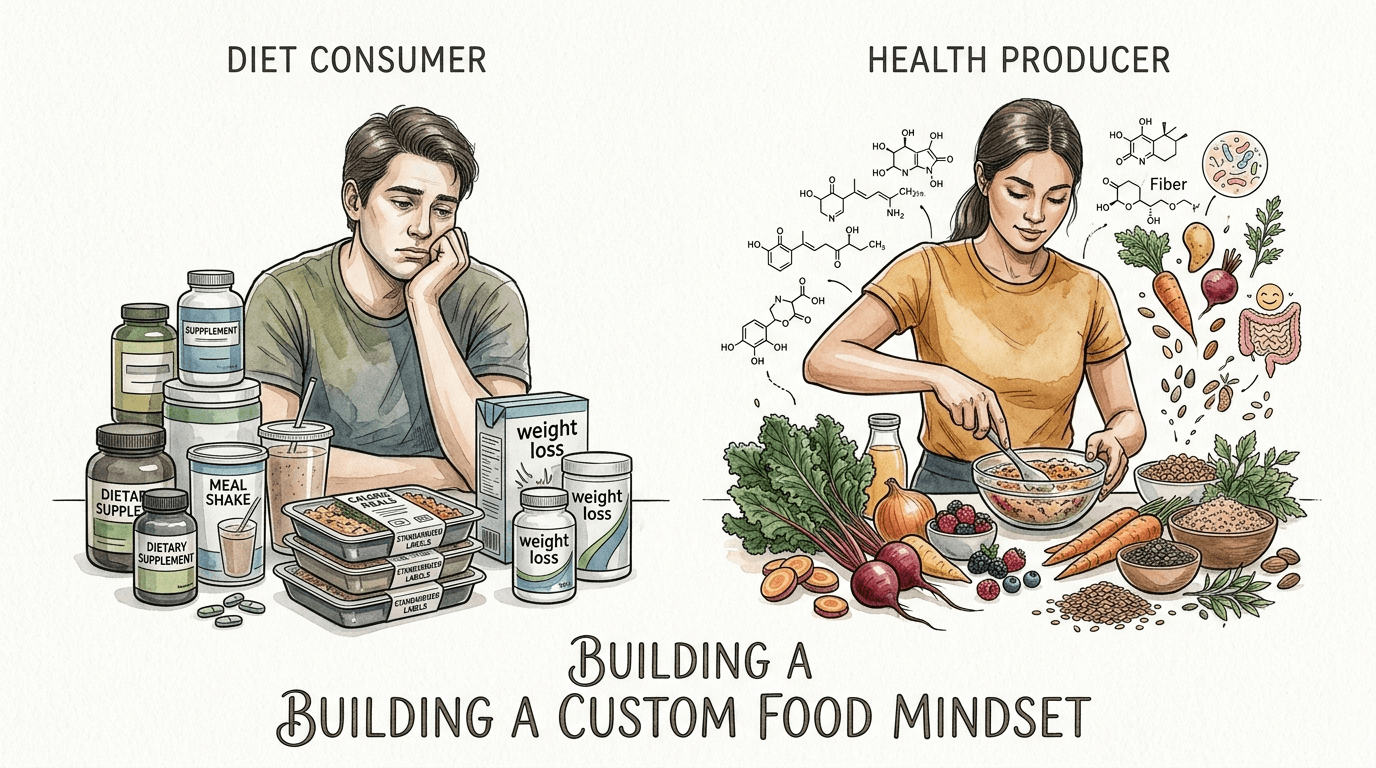
Stop buying their solutions and start building your own. The diet industry profits from your confusion. They want you to remain a permanent consumer of their ‘next big thing.’ It’s time to step into the role of Producer—the architect of your own health philosophy based on your own body’s evidence.
Most people approach nutrition like a software update they didn’t ask for. They download a set of rigid rules, try to force their life to fit the code, and then crash when the system inevitably fails. This cycle isn’t your fault; it is the natural result of being a Diet Consumer. A consumer waits for the next influencer or book to tell them what to eat, while a Health Producer looks at their own biological data to decide what works.
In this guide, we are moving beyond the surface level of calorie counting. We are diving into how you can build a custom food mindset that treats your body as a laboratory rather than a temple you are constantly desecrating. You will learn to identify your unique bio-individual needs and create a sustainable system that evolves as you do.
Building A Custom Food Mindset
A custom food mindset is the psychological and practical framework you use to make nutritional decisions based on internal feedback rather than external commands. It is the shift from asking “Is this food allowed?” to “How does this food impact my energy, focus, and long-term health?” Research shows that personalized nutrition is significantly more effective than generic approaches because human biology is not a monolith.
This concept exists because the traditional “one-size-fits-all” model ignores the reality of bio-individuality. For example, two people can eat the exact same banana and have completely different blood sugar responses. One person might experience a steady energy release, while another might see a massive glucose spike followed by a crash that triggers intense cravings.
In the real world, a custom food mindset is used by high-performers, athletes, and anyone who has realized that standard dietary guidelines are often based on “the average person,” who statistically does not exist. It is an iterative process of self-experimentation. Think of it like tuning a high-performance engine; you don’t just put in any fuel and hope for the best. You test, observe the exhaust, check the temperature, and adjust the mixture.
How to Build Your Custom Food System Step-by-Step
Building your own system requires a move from passive consumption to active production. You are no longer just eating; you are gathering data points.
Step 1: Establish Your Baseline
Before you can change anything, you must know where you are starting. This involves a period of honest, “judgment-free” observation. For 7 to 10 days, record everything you consume without trying to restrict or improve it. Note your energy levels 60 minutes after eating and your hunger levels before your next meal.
Step 2: Identify Your Biological Cues
Your body is constantly sending signals, but the diet industry has taught you to ignore them. Focus on three primary indicators:
- Satiety: Does this meal keep you full for 3–5 hours, or are you looking for a snack 45 minutes later?
- Cognitive Clarity: Do you feel sharp after lunch, or do you experience the “afternoon slump”?
- Digestive Comfort: Is there bloating, lethargy, or discomfort?
Step 3: Run N=1 Experiments
An “N=1” experiment is a study with a sample size of one: you. Pick one variable to change at a time. For example, try increasing your protein intake at breakfast for five days. Observe the results. If your mid-morning focus improves and your cravings at night decrease, you have produced a piece of evidence for your personal blueprint.
Step 4: Use Objective Data Tools
While subjective feelings are vital, objective data can accelerate the process. Tools like Continuous Glucose Monitors (CGMs), wearable sleep trackers, or even simple kitchen scales provide the “raw numbers” that remove the guesswork. These tools help you see exactly how a “healthy” meal might be affecting your specific metabolic health.
Benefits of the Health Producer Approach
Transitioning to a Producer mindset offers more than just physical changes. It provides a level of psychological freedom that “dieting” can never achieve.
Metabolic Flexibility
When you build a custom mindset, you often discover how to achieve metabolic flexibility—the body’s ability to switch efficiently between burning carbs and burning fat. This leads to steadier energy throughout the day and eliminates the “hangry” episodes that lead to poor decision-making.
Reduced Decision Fatigue
The average person makes over 200 food-related decisions every day. A custom system creates a “template” that automates the easy choices. You aren’t “deciding” what to eat for lunch; you are executing a proven plan that you know makes you feel good. This saves your mental energy for more important tasks.
Long-Term Sustainability
Diets fail because they are temporary. A custom mindset is a living document. It accounts for the fact that your needs at age 25 are different from your needs at age 45, or that your body requires different inputs during a high-stress work week compared to a relaxing vacation.
Challenges and Common Mistakes
The path to becoming a Health Producer is not without its traps. Most people fail here because they fall back into “Consumer” habits.
Eyeballing and Underestimation
One of the most frequent errors is guessing portion sizes. Studies show that even trained nutritionists often underestimate their caloric intake when they don’t weigh their food. “A handful of nuts” can range from 150 to 450 calories depending on the size of the hand. In the beginning, precision is necessary to build an accurate mental map.
Relying on Generic Databases
Many tracking apps use user-generated data that is rife with errors. Logging “Chicken Stir Fry – 1 Bowl” is useless because the oil, sugar in the sauce, and portion of protein vary wildly between kitchens. Producers look for verified entries or log raw ingredients to ensure the data is “clean.”
The “Good vs. Bad” Trap
Producers avoid moralizing food. Labeling a cookie as “bad” or “a sin” triggers a psychological shame response that often leads to binging. Instead, a Producer views the cookie as a “high-glucose, low-satiety input.” This clinical view allows you to decide if the enjoyment of the cookie is worth the potential energy dip later, without the emotional baggage.
Limitations and Practical Boundaries
While a custom mindset is powerful, it is not a replacement for medical science or professional intervention in certain scenarios.
Environmental Constraints
Your biology doesn’t exist in a vacuum. Food deserts, high-stress jobs, and social obligations are real boundaries. You might know that a specific home-cooked meal is your “optimal” fuel, but if you are traveling for work, your system must have “Plan B” and “Plan C” options that are “good enough” rather than perfect.
Medical Oversight
If you have a diagnosed metabolic disorder, such as Type 2 Diabetes or PCOS, your “experiments” should be conducted in partnership with a healthcare professional. Biological feedback is essential, but it must be interpreted within the context of your clinical pathology.
Cost and Accessibility
The “ideal” custom setup often involves expensive wearables, high-quality proteins, and time for food prep. It is important to recognize these trade-offs. A Producer doesn’t complain about the lack of a CGM; they use the tools they *can* afford, like a $5 notebook and a $15 kitchen scale, to get 80% of the results.
Diet Consumer vs. Health Producer
The following table highlights the fundamental differences in how these two archetypes approach their health.
| Feature | Diet Consumer | Health Producer |
|---|---|---|
| Source of Truth | Influencers, Books, Fads | Personal Data & Bio-feedback |
| Primary Goal | Weight loss at any cost | Optimized function & Longevity |
| Reaction to Failure | Guilt and quitting | Curiosity and adjustment |
| Time Horizon | Short-term (30-day “fix”) | Lifetime (evolving system) |
| Level of Effort | Passive (follow the rules) | Active (design the rules) |
Practical Tips for Immediate Application
You don’t need a PhD to start producing your own health data. Start with these high-leverage adjustments today.
- Log BEFORE you eat: Deciding what to eat while you are already hungry is a recipe for failure. Enter your meal into your tracker 15 minutes before you take the first bite. This allows you to see the nutritional impact and adjust the portion *before* it’s in your stomach.
- The “Protein First” Rule: For most people, starting a meal with protein and fiber significantly blunts the glucose response. Try eating your steak and greens before you touch the potato. Observe if your post-meal “brain fog” disappears.
- Scan, don’t search: Use the barcode scanner on your tracking app. This pulls the exact manufacturer data rather than a generic (and often wrong) user entry.
- Track your “non-scale” victories: Your weight might fluctuate due to water retention or muscle gain. Track your sleep quality, skin clarity, and mood as secondary metrics. These are often better indicators of a “winning” food mindset than the scale.
Advanced Considerations: Epigenetics and Chronobiology
Serious practitioners eventually look beyond “what” to eat and focus on “when” and “how” those inputs interact with their DNA.
Nutrigenomics
The field of nutrigenomics studies how nutrients influence gene expression. For instance, individuals with specific variants of the MTHFR gene may have difficulty processing standard folic acid and need specific forms of folate from leafy greens. Others with the CYP1A2 gene variant might be “slow metabolizers” of caffeine, meaning that afternoon cup of coffee is ruining their sleep more than they realize.
Chronobiology and Meal Timing
Your body follows a circadian rhythm that dictates when it is most efficient at processing certain nutrients. Insulin sensitivity is typically higher in the morning and decreases as the day goes on. For a Health Producer, this might mean “front-loading” carbohydrates during the day when the body can handle them and focusing on fats and proteins in the evening to maintain stable blood sugar through the night.
Scenario: The Professional Performance Blueprint
Consider “Sarah,” a 35-year-old marketing executive. For years, she was a Diet Consumer, jumping from Keto to Intermittent Fasting. She lost weight but felt exhausted and irritable.
As a Health Producer, Sarah started a 14-day tracking loop. She discovered that fasting until noon caused her cortisol to spike, leading to a massive “crash” and sugar cravings by 4:00 PM. She experimented by adding a high-protein breakfast (30g of protein) at 8:00 AM.
The result? Her afternoon cravings vanished. She also used a sleep tracker and noticed that drinking wine with dinner destroyed her “Deep Sleep” scores, which correlated with her making poor food choices the following day. By identifying these patterns, Sarah didn’t just “go on a diet.” She built a Performance Blueprint that allowed her to stay lean and sharp without the willpower struggle.
Final Thoughts
Transitioning from a Diet Consumer to a Health Producer is the ultimate act of self-reliance. It requires you to stop looking for a “hero” in a white coat or on a social media feed and start trusting the evidence provided by your own biology. This process is not about perfection; it is about informed iteration.
The diet industry thrives on the fact that most people are afraid to fail. But for a Producer, a “failed” experiment is just a data point that narrows the search for what works. Every time you realize a certain food makes you feel sluggish, you haven’t “messed up”—you’ve gained a piece of the puzzle.
Start small. Pick one meal this week to measure and observe. Build your system one data point at a time. The goal is to reach a place where you no longer “need” a diet because you have a deep, intuitive, and data-backed understanding of what it takes for you to thrive. Turn off the noise, open your journal, and start building.
Sources
1 dietpulse.app | 2 sfginc.com | 3 thepridenz.com | 4 abhifit.com | 5 starkelnutrition.com | 6 nih.gov | 7 lifevantage.com | 8 ebsco.com | 9 precisionnutrition.com