


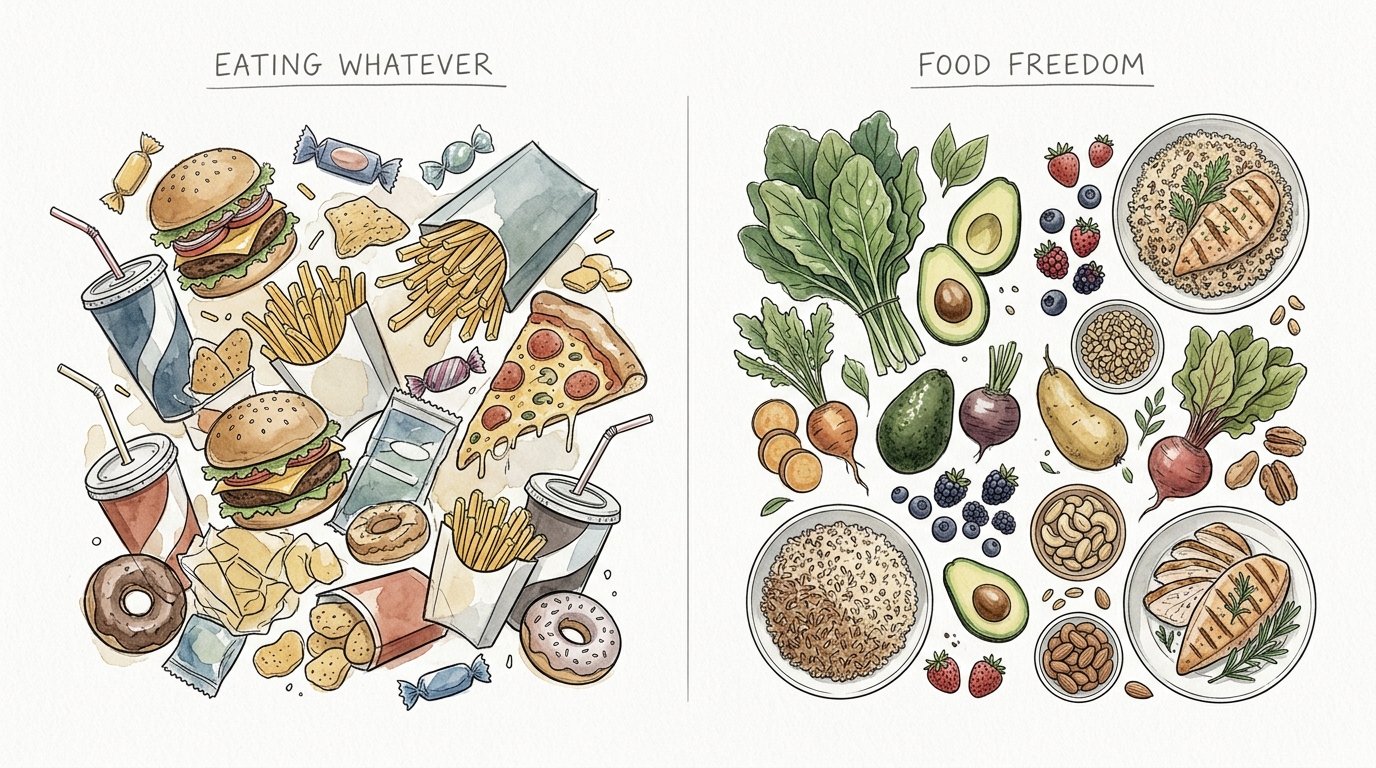
Food freedom isn’t the absence of structure; it’s the presence of professional-level self-awareness. True Food Freedom isn’t just ‘eating whatever you want’—that’s just a recipe for returning to the habits that made you miserable. The ‘Pro’ level is sophisticated self-regulation. It’s the ability to navigate a buffet with the precision of a surgeon, choosing exactly what serves your joy and your health without the drama of ‘forbidden’ foods.
Most people mistake impulsivity for freedom. They think that grabbing a donut because it’s there is an act of liberation. In reality, that is often just a reaction to an external cue or an emotional trigger. Real freedom is having the internal data to decide if that donut actually serves you in the moment.
This guide will walk you through the transition from “Amateur Freedom” to “Pro Regulation.” You will learn how to rebuild the connection between your brain and your body. This isn’t a diet; it’s a high-performance system for living.
The Difference Between Eating Whatever And Food Freedom
Amateur freedom is reactive. It happens when you stop dieting but haven’t yet learned how to listen to your body. You might find yourself eating everything in sight because you finally “can,” only to end up feeling sluggish and frustrated. This phase is often called the “pendulum swing,” where you move from extreme restriction to extreme indulgence.
Pro-level food freedom is proactive. It is rooted in what scientists call interoceptive awareness, or the ability to sense what is happening inside your body. Instead of following a list of “good” or “bad” foods, you follow a sophisticated internal feedback loop. You eat because you are hungry, you choose foods that provide both pleasure and nourishment, and you stop when you are satisfied.
Think of it like driving a high-end sports car. An amateur just slams on the gas and the brakes, hoping for the best. A pro understands the mechanics of the engine, feels the grip of the tires, and adjusts their speed with total precision. They aren’t restricted by the car; they are empowered by their mastery of it.
Real-world food freedom means you can walk into a party, see a spread of appetizers, and feel zero anxiety. You don’t need a “cheat day” because no food is off-limits. You simply check in with your hunger, your energy levels, and your goals before making a choice.
The Mechanics of Pro-Level Regulation
Transitioning to this level requires shifting from an “open-loop” system to a “closed-loop” system. In an open-loop system, you follow external rules like “no carbs after 6 PM.” These rules ignore how your body actually feels. In a closed-loop system, your choices are based on the constant feedback your body provides.
The first step is identifying biological hunger versus hedonic hunger. Biological hunger is a homeostatic need for calories, often felt as a growling stomach or a dip in energy. Hedonic hunger is the desire for pleasure, triggered by the sight, smell, or thought of highly palatable foods. Pros acknowledge both but prioritize the body’s actual needs.
Using a hunger and fullness scale is a classic tool for this process. Imagine a scale from 1 to 10, where 1 is painfully hungry and 10 is painfully full. The goal is to start eating around a 3 or 4 and stop around a 6 or 7. This prevents the “primal hunger” that leads to overeating later.
Developing interoceptive sensitivity takes time. You have to learn to “hear” the quiet signals of your body over the loud noise of the modern food environment. This means slowing down, removing distractions while eating, and actually tasting your food. It sounds simple, but it is a foundational skill of the pro-level eater.
The Benefits of Sophisticated Self-Regulation
The most immediate benefit is the end of “food noise.” When you stop telling yourself you can’t have something, the obsession with that food eventually fades. You no longer spend your entire afternoon thinking about the cookies in the breakroom. Your brain is freed up to focus on things that actually matter.
Metabolic health often improves naturally when you stop the cycle of restriction and binging. Constant dieting can disrupt your hormones, especially those responsible for hunger and satiety like ghrelin and leptin. By eating consistently and honoring your body’s signals, you help these systems return to their natural baseline.
Emotional resilience is another major advantage. Many people use food to cope with stress, boredom, or sadness. Pro-level regulation helps you identify these emotional triggers without judgment. You learn to ask, “Am I hungry, or am I just looking for a distraction?” This awareness allows you to find better ways to meet your emotional needs.
Sustainability is the ultimate win. Diets fail because they are temporary and grueling. Food freedom is a lifelong practice that evolves with you. It works whether you are at home, traveling, or celebrating a holiday. You never have to “start over” on Monday because you never left the path.
Challenges and Common Pitfalls
The most common trap is “Pseudo-Permission.” This is when you tell yourself you can eat anything, but in the back of your mind, you are still judging yourself. If you feel guilty after eating a slice of pizza, you haven’t actually given yourself permission. That lingering guilt will almost always trigger a “Last Supper” binge later.
The “Last Supper Effect” is a psychological phenomenon where you overeat because you think a period of restriction is coming. Even just the *thought* of starting a diet on Monday can cause you to binge on Sunday night. Your brain enters a “scarcity mindset” and tries to get as much fuel as possible before the “famine” starts.
Another mistake is turning food freedom into “The Hunger-Fullness Diet.” This happens when you start using hunger and fullness cues as rigid rules. If you eat when you aren’t perfectly hungry and then feel like you “failed,” you’ve just created another diet. Pro-level regulation allows for flexibility; sometimes we eat for social reasons or pure pleasure, and that is okay.
Social pressure can also be a massive hurdle. Friends and family might comment on your plate or try to push “cheat meals” on you. Without a strong internal compass, it is easy to fall back into old patterns. Staying “Pro” means trusting your own body more than the opinions of others.
Limitations and Realistic Constraints
Food freedom isn’t a magic wand that works perfectly for everyone immediately. Some medical conditions, like certain eating disorders or metabolic diseases, require more structured clinical support. If your internal hunger signals have been severely disrupted, you may need a phase of “mechanical eating” before you can trust your intuition.
Neurodivergent individuals, specifically those with ADHD or Autism, may struggle with interoception. They might not feel hunger until they are at a point of physical collapse, or they might struggle to sense when they are full. In these cases, using some external structure—like scheduled meals—is actually a pro-level strategy for self-care.
The modern food environment is also a legitimate constraint. We live in an “obesogenic” world designed to bypass our fullness signals with ultra-processed foods. These foods are engineered to be hyper-palatable, making it harder to hear your body’s “stop” signal. Recognizing this isn’t an excuse; it’s a tactical observation that helps you navigate the grocery store more wisely.
Financial and environmental factors play a role as well. Not everyone has easy access to a variety of fresh, whole foods that make sensing satiety easier. True food freedom means doing the best you can within your current circumstances, without the added burden of perfectionism.
Amateur Freedom vs. Pro Regulation
| Feature | Amateur Freedom | Pro Regulation |
|---|---|---|
| Decision Making | Impulsive and reactive. | Intentional and data-driven. |
| Internal Cues | Ignored or drowned out. | Highly sensitive and prioritized. |
| Food Labels | Moralized (Good/Bad). | Neutralized (Fuel/Experience). |
| After-Meal Feeling | Guilt or physical discomfort. | Satisfaction and stable energy. |
| Structure | Chaotic or nonexistent. | Sophisticated and supportive. |
Practical Tips for Sophisticated Eating
Start by auditing your environment. A pro knows that willpower is a finite resource. Keep highly tempting, low-satiety foods out of your immediate sightline at home. This isn’t about restriction; it’s about making the choice that serves your future self easier to make.
Use the “10-Minute Rule” for cravings. If you feel an intense urge to eat something but you know you aren’t physically hungry, wait 10 minutes. Engage in a different activity, like drinking water or taking a quick walk. If the craving is still there, eat it mindfully, but often the impulse will pass once the brain is distracted.
Prioritize “Protein Leverage” to help your satiety signals work better. Research shows that our bodies have a strong drive to consume a certain amount of protein. If you start your meal with a solid protein source, your brain will likely receive the “I’m full” signal much sooner. This makes self-regulation feel effortless rather than forced.
Hydrate before you evaluate. Dehydration often masks itself as hunger. Drinking a glass of water before a meal can help you clear the noise and get a more accurate reading of your actual hunger levels. This is a simple, high-ROI habit for any pro-level eater.
Advanced Considerations in Neurobiology
The prefrontal cortex is the “CEO” of your brain, responsible for executive function and impulse control. Chronic stress and lack of sleep physically weaken this part of the brain. When your CEO is tired, the “reward center” (the striatum) takes over, making you more susceptible to hedonic eating.
Dopamine plays a dual role in this process. It is the chemical of “more,” driving you to seek out food rewards. However, overstimulating your reward system with ultra-processed foods can lead to “downregulation,” where you need more and more food to feel the same level of pleasure. Professionals understand this and aim for a “dopamine baseline” that allows them to enjoy simple foods.
The role of the vagus nerve cannot be overstated. This nerve is the primary highway for signals traveling from your gut to your brain. High-fiber foods and mindful breathing can improve “vagal tone,” making those fullness signals clearer and faster. Improving this physical connection is a key part of advanced self-regulation.
Ultimately, you are training your nervous system. Every time you pause, check in, and make a conscious choice, you are strengthening the neural pathways for regulation. It is a form of neuroplasticity. You are literally rewiring your brain to be free.
Real-World Scenarios
Imagine you are at a holiday dinner. The table is loaded with high-calorie favorites. An amateur either tries to “white-knuckle” it and eat nothing (only to binge later) or eats everything until they are sick. A pro surveys the options, picks the items they truly love, and eats them slowly, stopping when they feel comfortably full.
Consider a high-stress day at the office. You are tired, frustrated, and there’s a box of donuts in the breakroom. An amateur grabs three donuts without thinking because they “need” the sugar. A pro recognizes the stress, acknowledges the desire for the donut, but decides to have a high-protein lunch first to stabilize their blood sugar before deciding if the donut is actually worth it.
Think about a late-night craving while watching TV. The impulse is to finish a whole bag of chips. A pro-level response is to put a serving of chips in a bowl, sit down without the screen, and fully experience the flavor. By the time the bowl is empty, the brain has registered the pleasure, and the need to continue usually vanishes.
These scenarios show that freedom isn’t about the food itself. It is about the relationship between you and the food. The goal is to always be the one in the driver’s seat, making the decision rather than letting the food decide for you.
Final Thoughts
Sophisticated self-regulation is the ultimate goal for anyone tired of the diet cycle. It moves you past the “all-or-nothing” mentality and into a space of calm, calculated choice. You aren’t just eating; you are managing a complex biological system with the skill of an expert.
This journey requires patience and a willingness to fail. You will have days where you eat past fullness or miss your hunger cues. The pro-level response to these moments isn’t shame; it’s data collection. You ask what happened, learn from it, and move on to the next meal.
Start today by simply noticing your hunger. Don’t try to change anything yet; just observe. The more you listen, the more your body will tell you. True food freedom is waiting for you on the other side of awareness.
Sources
1 nutritional-psychology.org | 2 easenutritiontherapy.com | 3 thropetherapy.com | 4 healthline.com | 5 patientslikeme.com | 6 psychologytoday.com | 7 thebalancedpractice.com | 8 ubc.ca | 9 karalydon.com | 10 hiwellapp.com | 11 appetiteforbalance.com | 12 bodymetrixhealth.com