


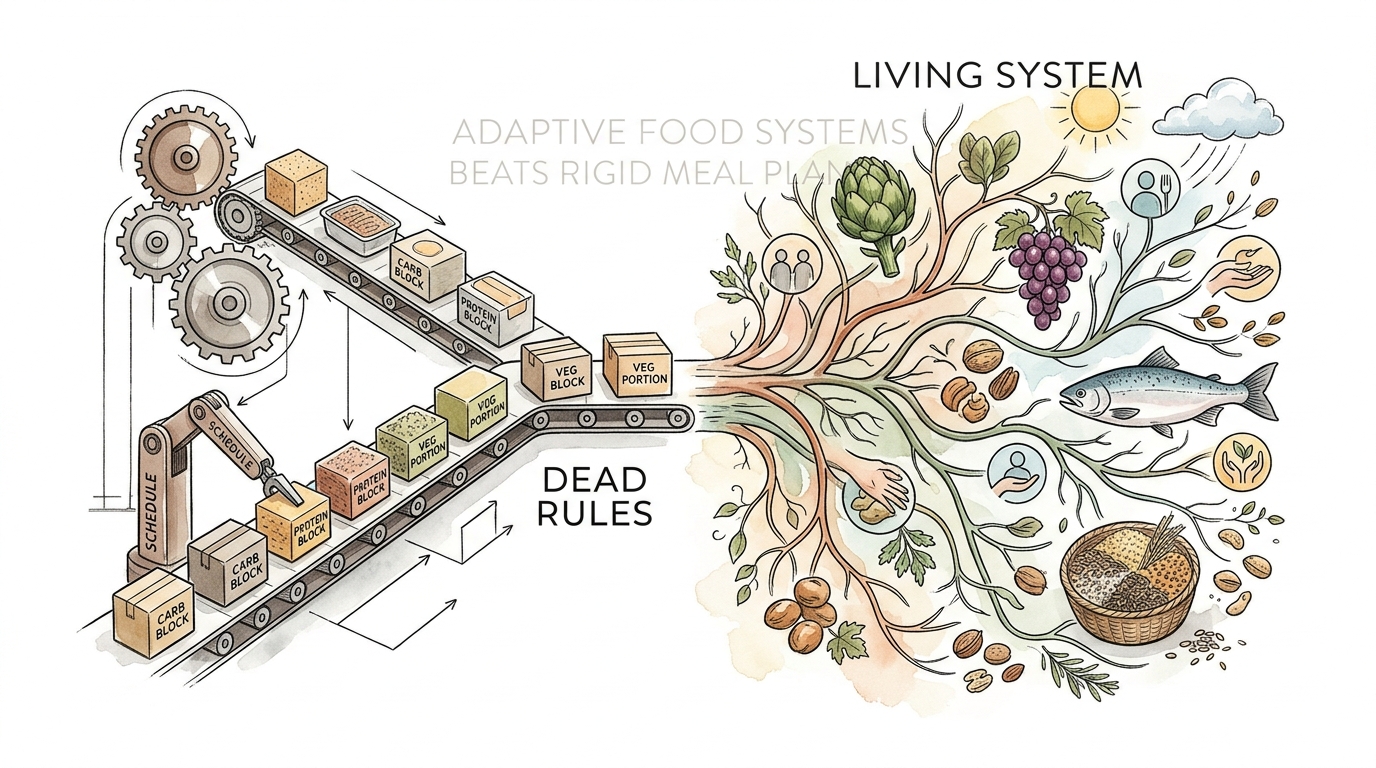
A stone-cold meal plan can’t survive a real-life Tuesday, but a living system thrives in the chaos. We try to force our lives into ‘Dead Rules’—rigid calendars and fixed menus that break the moment life gets messy. Food Freedom is about growing a ‘Living System.’ It’s a mindset that breathes, adapts to your cycle, your stress levels, and your social life. If your plan doesn’t have a pulse, it won’t keep you alive in the long run.
Why Adaptive Food Systems Beat Rigid Meal Plans
Most diet plans are designed in a vacuum. They assume every day is a perfect Saturday morning with zero stress and a fully stocked fridge. In reality, life throws curveballs like late meetings, sick kids, and sudden social invites. Rigid meal plans are “Dead Rules” because they cannot bend; they only break.
Adaptive food systems are built on the principle of flexible restraint. Research shows that people who use rigid dieting strategies—like banning entire food groups—are more likely to suffer from mood disturbances and higher body mass index (BMI) over time. They fall into an “all-or-nothing” trap. One cookie leads to a “ruined” day, which leads to a weekend-long binge.
Living systems prioritize resilience over perfection. Instead of telling you exactly what to eat at 12:15 PM, a system provides a framework. It recognizes that your body’s needs change. You might need more fuel on a high-stress day or different nutrients during specific phases of your menstrual cycle. It’s the difference between a stone wall and a hedge; the hedge bends in the wind, while the wall crumbles.
These systems work because they reduce decision fatigue. Following a rigid plan takes massive willpower until it doesn’t. Once that willpower is exhausted, the system collapses. An adaptive system uses “modular” components to make healthy choices the path of least resistance, even when you’re exhausted.
How It Works: Building Your Living System
Transitioning from a rigid plan to a living system requires a shift from “meals” to “modules.” You aren’t cooking a specific dish for Tuesday night; you are preparing building blocks that can be assembled in minutes.
The Modular Prepping Method
Forget the Sunday afternoon spent portioning 15 identical plastic containers of chicken and broccoli. That is the quickest way to food boredom. Instead, prep components separately. Cook two types of protein (like shredded chicken and ground beef), two types of carbohydrates (like roasted sweet potatoes and quinoa), and a massive variety of vegetables.
Store these in large containers. When Tuesday hits and you’re too tired to cook, you have a “choose your own adventure” kitchen. You can toss the chicken with greens and a lemon vinaigrette for a light dinner. Or, you can sauté the beef with peppers and throw it over quinoa for a hearty bowl. The work is done, but the choice is yours.
Nutritional Autoregulation
Living systems use your body’s hunger signals as data, not as enemies. This is called autoregulation. Start every meal with a foundation of protein and vegetables. These provide the essential amino acids and micronutrients your body needs for repair and satiety. Then, add fats and carbohydrates based on your activity levels and hunger.
If you spent the day at a desk and aren’t very hungry, keep the carbs low. If you hit a heavy workout or feel your energy flagging, increase the starch. This allows your intake to match your output without needing a calculator for every bite.
Cycle Syncing for Hormonal Harmony
For women, a living system must account for the menstrual cycle. Your metabolic rate and nutritional needs shift across four distinct phases. During the follicular phase (days 6–13), you may feel more energetic and insulin-sensitive, making it a great time for vibrant, fresh meals and higher-fiber grains. Estrogen is rising, and your body handles carbohydrates more efficiently.
During the luteal phase (days 15–28), your resting metabolic rate increases, and you might experience more intense cravings. A living system doesn’t call this “failing.” It anticipates it. You might need to increase your intake of complex carbohydrates like oats or lentils to stabilize blood sugar and mood. Focusing on magnesium-rich foods like dark chocolate or pumpkin seeds can help ease PMS symptoms before they start.
The Measurable Benefits of Flexibility
The primary advantage of an adaptive system is sustainability. Because nothing is forbidden, the psychological urge to binge is drastically reduced. You aren’t “cheating” on a plan; you are simply making a different choice within the system. This leads to a much healthier relationship with food and a more stable body weight over years, not just weeks.
- 89% Social Participation: Flexible systems allow you to eat out with friends or attend family events without stress. You simply adjust your other modules to compensate.
- Reduced Cortisol: The stress of “failing” a diet spikes cortisol, which can actually encourage fat storage. Living systems remove that stress.
- Skill Acquisition: Rigid plans teach you how to follow orders. Living systems teach you how to eat. You learn the nutritional value of foods and how they make you feel.
- Metabolic Flexibility: By varying your intake based on activity, you train your body to switch efficiently between burning fats and carbohydrates.
Challenges and Common Mistakes
The biggest hurdle to a living system is the “Decision Trap.” When people first move away from a rigid plan, they often feel overwhelmed by the number of choices. This is where “Dead Rules” actually feel comfortable; they tell you what to do so you don’t have to think. To avoid this, you must keep your modular prep simple. Limit yourself to three proteins and three carbs at any given time.
Another common mistake is the “Vague System.” Flexibility does not mean “eat whatever you want, whenever.” A living system still has boundaries. If you don’t prep your modules, the system reverts to chaos. You must still dedicate time to the “infrastructure” of your food life—grocery shopping and bulk prepping components—even if you don’t follow a strict menu.
Many people also struggle with the psychological shift. They feel guilty if they don’t have a “perfect” day. They treat a flexible system like a loose rigid plan. You have to actively practice the “Grey Zone.” It isn’t about being 100% on or 100% off. Success in a living system is measured by your ability to get back to your baseline at the very next meal, not the next Monday.
Limitations: When This May Not Be Ideal
Adaptive systems are designed for long-term health, lifestyle, and moderate body composition goals. However, there are specific scenarios where “Dead Rules” might actually be necessary. Competitive athletes, such as bodybuilders or marathon runners in a peak training phase, often require extreme precision. When you are trying to reach 5% body fat or fuel for a sub-3-hour marathon, the margin for error is thin.
Medical conditions also require more rigidity. Individuals with severe food allergies, celiac disease, or specific metabolic disorders like Type 1 Diabetes cannot simply “adapt” to a high-carb meal if their system can’t handle it. In these cases, the rules are life-saving. For the average person looking for Food Freedom, however, the rigid approach is usually more harmful than helpful.
Dead Rules vs. Living Systems
The differences between these two approaches are best seen in how they handle common lifestyle factors. One is a cage; the other is a compass.
| Factor | Dead Rules (Rigid) | Living System (Adaptive) |
|---|---|---|
| Mindset | All-or-Nothing / Binary | Continuum / Progress |
| Meal Prep | Fixed meals in containers | Modular components (Proteins/Carbs) |
| Social Life | Brings own food or skips events | Adjusts daily modules to fit event |
| Stress Response | System breaks; guilt follows | System simplifies; recovery prioritised |
| Hunger | Ignored or fought with willpower | Used as data to adjust fuel intake |
Practical Tips for Immediate Application
Building a living system doesn’t happen overnight. It is a set of skills you refine with practice. Start with these three strategies to inject some life into your nutrition.
- The 3-2-1 Prep: Every Sunday, prep 3 vegetables, 2 proteins, and 1 starch. This creates enough variety to keep things interesting without spending 4 hours in the kitchen.
- Master the Sauce Cabinet: The same chicken and rice can taste like Mexican street food or a Thai curry depending on the sauce. Keep 5 high-quality, low-sugar condiments on hand. They are the “software” that updates your modular “hardware.”
- The “Tuesday Test”: Always have two “emergency modules” in the freezer. A bag of frozen shrimp and a bag of stir-fry veggies can be cooked in 6 minutes. This prevents the “order pizza” default when the day falls apart.
- Use the “One Plate” Rule: When eating out or in a high-stress social situation, don’t worry about macros. Fill half your plate with color (veg), a palm-sized portion of protein, and the rest with whatever looks best. This simple heuristic keeps the system alive anywhere.
Advanced Considerations: Beyond the Basics
Once you are comfortable with modular components, you can begin to optimize the system for performance and recovery. One advanced technique is “Carb Cycling” within the living system. Instead of a fixed daily target, you match your carbohydrate intake to your training intensity. High-intensity days get the sweet potatoes and rice; rest days focus on fats and fiber. This prevents metabolic adaptation and keeps your body responsive to insulin.
You can also incorporate “Stress-Adaptive Nutrition.” When your wearables (like an Oura ring or Whoop) show a low recovery score or high stress, your living system should automatically pivot. Increase your intake of anti-inflammatory foods like fatty fish (omega-3s) and antioxidants (berries). Reduce caffeine and focus on “grounding” meals—warm stews or soups—which are easier for a stressed digestive system to process.
Consider the gut-brain axis. A living system isn’t just about calories; it’s about the microbiome. Aim for 30 different plant types per week. Because you are prepping modular veggies rather than fixed meals, it is much easier to toss a handful of different seeds or sprouts onto your bowl each day. This diversity builds a resilient gut, which in turn improves your mood and reduces cravings.
Example Scenario: The Stressful Tuesday
Let’s look at how this works in practice. Imagine “Alex.” Alex has a rigid meal plan: 6 oz chicken, 1/2 cup brown rice, and 1 cup steamed broccoli for dinner at 7:00 PM.
On Tuesday, Alex’s boss calls an emergency meeting at 6:30 PM. Alex doesn’t get home until 8:30 PM. He is exhausted, the broccoli is raw in the fridge, and the rice takes 40 minutes to cook. The “Dead Rule” says he must cook it or he has failed. Alex is too tired, so he orders a burger and fries, feels like a failure, and gives up on the plan for the rest of the week.
Now, look at Alex with a “Living System.” Alex has prepped shredded chicken and has a bag of frozen cauliflower rice. When he gets home at 8:30 PM, he sees his modules. He knows he’s stressed and it’s late, so his body doesn’t need high energy (carbs) right before bed. He tosses the chicken and cauliflower rice in a pan with some pesto and a handful of spinach. It takes 5 minutes. He eats, feels nourished, and wakes up Wednesday morning still “on the system.”
Final Thoughts
Rigid meal plans are built on the hope that your life will be perfect. Living systems are built on the reality that it won’t be. By moving from “Dead Rules” to an adaptive framework, you stop fighting against your schedule, your hormones, and your social life. You start working with them.
This approach transforms food from a source of stress into a tool for resilience. It requires more initial thought to set up the modules and learn your body’s signals, but the payoff is a lifetime of freedom. You no longer need to “start over” every Monday because you never actually “fell off.”
Experiment with the modular prep this week. Start small. Pick two proteins and a few bags of frozen veggies. See how it feels to have the power of choice at 6:00 PM on a Tuesday. Once you experience the relief of a system that breathes with you, you’ll never want to go back to a plan that’s set in stone.
Sources
1 haileyhappensfitness.com | 2 reddit.com | 3 clevelandclinic.org | 4 fitchef.com | 5 bswhealth.com | 6 oova.life | 7 medium.com | 8 holisticperformance.institute | 9 emiliamorelli.com | 10 mykindred.co | 11 optifitnutrition.com | 12 telosstrength.com | 13 nih.gov | 14 substack.com | 15 rumen.com.au | 16 nih.gov | 17 researchgate.net | 18 redefinehealthybrands.com | 19 fitafnutrition.com