


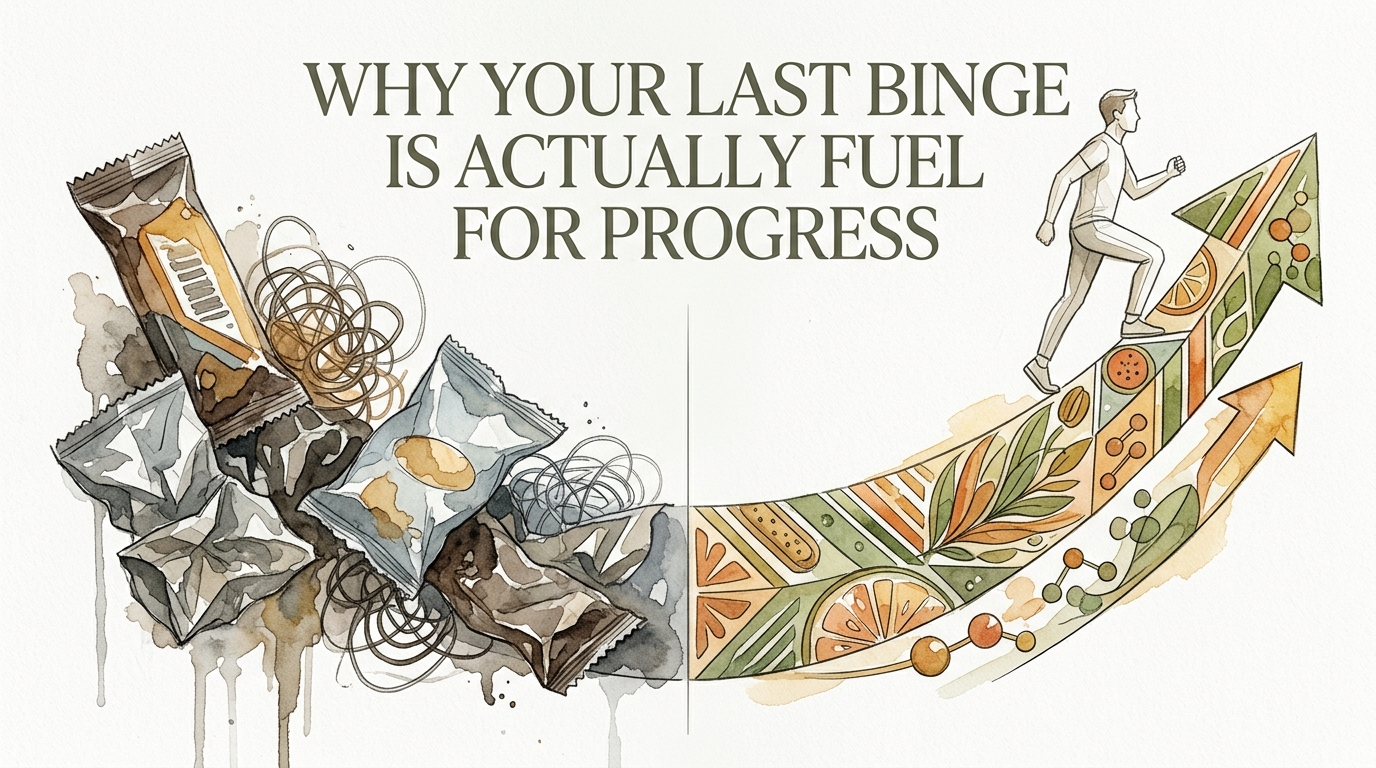
Your biggest dietary ‘mistake’ isn’t trash; it’s the raw data you need to build your permanent solution. Most people treat a ‘bad’ meal like a total system failure and throw the whole day away. In Food Freedom, we don’t believe in waste. Every craving, every slip-up, and every overindulgence is a high-octane fuel source of information. When you stop drowning in guilt, you start seeing the patterns that actually unlock your metabolism.
Diet culture has trained us to view a binge as a moral failure. It tells us we lack willpower. It suggests we need more discipline. This approach is a dead end. It creates a cycle of shame that prevents us from seeing what is actually happening under the hood. When you shift your perspective, you realize that your body isn’t “glitching.” It is responding to specific environmental, biological, and emotional inputs.
Practical weight loss isn’t about perfect execution. It’s about becoming a detective of your own biology. If you ate an entire sleeve of cookies at 10 PM, that’s not a reason to quit. It’s a data point. Why 10 PM? Why cookies? How did you feel three hours before? When you answer these questions, you stop being a victim of your cravings and start being the architect of your health.
Why Your Last Binge Is Actually Fuel For Progress
A binge is a concentrated burst of biological feedback. It exists because your brain’s reward system and your body’s survival mechanisms have reached a tipping point. Research shows that binge eating behaviors are often rooted in habit circuitry in the brain, specifically the sensorimotor putamen, which drives automatic responses to food cues. This isn’t a lack of character; it’s a neurological pattern that can be decoded.
Think of a “slip-up” like a warning light on your car’s dashboard. You wouldn’t smash the light with a hammer and keep driving. You would look under the hood to see why the engine is overheating. In the same way, overeating is a signal that something in your system is misaligned. Perhaps your cortisol is too high from work stress, or your leptin signals are being drowned out by ultra-processed foods.
When you treat these moments as fuel for progress, you remove the emotional weight. Instead of saying, “I have no self-control,” you say, “My body was seeking a dopamine hit because I only slept four hours last night.” This objective analysis is the only way to build a sustainable lifestyle. You are collecting the raw data required to customize a solution that actually works for your specific life.
How the Data Works: Decoding Your Cravings
Understanding how to use this “fuel” requires a step-by-step process of analysis. You aren’t just looking at the food you ate; you are looking at the context surrounding the event. This is where the real transformation happens.
The Biological Triggers
Hormones are the software of your metabolism. If you find yourself uncontrollably hungry, it’s likely a hormonal signal. Ghrelin, the “hunger hormone,” spikes when you skip meals or haven’t eaten enough protein. Leptin, the “fullness hormone,” can become resistant if you are chronically overconsuming sugar, meaning your brain never gets the “stop” signal. Stress triggers cortisol, which specifically drives cravings for high-fat, high-sugar “comfort” foods.
The Habit Loop
Your brain loves efficiency. If you always eat chips while watching Netflix, your brain builds a neural pathway that links the two. Eventually, sitting on the couch triggers the craving automatically. This is the dopamine loop in action. The brain anticipates the reward before you even take a bite. Recognizing these cues—the time of day, the location, the specific activity—is the first step in rerouting the habit.
The Post-Game Analysis Process
To turn a mistake into a blueprint, you need to perform a “post-game analysis” within 24 hours of the event. Ask yourself these four questions:
- Physical State: Was I actually hungry, or was I thirsty, tired, or in pain?
- Emotional State: Was I bored, anxious, lonely, or overwhelmed?
- Environmental Cues: Where was I? Who was I with? What was I doing?
- Previous Inputs: Did I restrict calories earlier in the day? Did I miss out on sleep?
Benefits of a Data-Scientist Mindset
Choosing to see your diet through a lens of data rather than drama provides immediate psychological and physiological advantages. It shifts you from a “fixed mindset” to a “growth mindset.”
Reduced Psychological Friction
The biggest barrier to weight loss isn’t the calories; it’s the “What the Hell Effect.” This is a documented psychological phenomenon where once you “break” your diet, you decide to eat everything in sight because the day is already “ruined.” When you view the first slip-up as data, the day isn’t ruined. You simply acknowledge the data point and move on to the next meal. This prevents a 500-calorie mistake from turning into a 5,000-calorie disaster.
Personalized Bio-Hacking
No two metabolisms are identical. General diet plans fail because they don’t account for your specific stress triggers or sleep patterns. By tracking your slips, you create a personalized manual for your body. You might find that you only binge on Thursdays—the day before your biggest weekly meeting. Now you have a target: manage Thursday’s stress, and the binge disappears.
Increased Metabolic Flexibility
When you stop the cycle of “binge and restrict,” your metabolism stabilizes. Constantly starving yourself after a big meal damages your insulin sensitivity and messes with your thyroid. By returning to normal, balanced eating immediately after a slip-up, you teach your body how to handle caloric fluctuations without going into “storage mode.”
Challenges and Common Mistakes
Even with the right mindset, several pitfalls can sabotage your progress. Understanding why these mistakes happen allows you to bypass them.
The “Punishment” Trap
Many people try to “make up” for a bad meal by doing two hours of cardio or fasting the next day. This is Wasted Effort. It reinforces the idea that food is something you must earn or pay for. Biologically, this often backfires by causing a massive ghrelin spike, leading to another binge 48 hours later.
Over-Reliance on Willpower
Willpower is a finite resource. If you are using it to resist every craving, you will eventually run out. The mistake is thinking you can “discipline” your way out of a biological urge. If your leptin is low and your ghrelin is high, biology wins every time. The solution is to change the data inputs—more sleep, more protein, less stress—rather than trying to be “stronger.”
Ignoring the “Why”
Simply recording that you ate a pizza isn’t enough. The mistake is stopping at the “what.” Without the “why,” the pattern will repeat. You must dig into the triggers. If you ignore the emotional or environmental data, you are just keeping a record of your failures instead of building a map to success.
Limitations: When Data Isn’t the Whole Story
While the data-driven approach is powerful, it has boundaries. It is a tool for self-awareness, not a clinical treatment for deep-seated issues.
Environmental limitations play a huge role. If you live in a “food desert” or work in an office where donuts are constantly on the desk, the data will tell you your environment is the problem, but solving it might require more than just mindset. You cannot “data-analyze” your way out of a lack of access to healthy food or a toxic social circle without making structural changes to your life.
Furthermore, for those struggling with clinical Binge Eating Disorder (BED), self-analysis should supplement professional medical or psychological help. Neural circuitry alterations in severe cases may require targeted therapies, such as cognitive behavioral therapy (CBT), to rewire the brain’s habit centers.
Drama-Based Dieting vs. Data-Driven Fueling
| Feature | Drama-Based Dieting | Data-Driven Fueling |
|---|---|---|
| Internal Narrative | “I’m a failure. I have no willpower.” | “That’s interesting. What triggered that?” |
| Reaction to “Slip-up” | Restrict, punish, or quit. | Analyze, adjust, and continue. |
| Focus | Short-term weight loss. | Long-term behavioral change. |
| Metabolic Effect | Stress-induced fat storage. | Hormonal stabilization. |
Practical Tips for Immediate Implementation
Start using your “mistakes” as fuel today with these actionable strategies.
- The 24-Hour Rule: Never judge a meal while you are still eating it or immediately after. Wait until the next morning when your logic center (prefrontal cortex) is back online to perform your analysis.
- Track the “Before”: Instead of just tracking what you ate, track how you felt 60 minutes before the meal. Were you “hangry”? Were you bored? This is the most valuable data point you have.
- Focus on Protein and Fiber: After an overindulgence, don’t fast. Eat a meal high in lean protein and fiber. This stabilizes blood sugar and tells your brain that the “famine” is over, quenching the urge to binge again.
- Hydrate with Intention: High-salt and high-sugar binges cause water retention and brain fog. Drink 16–20 ounces of water immediately to help your kidneys flush the excess and restore cognitive function.
- Identify Your “Safe” Alternatives: Use your data to find patterns. If you always crave ice cream at night, have a high-protein Greek yogurt with fruit ready. You aren’t “restricting”; you are providing a better input for the same craving.
Advanced Considerations: Neurotransmitters and Metabolism
For those looking to go deeper, understanding the neurochemistry of “data” is vital. When we eat hyperpalatable foods, our brain releases a massive surge of dopamine. Over time, the brain downregulates its dopamine receptors to protect itself from overstimulation. This means you need *more* food to feel the same level of satisfaction—a process called tolerance.
This “numbness” in the reward system is why a single cookie doesn’t feel like enough. By using the data-driven approach, you are essentially performing a “dopamine reset.” By identifying triggers and reducing the frequency of massive spikes, you allow your brain’s receptors to become sensitive again. Eventually, a piece of fruit or a balanced meal provides the same satisfaction that a box of donuts once did.
Metabolically, this approach also addresses insulin resistance. Chronic overeating keeps insulin levels high, which locks fat in your cells. By stopping the “all-or-nothing” cycle, you allow insulin to drop between meals, which is the “master key” to accessing stored body fat for energy.
Example: Sarah’s Sunday Night “Slip-up”
Sarah has been trying to lose 20 pounds. On Sunday night, she ate a large pizza and half a tub of ice cream by herself.
Old Way (Drama): Sarah feels disgusted. She calls herself “lazy” and “hopeless.” She decides she will start a 3-day juice fast on Monday to punish herself. By Tuesday, she is so hungry she binges again. The cycle continues, and she gains 2 pounds by the end of the month.
New Way (Data): Sarah wakes up Monday, feels bloated, but stays calm. She looks at her journal. She realizes she skipped lunch on Sunday to “save calories” for dinner. She also notes she stayed up late Saturday night and was exhausted.
- Conclusion: Extreme hunger + Sleep deprivation = Loss of control.
- Action Plan: Never skip Sunday lunch again. Prioritize an extra hour of sleep on Sunday afternoons if Saturday was a late night.
- Result: Sarah eats a high-protein breakfast Monday, goes for a 20-minute walk, and stays on track. She loses 1 pound that week because she didn’t let one meal turn into a week-long spiral.
Final Thoughts
Transforming your relationship with food requires a fundamental shift from judgment to curiosity. When you stop treating your mistakes like trash and start treating them like raw data, you reclaim your power. You are no longer “at the mercy” of your cravings; you are the one observing and adjusting the system.
Food freedom isn’t the absence of mistakes. It’s the presence of a system that knows exactly what to do with them. Every slip-up is an opportunity to learn something about your biology that a textbook could never tell you. It is the high-octane fuel you need to build a permanent, sustainable solution.
Start looking for the patterns. Respect the signals your body is sending. Experiment with your inputs—sleep, protein, stress management—and watch how the “data” changes over time. Your metabolism isn’t broken; it’s just waiting for you to start reading the manual.
Sources
1 salisbury.edu | 2 everydayinspiration.co | 3 healthline.com | 4 healthline.com | 5 jmir.org | 6 bbrfoundation.org | 7 harvard.edu | 8 osu.edu | 9 researchgate.net | 10 nih.gov | 11 nih.gov | 12 nih.gov | 13 find-foodfreedom.com | 14 frontiersin.org | 15 cdc.gov | 16 onebitenutrition.com | 17 nutritionwithwendi.com