


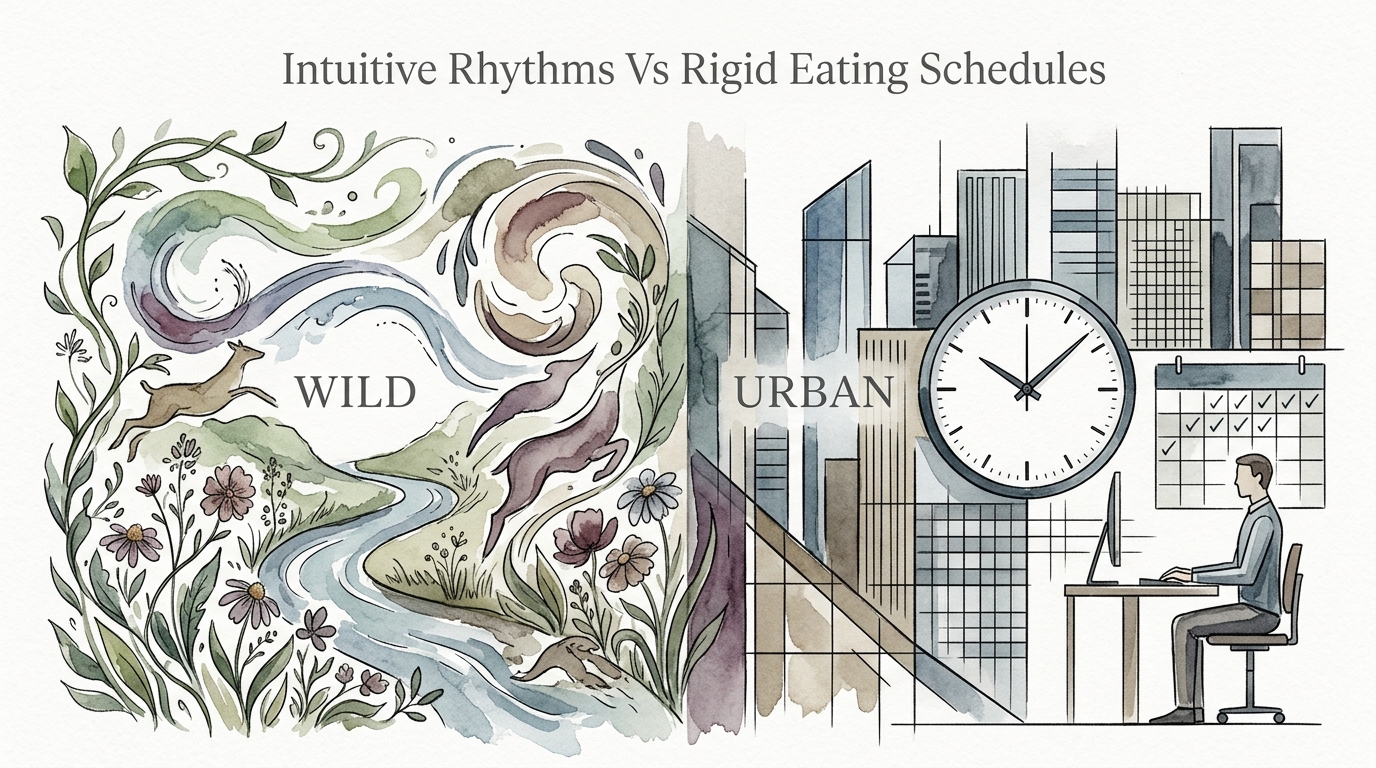
Your body isn’t a machine that follows a schedule; it’s an ecosystem that follows a rhythm. We’ve ‘urbanized’ our eating with rigid schedules and artificial rules, turning our health into a gray grid. Food freedom is about ‘rewilding’—returning to the natural, organic rhythms of your own biology that know exactly when to fuel and when to rest.
Step outside the world of calorie-counting apps and pre-planned meal containers for a moment. Most of us eat because a clock on the wall says it is 12:00 PM, not because our stomach is actually growling. We stop eating because a plate is empty, not because our brain has received the signal of satiety. This disconnect is the “urbanization” of our health, a state where external rules override internal wisdom.
Returning to a “wild” state of eating doesn’t mean moving to the woods or foraging for every meal. It means reclaiming the ability to hear what your body is asking for in real-time. It is about understanding that your metabolism is a living, breathing process that shifts with the rising sun and the falling moon. When you align your eating with these biological beats, health stops being a chore and starts being an instinct.
Intuitive Rhythms Vs Rigid Eating Schedules
Rigid eating schedules are a product of the industrial age. We were taught to eat three square meals a day to fit into a factory or office shift. This structure ignores the fact that every human has a unique internal clock called the circadian rhythm. This master clock, located in the suprachiasmatic nucleus (SCN) of your brain, regulates everything from your body temperature to your appetite hormones.
Intuitive rhythms focus on interoceptive awareness—the ability to sense what is happening inside your body. When you eat intuitively, you are listening to cues like stomach stretching, energy dips, and even the “mouth-feel” of what sounds good. Rigid schedules, on the other hand, rely on willpower and external metrics. They tell you that you must eat at 8:00 AM, even if you aren’t hungry, or that you must stop eating at 6:00 PM, even if you’ve had a high-activity day and your muscles are screaming for glucose.
Think of it like a garden. A rigid schedule is like an automated sprinkler system that turns on every day at 4:00 PM regardless of whether it is raining or a heatwave. An intuitive rhythm is like a gardener who feels the soil and only adds water when the plants actually need it. One is efficient on paper; the other is effective in practice. Scientific research shows that aligning food intake with these natural biological signals can improve metabolic flexibility and long-term health.
How It Works: The Biology of Hunger and Time
Your body uses a complex network of chemical messengers to tell you when to eat. The primary players are ghrelin, often called the “hunger hormone,” and leptin, the “fullness hormone.” In a “wild” or natural state, these hormones rise and fall in a predictable dance. Ghrelin peaks when your stomach is empty, signaling your brain to go find fuel. Leptin is released by your fat cells to tell the brain you have enough energy stored and can stop eating.
Modern life disrupts this dance. Artificial blue light from phones and late-night snacking can trick your brain into thinking it is daytime, suppressing melatonin and keeping ghrelin high when it should be low. This is why you might feel “false hunger” at 10:00 PM. Rewilding your eating involves re-syncing these hormones by honoring actual physical hunger and paying attention to the signals of satiety.
Chrononutrition is the science of how meal timing interacts with these biological clocks. Your body is generally more insulin-sensitive in the morning and early afternoon, meaning it can process sugars and carbohydrates much more efficiently when the sun is up. As the day turns to night, your pancreas slows down insulin production in anticipation of rest. Eating a massive, carb-heavy meal late at night forces your body to work against its natural programming, often leading to poor sleep and metabolic strain.
Benefits of Reclaiming Food Freedom
Choosing intuitive rhythms over rigid grids offers measurable advantages for both your mind and your metabolism. One of the most significant benefits is improved insulin sensitivity. By eating the majority of your calories during daylight hours, you allow your body to process nutrients when its metabolic machinery is at peak performance. This alignment helps keep blood sugar stable and reduces the long-term risk of insulin resistance.
Psychological well-being is another massive win. Traditional dieting often involves a cycle of restriction followed by “cheating,” which breeds guilt and anxiety. Food freedom removes the “good” and “bad” labels from food. When you stop viewing a slice of pizza as a “failure,” it loses its power over you. People who practice intuitive eating often report a significant decrease in binge eating and a much higher level of body satisfaction.
Digestive health also thrives under an intuitive model. Your digestive system needs periods of rest to perform the “housekeeping” tasks required to maintain a healthy gut microbiome. When you graze all day and night, you never give your gut the chance to reset. Following a rhythm that includes a natural overnight fast allows for better nutrient absorption and a more resilient immune system.
Challenges on the Path to Intuitive Eating
The transition from a rigid schedule to a natural rhythm isn’t always a smooth straight line. Many people find their hunger hormones are “broken” after years of chronic dieting. If you have spent decades ignoring hunger cues or using caffeine to suppress your appetite, your body might not send clear signals right away. This can lead to a period of confusion where you aren’t sure if you are actually hungry or just bored.
Fear of losing control is another common pitfall. The “urbanized” mind worries that without rules, it will eat nothing but cookies and chips. This fear usually stems from a history of restriction. When you finally give yourself unconditional permission to eat, there might be an initial “honeymoon phase” where you crave all the previously forbidden foods. However, as the novelty wears off and you pay attention to how those foods actually make you feel, your body naturally begins to crave variety and nourishment.
Social pressure remains a significant hurdle. Our world is built around scheduled meals. Business lunches, dinner parties, and family breakfasts all happen at specific times. Learning to navigate these social structures while staying true to your internal cues requires practice and a bit of “flexible structure.” You might choose to have a smaller portion if you aren’t hungry, or simply enjoy the company while waiting to eat until your body is ready.
Limitations: When Intuitive Cues Aren’t Enough
While intuitive eating is a powerful framework, it isn’t a one-size-fits-all solution for every situation. Certain medical conditions can interfere with the body’s ability to send accurate hunger and fullness signals. For example, individuals with Type 1 Diabetes must rely on external monitoring and rigid dosing schedules to stay safe. In these cases, the “urban” grid is a life-saving necessity, though intuitive principles can still be used to manage the psychological side of eating.
Severe eating disorder recovery often requires a period of “mechanical eating” before intuition can be trusted. If the body has been in a state of starvation or extreme cycles of binging and purging, the hunger-fullness signaling system is often offline. A structured meal plan helps restore biological stability so that, eventually, the person can transition back to a more intuitive rhythm.
Athletes with high training volumes also face unique challenges. Intense exercise can temporarily suppress appetite, a phenomenon known as exercise-induced anorexia. If an endurance runner only ate when they felt “hungry,” they might not consume enough calories to support their recovery and performance. These individuals often need a “flexible structure” that combines internal cues with the external knowledge of their energy requirements.
Rigid Schedules vs. Intuitive Rhythms
| Feature | Rigid Schedules | Intuitive Rhythms |
|---|---|---|
| Primary Driver | The Clock / Meal Plan | Internal Hunger / Satiety |
| Metabolic Focus | Calorie Control | Hormonal Alignment |
| Psychological State | Discipline / Anxiety | Trust / Curiosity |
| Flexibility | Low (Pass/Fail) | High (Adaptive) |
| Sustainability | Often leads to burnout | Built for long-term lifestyle |
Practical Tips for Rewilding Your Habits
Starting your journey toward food freedom doesn’t require a total overhaul of your life in a single day. Small, intentional shifts can help you reconnect with your biological baseline. One of the most effective strategies is to prioritize natural light exposure first thing in the morning. Stepping outside for just 10 to 15 minutes of sunlight helps set your master clock, which in turn regulates your hunger hormones for the rest of the day.
Practice the “Check-In” method before every meal. Instead of reaching for food automatically because it is “time,” take three deep breaths and ask yourself, “On a scale of one to ten, how physically hungry am I?” Physical hunger usually builds slowly and is felt in the stomach, whereas emotional hunger or boredom strikes suddenly and is felt “above the neck.” This simple pause builds the muscle of interoceptive awareness.
Minimize blue light exposure in the evening to protect your sleep and next-day metabolism. When you look at bright screens late at night, you suppress melatonin and confuse your peripheral clocks. This often leads to “midnight munchies” that aren’t based on energy needs but on hormonal disruption. Try dimming the lights after sunset and switching to a book or a podcast an hour before bed to support a natural metabolic fast.
Advanced Considerations for Serious Practitioners
If you have mastered the basics and want to dive deeper into biological optimization, consider your specific chronotype. Are you a “Morning Lark” or a “Night Owl”? Research suggests that our internal clocks aren’t all set to the same time. A Morning Lark may naturally want their largest meal at 10:00 AM, while a Night Owl might find their peak metabolic window is shifted a few hours later. Honoring these genetic predispositions can further enhance your energy levels.
Mitochondrial health is the next frontier of intuitive rhythms. Your mitochondria—the powerhouses of your cells—have their own daily cycles of energy production and repair. They are highly sensitive to the timing of nutrient intake. By aligning your heaviest meals with your most active hours, you provide the fuel exactly when your mitochondria are most capable of converting it into ATP without creating excessive oxidative stress.
The gut microbiome also operates on a clock. Different strains of bacteria are more active at different times of the day. Feeding your “good” bacteria high-fiber, diverse plant foods during daylight hours supports their natural proliferation. Chronic late-night eating can actually shift the composition of your microbiome toward strains that are associated with inflammation and weight gain. Consistency in your “wild” rhythm supports a diverse and thriving internal ecosystem.
Example Scenario: The Urban vs. The Wild Day
Imagine Sarah, a marketing executive who lives a typical “urbanized” life. She wakes up to a blaring alarm in a dark room, drinks coffee to “turn on” her brain, and eats a protein bar at 8:00 AM because that is what her diet plan says. She spends all day under fluorescent lights, eats a salad at her desk while answering emails, and has a large dinner at 8:30 PM after a long commute. She scrolls on her phone until midnight, struggling to fall asleep. Her body is in a state of constant “circadian mismatch,” leading to foggy brain and erratic hunger.
Now, imagine Sarah “rewilds” her day. She wakes up and immediately opens her curtains to let in the sun. She isn’t hungry right away, so she waits until 10:30 AM when her stomach actually rumbles. She takes a 20-minute walk outside after lunch to soak up more natural light. She notices she is tired in the afternoon, so instead of more caffeine, she has a small, nutrient-dense snack and a glass of water. She has a satisfying dinner at 6:30 PM and dims the lights in her house by 8:00 PM. By 10:00 PM, her body is naturally flooded with melatonin, and she falls into a deep, restorative sleep.
The difference isn’t just in what Sarah ate; it is in the timing and the source of her decisions. In the second scenario, Sarah is working with her biology instead of against it. She feels more energetic, her digestion improves, and the “need” to follow a strict diet disappears because her body is finally telling her exactly what it needs.
Final Thoughts
Embracing intuitive rhythms is about moving from a state of control to a state of connection. When you stop fighting your body with rigid grids and artificial rules, you open the door to a level of health that feels effortless. Your biology is not your enemy; it is a sophisticated system that has evolved over millions of years to keep you thriving. Food freedom is simply the act of getting out of your own way and letting that system do its job.
The journey of rewilding is a practice, not a destination. There will be days when life gets in the way, when schedules become unavoidable, or when you simply choose to eat for pleasure rather than hunger. That is the beauty of this approach—it is flexible enough to handle the complexity of modern life while keeping you anchored in your natural biology. Trust the process, listen to the cues, and enjoy the freedom that comes with being in sync with your own rhythm.
Experiment with these principles and see how your body responds. You might find that your “ideal” diet looks nothing like what you find in a magazine, and that is perfectly okay. The goal is to build a lifestyle that supports your unique ecosystem, giving you the energy and clarity to live your life to the fullest. As you continue to explore these natural rhythms, you may find that other areas of your life—like movement, sleep, and stress management—naturally begin to rewild as well.
Sources
1 wholeyounutrition.com | 2 evelyntribole.com | 3 news-medical.net | 4 medium.com | 5 wholehealthpartners.com | 6 aipono.com | 7 hopkinsmedicine.org | 8 renfrewcenter.com | 9 julienutrition.com | 10 harvard.edu | 11 laugaunutrition.com | 12 ksl.com | 13 ancientandbrave.earth | 14 veri.co | 15 wral.com | 16 memphisnutritiongroup.com | 17 rubyoaknutrition.com | 18 rachaelhartleynutrition.com | 19 thewholebeingco.com | 20 medium.com