


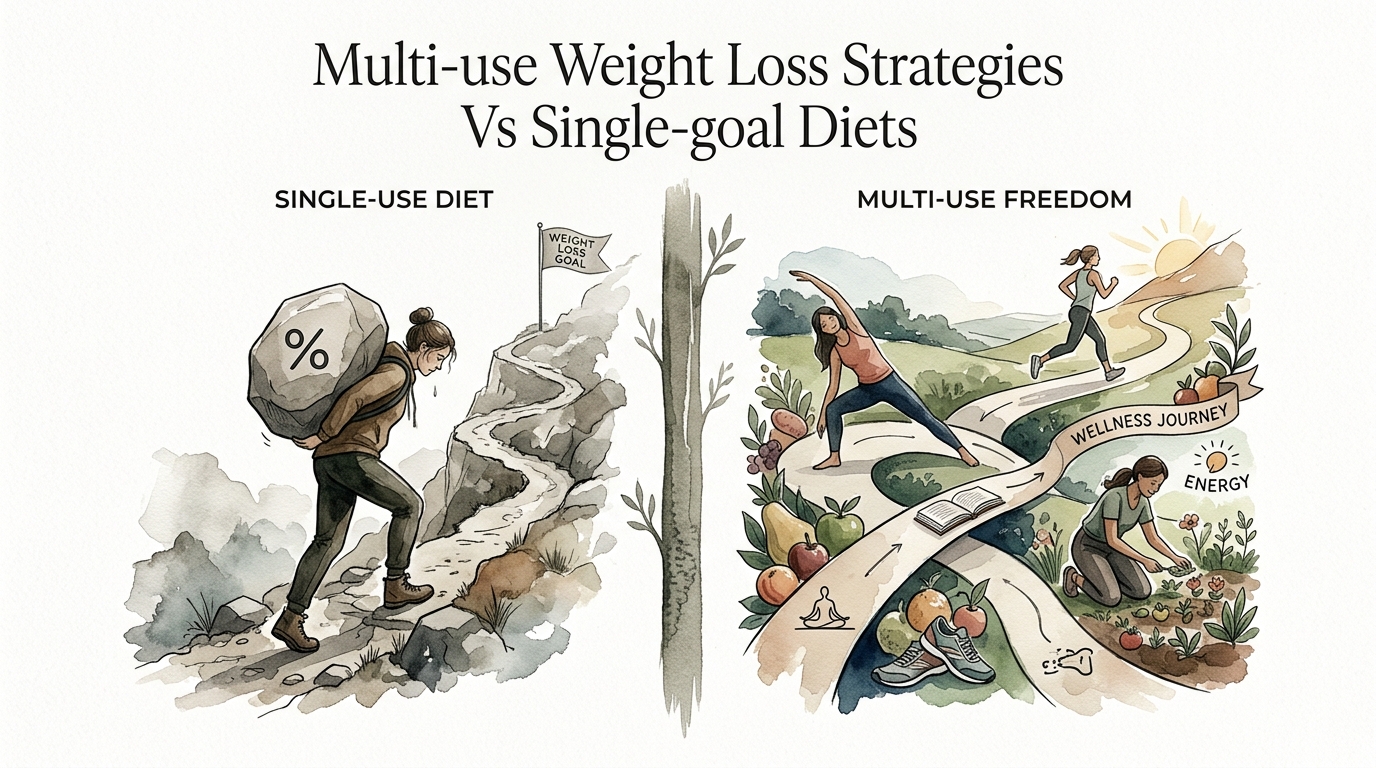
Stop using disposable mindsets for a life-long journey; you need a tool that works in every season. Most people approach weight loss with a ‘Single-Use’ mindset—a tool designed only to get them to a specific date or event. Once the event passes, the tool breaks. Food Freedom is the ‘Multi-Use’ alternative. It’s a versatile toolkit that provides mental clarity during work, social ease during dinner parties, and energy for your family. Build a mindset that serves more than just the scale.
Multi-use Weight Loss Strategies Vs Single-goal Diets
Think of a single-goal diet like a paper plate. It serves a purpose for one meal, but it cannot handle the weight of a life-long feast. These diets are built around temporary restrictions meant to hit a specific number on the scale by a specific deadline. While they might get you into that dress or suit for a wedding, they rarely provide the infrastructure needed for the day after the event.
Multi-use weight loss strategies are the equivalent of high-quality, durable cookware. They are designed to adapt to your environment, whether you are celebrating a holiday or navigating a high-stress work week. This approach moves the focus away from “fixing” a problem and toward “fueling” a life. It treats your body as a sophisticated system that needs various inputs for different seasons.
Single-goal diets typically rely on external rules, such as calorie counting or cutting out entire food groups. This creates a “fragile” success—if you eat one thing off-plan, the entire system feels broken. Multi-use freedom relies on internal cues, such as hunger and satiety, which remain consistent no matter where you are or what is being served. Research shows that this shift from external control to internal trust is the hallmark of those who maintain their results for years rather than weeks.
Real-world success requires a toolkit that doesn’t shatter when life gets messy. A single-goal mindset often views a social gathering as a “cheat day” or a threat. A multi-use mindset views that same gathering as an opportunity to practice social ease and mindful enjoyment. One leads to guilt; the other leads to a sustainable, happy lifestyle.
How It Works: The Mechanics of Multi-Use Freedom
Transitioning to a multi-use mindset involves retraining both the brain and the body to respond to biological signals rather than arbitrary rules. This process is rooted in the concept of Intuitive Eating, which encourages individuals to honor their hunger and respect their fullness. It is a system built on three primary pillars: metabolic flexibility, cognitive re-framing, and sensory attunement.
Metabolic flexibility is the body’s ability to switch between burning carbohydrates and burning fat based on availability. When you are on a restrictive, single-use diet, your body often becomes “stiff” or “stuck” in one fuel mode, leading to energy crashes and intense cravings. By eating a diverse range of nutrients and avoiding extreme restriction, you train your mitochondria—the powerhouses of your cells—to be efficient fuel-switchers. This creates steady energy levels that last through a long workday without the need for constant snacking.
Cognitive re-framing involves “challenging the food police.” This is the internal voice that labels food as “good” or “bad.” Multi-use freedom removes the morality from eating. Food is viewed through the lens of its purpose: some foods provide quick energy, some provide long-lasting satiety, and some provide emotional connection and pleasure. When no food is “off-limits,” the psychological “rebound effect”—where you binge on forbidden foods—simply disappears.
Sensory attunement is the practice of eating mindfully to notice how different foods make you feel. Instead of asking “Does this fit my macros?”, you ask “How will this meal affect my energy in two hours?” This shift turns eating into a feedback loop. You begin to notice that while a high-sugar snack might taste good, it often leads to brain fog, whereas a balanced meal with protein and fiber supports focus. This internal feedback is far more powerful than any external app.
The Step-by-Step Transition
- Audit your “Food Police”: Notice when you use words like “cheat,” “guilty,” or “bad” regarding your meals. Replace these with neutral observations.
- Eat for Satisfaction: Physical fullness is not the same as satisfaction. A bowl of plain steamed broccoli might make your stomach full, but it won’t satisfy your taste buds, leading you to search for more food later.
- Practice Biological Respect: Eat when you are hungry. Waiting until you are “starving” often triggers a primal drive to overeat, bypassing your body’s ability to notice when it has had enough.
- Prioritize Sleep and Stress Management: High cortisol levels can mask hunger cues and drive cravings for high-density energy (sugar and fat). A multi-use strategy recognizes that health is not just about the plate.
The Measurable Benefits of Multi-Use Living
Shifting away from the scale-only focus reveals benefits that impact every area of your existence. While weight loss may occur as a natural byproduct of improved metabolic health, the immediate “wins” are often found in your quality of life. Participants in non-diet approaches frequently report higher levels of self-esteem and a more positive body image, regardless of their starting weight.
Mental Clarity: Restrictive dieting is a massive cognitive load. Your brain spends significant energy tallying numbers, resisting cravings, and feeling guilt. When you achieve food freedom, that mental energy is reclaimed. This leads to better performance at work and more presence with your family. You are no longer “distracted” by the next meal.
Social Ease: One of the most common pitfalls of single-use diets is social isolation. People avoid parties because they are afraid of the buffet. Multi-use freedom allows you to navigate these events with ease. Because you have unconditional permission to eat all foods, the “urgency” to overeat at a party vanishes. You can enjoy a slice of cake and move on, knowing it doesn’t “ruin” anything.
Steady Energy and Improved Mood: By focusing on metabolic flexibility, you avoid the blood sugar rollercoasters that cause irritability and “hangriness.” Stable glucose levels lead to a more balanced emotional state. Your family gets the best version of you, not the version that is cranky from caloric deprivation.
Improved Biomarkers: Studies have shown that non-restrictive approaches can lead to improvements in blood pressure and cholesterol. Focusing on “adding” nutrient-dense foods like fruits, vegetables, and whole grains—rather than just “subtracting” calories—supports heart health and reduces systemic inflammation.
Challenges and Common Mistakes
The journey to food freedom is not always a straight line. Because we live in a “diet culture” that glorifies restriction, it is easy to fall back into old habits. One of the biggest mistakes is treating Intuitive Eating like the “Hunger and Fullness Diet.” If you turn listening to your body into another set of rigid rules, you have simply swapped one cage for another.
Mistakes often happen when people try to rush the process. After years of dieting, your internal signals might be muffled. It takes time for the body to trust that it won’t be starved again. During this phase, some people experience a period of eating more of the “forbidden” foods they used to restrict. This is often misinterpreted as “losing control,” but it is actually a necessary part of neutralizing those foods. The goal is to reach a state of habituation, where cookies are just cookies, not a high-stakes temptation.
Another pitfall is ignoring the “satisfaction factor.” People often eat what they think they “should” eat rather than what they actually want, which leads to feelings of deprivation. True food freedom means choosing the food that honors both your health and your palate. Balancing “gentle nutrition” with pleasure is the key to long-term adherence.
Limitations: When This Approach May Not Work Well
While food freedom is a powerful tool, it is important to acknowledge its limitations. This approach requires a level of self-reflection and patience that might be difficult for someone in a state of high acute stress or a medical crisis. In certain clinical situations, specific dietary restrictions are medically necessary and must be prioritized over intuitive signals.
Individuals with certain medical conditions, such as Type 1 Diabetes, advanced kidney disease, or specific food allergies, cannot rely solely on “intuition” to guide their intake. In these cases, medical guidelines must provide the framework, though the psychology of food freedom can still be applied to reduce the shame and stress associated with those necessary restrictions.
Furthermore, if someone is currently struggling with an active, severe eating disorder, they may need a structured meal plan designed by a medical professional before they can safely transition to intuitive cues. Biological hunger signals are often completely offline during the depths of an eating disorder and require a period of “re-feeding” to return to normal functioning.
Comparison: Single-Use Diets vs. Multi-Use Freedom
| Feature | Single-Use Diets | Multi-Use Freedom |
|---|---|---|
| Primary Goal | Specific weight or event date. | Whole-life health and energy. |
| Control Mechanism | External (Apps, points, rules). | Internal (Hunger, fullness, satisfaction). |
| Flexibility | Fragile; fails when life gets busy. | Resilient; adapts to all seasons. |
| Mental Impact | High anxiety and “food noise.” | Mental clarity and reduced stress. |
| Long-term Success | High rate of weight regain (yo-yo). | Sustainable lifestyle maintenance. |
| Metabolic Effect | Possible metabolic slowdown. | Improved metabolic flexibility. |
Practical Tips for Immediate Application
Moving toward a life-long toolkit starts with small, daily adjustments. You don’t need to throw out your kitchen today; you just need to change how you interact with it. Start by focusing on what you can add to your life rather than what you must take away.
- The “Plus One” Rule: Instead of cutting out your favorite pasta, ask what you can add to it to make it a “multi-use” meal. Adding a side of roasted vegetables or a lean protein increases the fiber and satiety, turning a quick-burning meal into sustained fuel.
- Ditch the Distractions: Try to eat at least one meal a day without your phone or the TV. When you are distracted, your brain misses the “fullness” signals sent by your stomach, making it much easier to overeat without realizing it.
- The Savoring Technique: Take three deep breaths before you start eating. This shifts your nervous system from “fight or flight” to “rest and digest.” Spend the first three bites focusing intensely on the texture, temperature, and flavor of the food.
- Curate Your Environment: Unfollow social media accounts that promote “quick fixes” or body shaming. Surround yourself with voices that emphasize health, strength, and autonomy.
Advanced Considerations: The Science of Cellular Fuel
For those looking to deepen their understanding, the concept of “metabolic switching” is a fascinating area of study. This is the physiological transition from using glucose (sugar) derived from your last meal to using ketones (fat) stored in your body. In a state of chronic over-feeding or constant snacking—common in many modern diets—the body loses the “muscle memory” of how to burn fat efficiently.
Training your body for multi-use energy involves allowing for periods where insulin levels are low. This doesn’t require extreme fasting, but it does mean avoiding constant grazing. When you allow your digestive system to rest for 12 to 14 hours overnight, you encourage mitochondrial health and improve insulin sensitivity. This makes it easier for your body to access stored energy when you are busy and unable to eat immediately, preventing the “crash” that leads to poor food choices.
Advanced practitioners also focus on the “gut-brain axis.” The bacteria in your gut influence your cravings and your mood. A diet rich in diverse fibers (from 30+ different plants per week) fosters a microbiome that actually supports your food freedom. When your gut is healthy, it sends signals to the brain that promote satiety and reduce the “noise” of intense sugar cravings.
Real-World Scenarios: Multi-Use in Action
The High-Stress Work Week
In a single-use mindset, a stressful week usually leads to “falling off the wagon.” You are too tired to cook, so you grab fast food, feel guilty, and then decide to “start again Monday.” In a multi-use mindset, you recognize that stress increases your need for nourishment. You might rely on convenient, pre-cut vegetables and rotisserie chicken. You eat enough during the day so you don’t arrive home “starving” and lose control. The goal is to keep your energy stable so you can handle the stress, not to be “perfect” with your diet.
The Holiday Dinner Party
A single-use dieter arrives at a party having “saved up” calories by not eating all day. They are ravenous and quickly overeat, leading to a physical “food hangover” and mental shame. A person with food freedom eats a normal lunch and arrives at the party feeling calm. They scan the options and choose the things they genuinely love. They eat until they are satisfied, not stuffed. Because they know they can have these foods any day of the year, there is no need to “get it all in now.”
Final Thoughts
Building a life-long relationship with food requires a fundamental shift in perspective. It is the difference between surviving a storm and building a house that can withstand any weather. By moving away from disposable, single-use dieting mindsets, you reclaim your autonomy and your energy. You stop fighting your body and start working with it.
Sustainable success is found in the quiet moments of trust—choosing a salad because it makes you feel vibrant, or choosing a piece of chocolate because it brings you joy, without either choice carrying the weight of a “moral failure.” This is the essence of Food Freedom. It is a toolkit that serves you in every season, providing the mental and physical foundation for a life lived to its fullest.
Experiment with these concepts slowly. Be patient with yourself as you unlearn years of restrictive messaging. The goal is not perfection; the goal is a resilient, flexible system that supports your unique life. As you build this mindset, you will find that the scale is the least interesting thing about your health journey.
Sources
1 immaculata.edu | 2 yourlifenutrition.co | 3 illinois.edu | 4 drelaynedaniels.com | 5 fulfillednutritiontherapy.com | 6 lcnutritionomaha.com | 7 harvard.edu | 8 cvwellbeing.com | 9 healthline.com | 10 umn.edu | 11 a4m.com | 12 obesitymedicine.org | 13 menopausenutritionist.ca | 14 mcgill.ca | 15 sciencealert.com | 16 myfitfoods.com | 17 skylandtrail.org | 18 nutritionalphysicaltherapy.com | 19 psychologytoday.com | 20 youngermemd.com | 21 pressbooks.pub | 22 thewholehealthpractice.com | 23 bhf.org.uk | 24 dietitianrachel.com | 25 nih.gov | 26 psychologytoday.com | 27 mdpi.com | 28 nih.gov | 29 lumen.me | 30 levels.com | 31 aarp.org | 32 webmd.com