


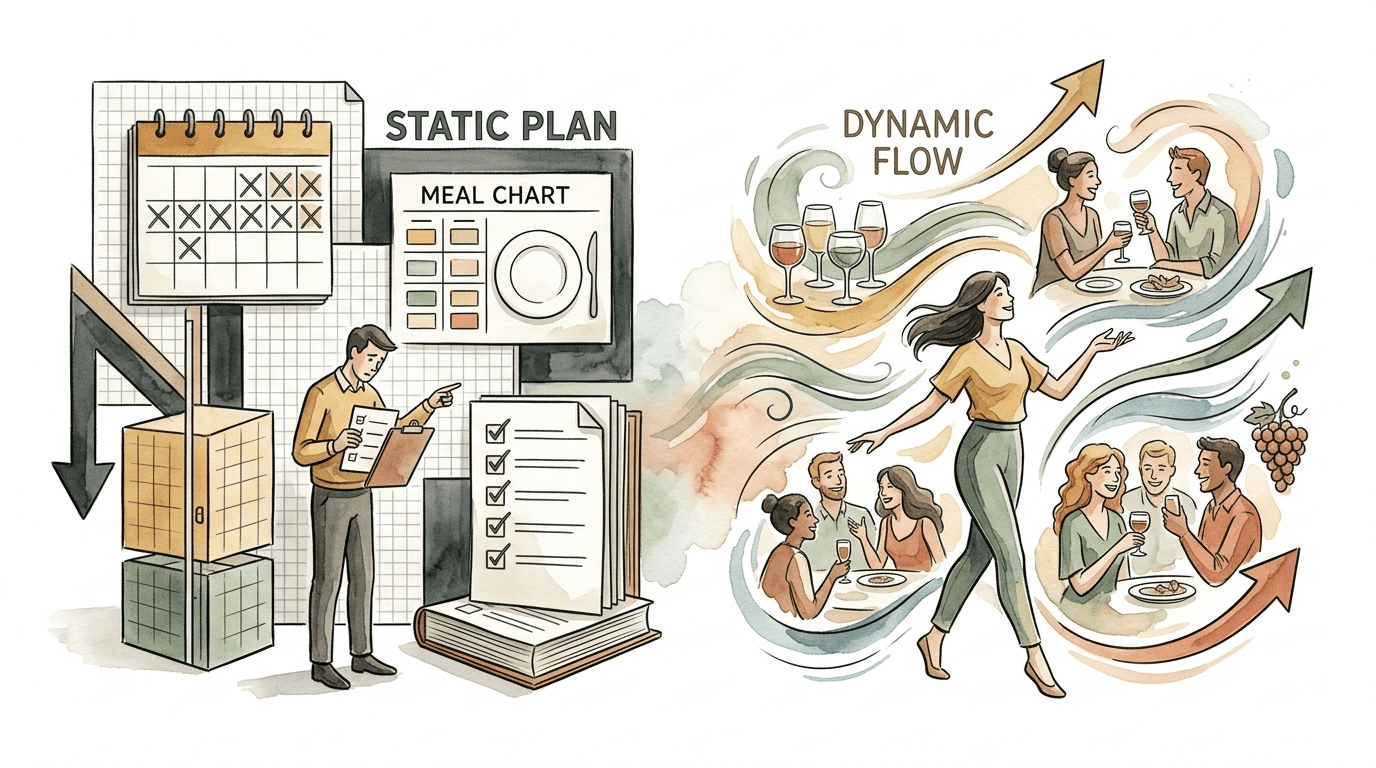
Don’t wait for the water to stop moving before you jump in; learn how to flow with the current of your life. A static mindset stays stuck in the mud whenever life gets ‘imperfect.’ You wait for the right week, the right mood, or the right moon phase to start. A dynamic mindset understands that life is a river. You don’t stop because there’s a pizza at the office; you flow around it. Food Freedom is about maintaining your momentum, no matter what flavor of chaos life throws your way.
Imagine your weight loss journey as a high-stakes road trip. A static plan is like a GPS that breaks the moment you hit a detour. If there is construction on the highway, you just park the car and give up. A dynamic mindset is the driver who sees the orange cones, laughs, and finds a scenic backroad. You still reach your destination, but you actually enjoy the ride.
This approach matters because your life is not lived in a laboratory. It is lived in crowded restaurants, festive holiday parties, and spontaneous happy hours. If your health goals cannot survive a birthday cake, your goals are too fragile. True progress happens when you learn to navigate the “imperfect” moments with confidence and grace.
Dynamic Weight Loss Mindset For Social Events
A dynamic mindset for social events is the practice of psychological flexibility. It is the ability to adjust your eating behaviors based on the current environment without losing sight of your long-term health. Instead of viewing a party as a “cheat day” or a “failure,” you view it as a data point in a much larger sequence of choices.
Rigid dieting relies on a binary system: you are either “on” your diet or “off” it. This creates a psychological trap where a single appetizer can lead to a weekend-long binge. Dynamic thinking replaces this with a spectrum of choices. You learn to ask yourself what “better” looks like in any given situation, rather than demanding “perfect.”
Research shows that people who use flexible restraint are far more successful at maintaining weight loss than those who use rigid restraint. Rigid dieters often have a higher Body Mass Index (BMI) because they are prone to the “what the hell” effect. This is the moment you eat one cookie, decide the day is ruined, and proceed to eat everything in the pantry. A dynamic mindset prevents this spiral by acknowledging that one choice does not define your identity or your progress.
You might find yourself at a wedding where the only options are heavy appetizers and an open bar. A static mindset feels panicked and deprived. A dynamic mindset scans the room, picks the two things that look the most delicious, and pairs them with plenty of water and conversation. You are in control of the food; the food is not in control of you.
How the Dynamic Mindset Works in Practice
Transitioning to a dynamic flow requires a shift in how you process environmental triggers. You must move from being a passive consumer to an active decision-maker. This process involves three main phases: preparation, presence, and post-event reflection.
Step one is the “pre-game” mental scan. Check your hunger levels before you leave the house. Arriving at a social event starving is a recipe for a “static” breakdown. Eat a high-protein snack like Greek yogurt or a handful of almonds an hour before you arrive. This stabilizes your blood sugar and ensures you are making choices with your prefrontal cortex, not your primal hunger.
Step two is the “environmental audit” once you arrive. Before grabbing a plate, take a full lap around the food spread. Identify the “must-haves” and the “skip-its.” Most of the time, we eat social food simply because it is there, not because we actually want it. By intentionally choosing the foods that provide the most satisfaction, you reduce the urge to mindlessly graze.
Step three involves the “social shift.” Remind yourself that the primary purpose of a gathering is connection, not calories. Hold your drink in your dominant hand. This creates a physical barrier that makes mindless reaching more difficult. Focus on the person you are talking to. Deepening a connection satisfies emotional needs that we often try to fill with appetizers.
Finally, practice “decision-making on the fly.” If the host brings out an unexpected dessert, you don’t need a rulebook to tell you what to do. You check in with your hunger, your goals for the week, and how much you actually like that specific dessert. If it’s a “yes,” you enjoy it mindfully. If it’s a “no,” you decline without guilt.
Benefits of Choosing a Dynamic Approach
Adopting a dynamic mindset offers measurable advantages for both your body and your brain. The most significant benefit is the elimination of the “rebound effect.” When you stop labeling foods as “forbidden,” they lose their power over you. You no longer feel the need to binge on “off-limit” items because you know you can have them again whenever you choose.
Long-term weight maintenance becomes significantly easier. Studies indicate that flexible dieting leads to better fat loss results over time compared to rigid protocols. This is because consistency beats intensity every single time. A person who eats 80% healthy and navigates social events with ease will outpace the person who eats 100% healthy for two weeks and then quits.
Mental health improvements are another major win. Rigid dieting is closely linked to increased anxiety, depression, and disordered eating patterns. A dynamic approach fosters body neutrality and self-compassion. You stop viewing yourself as “good” or “bad” based on what you ate for dinner. This reduces cortisol levels, which is a key factor in stubborn belly fat.
Social freedom is perhaps the most underrated benefit. You can finally attend a wedding or a dinner party without a cloud of food-related anxiety hanging over your head. You become the person who can enjoy a slice of pizza and then go right back to eating salads the next day without a second thought. This is the definition of true Food Freedom.
Challenges and Common Pitfalls
The transition from a static to a dynamic mindset is rarely a straight line. One of the biggest challenges is the influence of “food pushers.” These are well-meaning friends or family members who insist you “just try a bite” or tell you that “you’re already thin enough.” Responding to this pressure requires firm, polite boundaries.
Passive deflection is a powerful tool here. Instead of explaining your diet, which invites debate, simply say, “That looks delicious, but I’m full right now.” Most people will stop pushing if you don’t make it a “thing.” If you feel the need to justify your choices, you are still operating from a place of restriction rather than a place of power.
Another pitfall is the “saving up” trap. Many people skip breakfast and lunch to “save calories” for a big dinner. This almost always backfires. By the time you reach the event, your willpower is depleted, and your hunger hormones are screaming. You are much more likely to overeat and feel miserable afterward.
Lastly, watch out for “hidden” rigid rules. Sometimes we tell ourselves we are being flexible, but we are actually just creating new, complex rules. If your “flexible” plan involves five different apps and a spreadsheet, it’s not dynamic; it’s just a different kind of static. True flexibility feels light and intuitive.
Limitations: When This Approach May Not Be Ideal
While a dynamic mindset is the goal for most, there are situations where more structure is necessary. Individuals in the early stages of recovering from a clinical eating disorder may find total flexibility overwhelming. In these cases, a structured plan provided by a registered dietitian is often a safer starting point to rebuild a baseline of nourishment.
Extreme athletic performance goals might also require more rigid control. If you are a bodybuilder three weeks out from a show or a marathoner in peak training, your nutritional needs are highly specific. In these “seasons of intensity,” the margins for error are smaller, and a more static, data-driven approach is usually required.
Environmental limitations can also play a role. If you are in a situation where you have zero control over food quality or timing—such as certain military deployments or extreme remote travel—you may have to rely on a “survival” mindset rather than a “dynamic” one. In these cases, the focus shifts from optimization to basic adequacy.
Finally, some people struggle with a complete lack of structure. If total “flow” leads to total “chaos” for you, it is okay to use “bumpers.” Think of it like a bowling alley. You can have a dynamic flow, but keep some basic non-negotiables in place—like a minimum protein goal or a daily step count—to keep you from rolling into the gutter.
Comparison: Static Plan vs. Dynamic Flow
| Feature | Static Plan (Rigid) | Dynamic Flow (Flexible) |
|---|---|---|
| Core Philosophy | Rules and restrictions. | Values and adjustments. |
| Reaction to Detours | Quitting or “cheating.” | Adapting and pivoting. |
| Social Life | Anxiety-inducing or avoided. | Integrated and enjoyed. |
| Long-term Success | Low (High dropout rate). | High (Sustainable habits). |
| Internal Narrative | “I failed today.” | “I learned today.” |
Practical Tips for Social Events
Mastering the social scene is a skill that improves with practice. Start by using the “one-plate rule” at buffets. Instead of going back for seconds and thirds, fill one plate with a mix of high-protein items, vegetables, and one or two treats. When the plate is empty, you are done. This creates a clear physical end-point for the meal.
Hydration is your secret weapon. Drink a full glass of water between every alcoholic or sugary beverage. This not only cuts your liquid calorie intake in half but also keeps your decision-making sharp. Dehydration is often mistaken for hunger, leading to unnecessary snacking late in the evening.
Focus on “adding” rather than “subtracting.” Instead of telling yourself you can’t have the steak, tell yourself you must have a large serving of greens first. By focusing on getting your nutrients in, you naturally have less room for the calorie-dense items that don’t serve your goals.
Use the “10-minute pause.” If you find yourself eyeing the dessert table for a second helping, wait ten minutes. Walk away, engage in a conversation, or step outside for fresh air. Usually, the initial “hit” of a craving fades after a few minutes, allowing you to make a more conscious choice.
Advanced Considerations: The Role of Stress and Sleep
A dynamic mindset is significantly easier to maintain when your physiology is supported. Sleep deprivation is the enemy of flexibility. When you are tired, your amygdala becomes hyper-responsive to food cues, and your willpower (residing in the prefrontal cortex) is offline. Prioritize 7–9 hours of sleep before a big social weekend.
Stress management is equally critical. If you are using a social event as an escape from a high-stress week, you are more likely to use food as a primary coping mechanism. Practice a few minutes of box breathing before walking into a party. Lowering your heart rate helps you stay in a “flow” state rather than a “fight or flight” state.
Understand the “thermic effect of social eating.” Social meals are often higher in salt and carbohydrates, which causes temporary water retention. A dynamic mindset understands that a 3-pound jump on the scale after a wedding is not fat gain; it is simply biology. Don’t panic and slash calories the next day. Return to your baseline and let your body re-equilibrate.
Metabolic flexibility is the ultimate goal. This is the body’s ability to switch between burning carbohydrates and fats efficiently. By maintaining a generally high level of activity and a protein-rich diet, you create a “metabolic buffer” that allows your body to handle occasional high-calorie events without significant impact on your body composition.
Scenarios: Theory in Action
Scenario A: The Office Pizza Party.
A static mindset sees the pizza boxes and thinks, “Well, my diet is ruined for the day. I might as well eat four slices and grab a soda.” A dynamic mindset thinks, “I didn’t plan for pizza, but I can make this work. I’ll have two slices of the one with veggies, skip the soda for water, and I’ll make sure my dinner tonight is extra high in protein and fiber.” The day is a win.
Scenario B: The All-Day Family Holiday.
A static mindset tries to eat nothing all day, gets ravenous by 4 PM, and then spends three hours grazing on appetizers and desserts until they feel sick. A dynamic mindset eats a solid breakfast, enjoys a moderate plate of the “specialty” holiday foods at dinner, and spends the rest of the time playing games with cousins or helping clean up. They leave feeling energized and connected rather than bloated and guilty.
Scenario C: The Spontaneous Happy Hour.
A static mindset declines the invite because it’s not “on the plan,” leading to feelings of isolation and FOMO. A dynamic mindset goes, orders a soda water with lime and one appetizer to share, and enjoys the laughter. They realize that the “momentum” of their life is more important than a perfectly tracked day on an app.
Final Thoughts
Shifting from a static plan to a dynamic flow is the single most important move you can make for long-term health. It moves the needle from “temporary fix” to “permanent lifestyle.” You are no longer waiting for life to get quiet so you can be healthy. You are becoming healthy *because* you have learned to navigate the noise.
Consistency is not about never making a mistake; it is about never staying down. Every social event is a new opportunity to practice your “flow.” Some days you will navigate the appetizers like a pro; other days you might eat a few too many wings. In a dynamic mindset, both days provide valuable information for the future.
Start small. Choose one social event this week and commit to being a “dynamic” participant. Focus on the people, choose your indulgences intentionally, and keep your momentum moving forward. Your future self will thank you for the freedom you are building today.
Sources
1 bulknutrients.com.au | 2 rockrecoveryed.org | 3 herbalone.com | 4 weightlossrva.com | 5 medainc.org | 6 justinthomasmiller.com | 7 brownhealth.org | 8 mayoclinic.org | 9 pritikin.com | 10 connectionswellnessgroup.com | 11 transformationcentermadison.com | 12 bodyrecomposition.com