


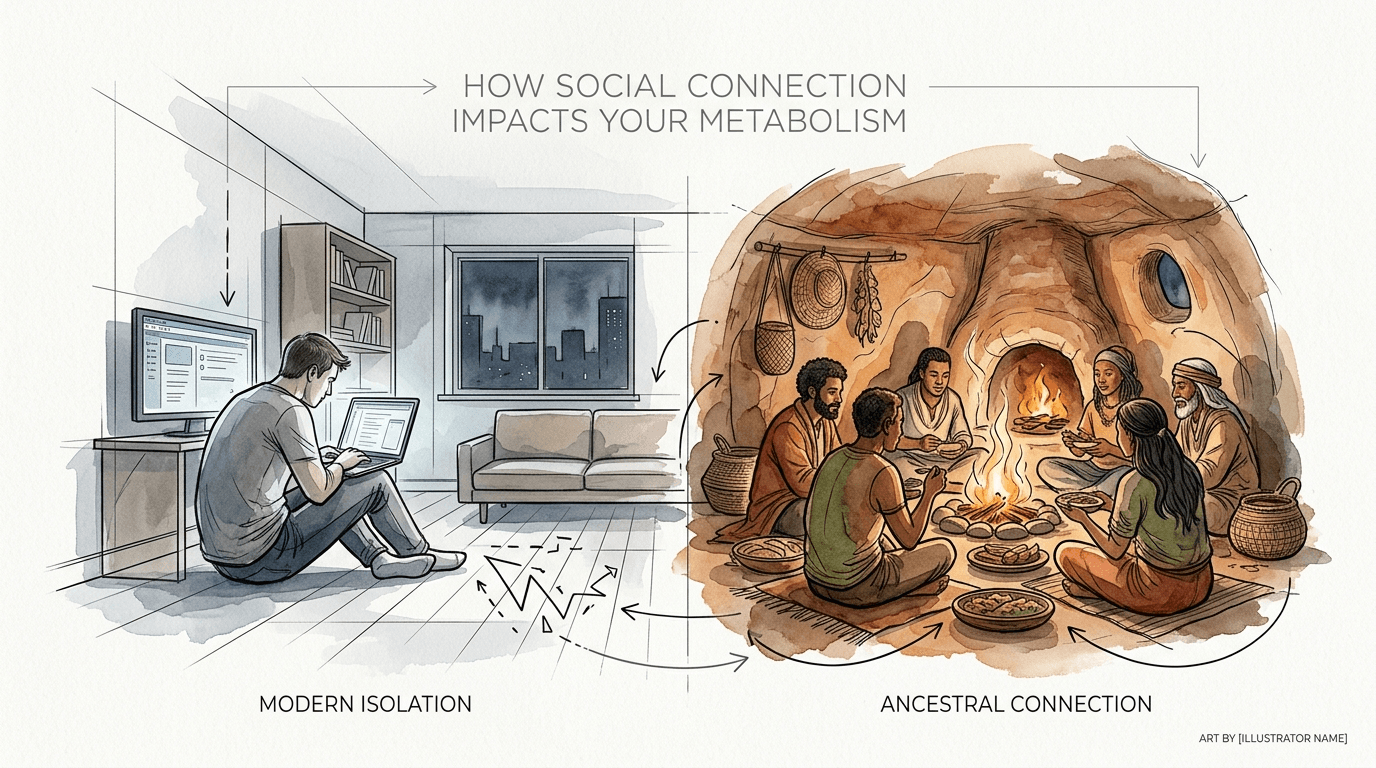
We traded the warmth of the tribe for the glow of the screen, and our metabolism is paying the price. For thousands of years, eating was a communal act of safety and celebration. Today, it’s a solitary act of convenience and shame. When we disconnect from people, we disconnect from our body’s natural satiety signals. It’s time to bring the tribe back to the table.
Metabolism is more than just calories in and calories out. It is a complex hormonal symphony regulated by your environment. Your body is constantly scanning for safety. In the past, safety meant being with the group. Today, chronic isolation signals a state of biological “emergency.” This shift changes how you process every single bite of food.
How Social Connection Impacts Your Metabolism
Social connection is a biological necessity, not a luxury. When you interact with people you trust, your brain releases oxytocin. Often called the “love hormone,” oxytocin does more than just make you feel warm and fuzzy. It acts as a powerful metabolic regulator.
Research shows that oxytocin can directly suppress appetite and reduce reward-related eating. It shifts your brain’s focus from “cravings” to “connection.” On the flip side, chronic loneliness acts as a persistent stressor. This triggers the HPA axis, leading to elevated cortisol levels.
High cortisol is a disaster for your waistline. It signals your body to store visceral fat and increases systemic inflammation. Over time, this leads to insulin resistance. When you are lonely, your body stays in a “fight or flight” state. In this mode, digestion is deprioritized, and fat storage becomes the default setting for survival.
The Biological Machinery of Connection
Your body uses the vagus nerve to communicate between the brain and the gut. This is the longest nerve in your body. It is the highway for your “rest and digest” system. Social engagement actually “tones” this nerve.
The Role of Vagal Tone
Vagal tone refers to how well your vagus nerve functions. High vagal tone means your body can pivot quickly from stress back to a state of calm. Positive social interactions—like laughter, eye contact, and deep conversation—stimulate the vagus nerve. This stimulation triggers the release of digestive enzymes and improves gut motility.
Oxytocin vs. Cortisol Balance
Oxytocin and cortisol are like a seesaw. When you are socially connected, oxytocin goes up, and cortisol naturally drops. This hormonal shift improves fat oxidation. Essentially, being with your “tribe” makes your body more efficient at using fat for fuel. Isolation flips this switch, making you more likely to crave high-sugar, high-fat “comfort” foods to self-soothe.
Benefits of Communal Dining
Communal eating is a cornerstone of the world’s Blue Zones. These are regions where people live the longest, healthiest lives. They don’t just eat healthy food; they eat it together. This practice provides measurable metabolic advantages.
- Improved Satiety: Socializing slows down the pace of a meal. This gives your brain the 20 minutes it needs to register leptin, the hormone that tells you you’re full.
- Lower Glycemic Response: Relaxation during a meal can actually lower the blood sugar spike of that meal. Stress hormones like cortisol usually cause blood sugar to rise; social safety prevents this.
- Enhanced Nutrient Absorption: A calm body produces more stomach acid and enzymes. You get more “bang for your buck” from the nutrients in your food.
- Reduced Emotional Eating: When your emotional needs are met by people, you are less likely to seek “fullness” through a bag of chips.
Challenges and Common Mistakes
While connection is a metabolic superpower, it has a trap known as social facilitation. Studies show that people often eat up to 44% more food when dining with friends or family compared to eating alone. This is an ancestral survival mechanism—our ancestors ate as much as possible when food was shared to ensure they wouldn’t starve later.
The “Social Facilitation” Trap
When we are having fun, we lose track of our internal satiety signals. We match the pace of the fastest eater at the table. This is why many “social butterflies” struggle with weight. They are getting the oxytocin, but they are also getting a massive caloric surplus because they aren’t paying attention to the food.
The “Strangers” Effect
Interestingly, this effect disappears when we eat with strangers. We often eat *less* in front of people we don’t know because we want to make a good impression. The metabolic magic only happens when you are with people who make you feel safe enough to be yourself, but that same safety can lead to mindless overindulgence.
Limitations: When Socializing Fails Metabolism
Not all social connections are created equal. If your social circle revolves entirely around “happy hours” and deep-fried appetizers, your metabolism will suffer regardless of your oxytocin levels. Toxic social stress is even worse than isolation.
High-conflict relationships or social anxiety can turn a dinner party into a metabolic nightmare. If you feel judged or on edge, your sympathetic nervous system takes over. This shuts down digestion and spikes insulin. In these cases, eating alone in a peaceful environment might actually be better for your blood sugar than a stressful family dinner.
Comparison: Solitary vs. Communal Eating
| Factor | Solitary Eating (Isolation) | Communal Eating (The Tribe) |
|---|---|---|
| Primary Hormones | High Cortisol, Low Oxytocin | High Oxytocin, Low Cortisol |
| Digestive State | Sympathetic (Fight/Flight) | Parasympathetic (Rest/Digest) |
| Eating Speed | Rapid (Mindless) | Moderate (Conversational) |
| Metabolic Focus | Fat Storage & Inflammation | Energy Expenditure & Repair |
Practical Tips for a Metabolic “Tribe”
You don’t need a massive dinner party every night to reap the benefits. Small, intentional shifts can rewire your metabolic response to food.
- The “No-Screen” Rule: Technology is a barrier to connection. Put the phones in another room. The “glow of the screen” interferes with your brain’s ability to process satiety.
- Eye Contact Matters: Real metabolic safety is signaled through the eyes. Make a point to look at your dining partners. It triggers the vagus nerve more effectively than just talking.
- The “First Bite” Ritual: Start the meal with a moment of gratitude or a shared breath. This tells your nervous system that the “hunt” is over and it is safe to digest.
- Curate Your Circle: Eat with people who value health. We unconsciously model the behaviors of our “tribe.” If they eat slowly and choose whole foods, you will too.
Advanced Considerations: Polyvagal Theory
Serious health practitioners should look into Polyvagal Theory. This theory suggests that our nervous system has three states. The “Social Engagement System” is the most advanced. It allows us to feel safe in the presence of others.
When this system is active, your heart rate slows down, and your Heart Rate Variability (HRV) increases. High HRV is a marker of a resilient metabolism and a healthy heart. By prioritizing social connection, you aren’t just “being nice.” You are training your nervous system to stay in the optimal zone for metabolic health and longevity.
Example Scenario: The Blue Zone Dinner
Imagine a resident in Okinawa, Japan. They don’t eat alone in front of a TV. They gather with their moai—a lifelong circle of friends. They serve small portions of plant-heavy dishes.
Because they are talking and laughing, the meal lasts an hour. Their oxytocin levels are high, which keeps their appetite in check. Their cortisol is low because they feel supported and safe. Even if the meal contains carbohydrates, their relaxed state ensures a stable insulin response. This isn’t just a “healthy diet”; it is a metabolic environment designed for survival.
Final Thoughts
The modern epidemic of metabolic disease is deeply linked to our epidemic of loneliness. We are trying to solve a hormonal problem with more “willpower,” but willpower is a finite resource that vanishes when we feel isolated. Your body is designed to thrive in a community.
When you bring the tribe back to the table, you change the chemistry of your body. You move from a state of survival to a state of thriving. Start small. Invite one friend to dinner. Turn off the TV. Listen more than you chew.
Experiment with your environment. Notice how you feel after a solitary meal versus a shared one. You might find that the best “supplement” for your metabolism isn’t a pill—it’s the person sitting across from you.
Sources
1 homedoc.com.au | 2 atlantichealth.org | 3 thelondonobesityclinic.com | 4 nih.gov | 5 frontiersin.org | 6 gethealthspan.com | 7 signos.com | 8 frontiersin.org | 9 godaellimentalhealth.com | 10 bluetreenutrition.com | 11 mhanational.org | 12 nih.gov | 13 physiology.org | 14 kvc.org | 15 ssib.org | 16 bluezoneshealth.com | 17 ahaclinics.com.au | 18 yourhealthmagazine.net | 19 harvard.edu