


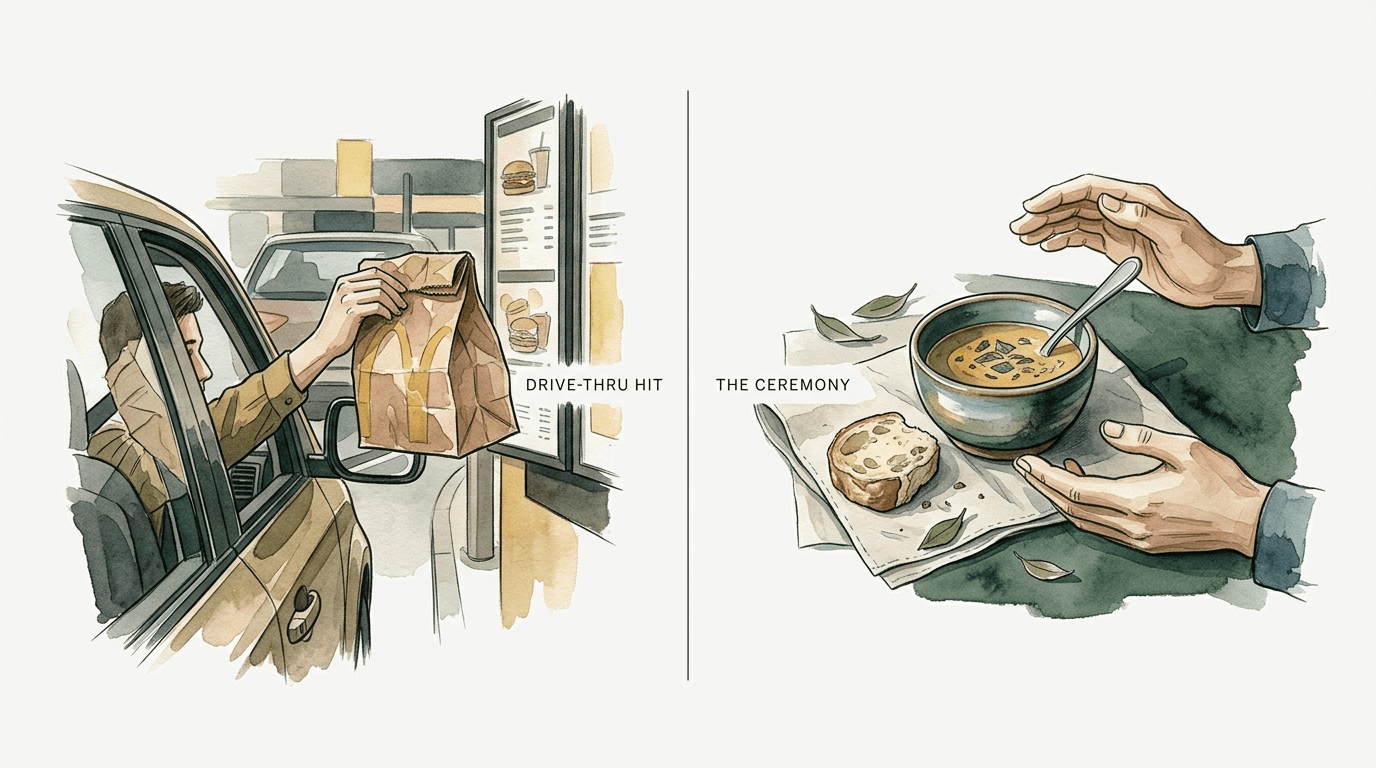
We stopped treating food as a guest and started treating it as a quick fix. Our ancestors didn’t have ‘cheat days’ because every meal was a ceremony. Now, we eat in transit, in secret, and in a rush. When you lose the ritual, you lose the respect for the fuel. Breaking free from diet culture starts with sitting down and staying a while.
The modern world has turned eating into a background task. We scroll through feeds while shoving sandwiches into our mouths. We drive with one hand on the wheel and the other in a bag of fries. This isn’t just about bad manners. It is a fundamental shift in how our bodies process energy.
When you rush, your body stays in a state of high alert. This prevents you from ever feeling truly satisfied. To fix your relationship with food, you must move from the quick “hit” to the intentional “ceremony.” This guide will show you exactly how to reclaim your plate and your health.
Mindful Eating Vs Modern Food Culture
Mindful eating is the practice of maintaining a non-judgmental awareness of your physical and emotional sensations while eating. It is the opposite of the “Drive-Thru Hit,” where the goal is speed and immediate dopamine. In modern culture, food is often viewed as a commodity or an inconvenience to be handled as quickly as possible.
Historically, humans viewed meals as the centerpiece of the day. Shared meals were the primary way our ancestors forged social bonds and ensured survival. Today, roughly one in four American adults eats all their daily meals in solitude. This is a 50% increase since 2003. When we eat alone and in a rush, we lose the internal cues that tell us we are full.
Modern food culture is designed to be “hyper-palatable.” Food scientists engineer products with specific combinations of fat, sugar, and sodium to override your brain’s natural satiety signals. This creates a cycle where you eat more but feel less satisfied. Mindful eating breaks this cycle by forcing the brain to catch up with the stomach. It shifts you from a “survival” state of eating into a “nourishment” state.
The Anatomy of the Ceremony: How Mindful Eating Works
Mindful eating works by engaging the parasympathetic nervous system. This is often called the “rest and digest” state. When you are stressed or rushed, your body produces cortisol. High cortisol levels divert blood flow away from your digestive tract and toward your muscles. This literally shuts down your ability to process nutrients efficiently.
To transition from a “Drive-Thru Hit” to “The Ceremony,” you must follow a deliberate process. This involves retraining your brain to recognize the difference between physical hunger and emotional cravings.
The 5 S’s of the Mindful Meal
- Sit Down: Never eat while standing, walking, or driving. Creating a dedicated space for your meal signals to your brain that it is time to focus on nourishment.
- Slowly Chew: Most people swallow food before it is properly broken down. Aim to chew each bite at least 20 to 30 times. This allows saliva enzymes to begin the digestive process early.
- Savor: Pay attention to the texture, temperature, and specific flavors of each bite. Is the food salty, sweet, or bitter? Is it crunchy or smooth?
- Simplify: Remove all distractions. Turn off the television and put your phone in another room. Research shows that eating in front of screens can lead to a 10% to 20% increase in calorie consumption because the brain “misses” the meal.
- Smile: Take a breath between bites. This brief pause helps you check in with your stomach’s fullness levels before you take the next forkful.
The BASICS Technique
Practitioners often use the BASICS acronym to ground themselves before a meal. First, Breathe and check your belly for hunger. Ask yourself on a scale of 1 to 10 how hungry you actually are. Second, Assess your food. Look at the colors and smell the aroma. Third, Slow Down your pace. Fourth, Investigate your hunger throughout the meal. Many people find they are full halfway through but keep eating out of habit. Finally, Chew thoroughly and Savor the finish.
Benefits of Reclaiming the Ritual
The benefits of mindful eating extend far beyond weight management. While traditional diets focus on *what* you eat, mindfulness focuses on *how* you eat. This leads to measurable physiological and psychological changes.
Improved Digestion: When you eat in a relaxed state, your body produces more digestive enzymes and stomach acid. This reduces common issues like bloating, gas, and acid reflux. Many cases of “indigestion” are actually “fast-digestion” caused by a stressed nervous system.
Stable Blood Sugar: Eating slowly prevents the massive glucose spikes associated with “wolfing down” refined carbohydrates. This leads to more stable energy levels throughout the afternoon and fewer “crashes” that trigger sugar cravings.
Better Satiety Signaling: It takes about 20 minutes for your stomach to send chemical signals to your brain that you are full. In a “Drive-Thru Hit” scenario, you can consume 1,000 calories in 10 minutes. By the time the signal arrives, you have already overeaten. Slowing down allows hormones like leptin to do their job.
Emotional Regulation: Mindful eating helps you identify “non-hunger” triggers. You begin to see when you are eating because you are bored, lonely, or stressed. This awareness is the first step in breaking the cycle of emotional eating.
Challenges and Modern Pitfalls
The biggest challenge to mindful eating is the environment we live in. We are surrounded by cues that encourage mindless consumption.
The “Dopamine Loop”: Hyper-palatable foods trigger a massive dopamine release in the brain. This is the same chemical released during gambling or drug use. It makes the “ceremony” feel boring at first because your brain is addicted to the “hit.”
The Productivity Myth: Many people feel that taking 20 minutes for a silent lunch is a waste of time. They believe they are being more productive by working through lunch. In reality, the resulting brain fog and poor digestion actually lower productivity in the long run.
Social Pressure: Eating is a social activity. If you are with a group that eats quickly or focuses on “cheat days” and “food guilt,” it can be difficult to maintain your own pace. People often feel the need to “keep up” with the fastest eater at the table.
Limitations and Realistic Constraints
Mindful eating is a powerful tool, but it is not a universal cure for every nutritional issue. There are realistic boundaries to consider.
Food Insecurity: For individuals living in food deserts or facing financial hardship, the “ceremony” may feel like a luxury. It is difficult to be mindful about a meal when you are worried about where the next one is coming from.
Orthorexia Concerns: In some cases, an extreme focus on “perfect” mindful eating can transition into a new form of disordered eating. If the ritual becomes a source of anxiety rather than a source of peace, it has lost its purpose.
Time Barriers: Parents with young children or professionals with back-to-back shifts may truly lack a 20-minute window for a silent meal. In these cases, the goal should be “more mindful” rather than “perfectly mindful.” Even taking three deep breaths before the first bite can make a difference.
Drive-Thru Hit Vs The Ceremony
To understand the difference, look at how these two approaches compare across different factors.
| Factor | The Drive-Thru Hit | The Ceremony |
|---|---|---|
| Primary Goal | Speed and immediate satisfaction. | Nourishment and awareness. |
| Nervous System | Sympathetic (Fight or Flight). | Parasympathetic (Rest and Digest). |
| Hormonal Response | High Cortisol, suppressed Leptin. | Balanced Ghrelin, active Leptin. |
| Digestion | Incomplete; prone to bloating. | Optimal; efficient nutrient uptake. |
| Post-Meal Feeling | Bloated, tired, or guilty. | Satisfied, energized, and calm. |
Practical Tips for Immediate Application
You don’t need a meditation cushion to start eating mindfully. You can begin with your next snack.
- The 20-Minute Timer: Set a timer on your phone for 20 minutes. Challenge yourself to make the meal last until the timer goes off. If you finish early, you know you are still in “Drive-Thru” mode.
- Use Your Non-Dominant Hand: This is a simple “pattern interrupt.” It forces you to pay attention to the physical act of eating because it feels slightly awkward.
- The “First Three Bites” Rule: If you can’t commit to a full mindful meal, commit to the first three bites. No talking, no screens, just the food. This sets a tone for the rest of the meal.
- Put Down the Utensils: After every bite, put your fork or spoon back on the table. Do not pick it up again until you have completely swallowed your current bite.
Advanced Considerations: Interoceptive Awareness
For those who want to go deeper, the ultimate goal of mindful eating is to build “Interoceptive Awareness.” This is the ability to sense the internal state of your body. Experienced practitioners can feel the exact moment their blood sugar begins to stabilize or when a specific food causes a subtle inflammatory response.
Advanced mindful eating also involves “Intuitive Selection.” Instead of following a rigid meal plan, you learn to ask your body what it needs. This is not about giving in to cravings for donuts. It is about recognizing that your body might need more protein after a heavy workout or more hydration on a hot day. This level of connection turns food from a source of stress into a source of data.
Scenario: The Mindful Shift
Imagine a busy professional named Sarah. Usually, Sarah eats a salad at her desk while answering emails. She finishes in eight minutes, barely remembers what the dressing tasted like, and feels hungry again by 3:00 PM. She often feels bloated and relies on caffeine to get through the afternoon.
One Tuesday, Sarah tries “The Ceremony.” She closes her laptop and moves to a small table near a window. She takes three deep breaths before opening her container. She notices the crunch of the cucumbers and the creaminess of the avocado. She puts her fork down between bites.
It takes her 22 minutes to finish. She realizes she didn’t actually need the second half of her sandwich because she felt full after the salad. At 3:00 PM, she feels alert and steady. She has no desire for the office cookies. By changing the *ritual*, Sarah changed her *biology*.
Final Thoughts
The “Drive-Thru Hit” is a symptom of a culture that values speed over substance. We have been taught that food is fuel to be consumed as efficiently as possible. But your body is not a machine, and your meals are not just transactions. When you reclaim the ceremony, you reclaim your health.
Mindful eating is a skill that requires practice, not a set of rules that requires perfection. Some days you will still find yourself eating a granola bar in the car. That is okay. The goal is to move the needle toward awareness and away from autopilot.
Start small. Choose one meal today to treat as a guest. Sit down, stay a while, and listen to what your body is telling you. You might be surprised at how much better the fuel works when you finally give it the respect it deserves.
Sources
1 foodunfolded.com | 2 medium.com | 3 psychologytoday.com | 4 mindful.org | 5 eatingdisorders.org.au | 6 thepongroup.com | 7 pushhere.com | 8 harvard.edu | 9 jacobin.com | 10 worldhappiness.report | 11 rdnjen.com | 12 spatzmedical.com | 13 eli.health | 14 fodyfoods.com | 15 lamclinic.com | 16 berkeley.edu | 17 usu.edu | 18 brighamandwomens.org | 19 healthcare-bulletin.co.uk | 20 nih.gov | 21 curioninsights.com | 22 nih.gov | 23 researchgate.net | 24 ku.edu