


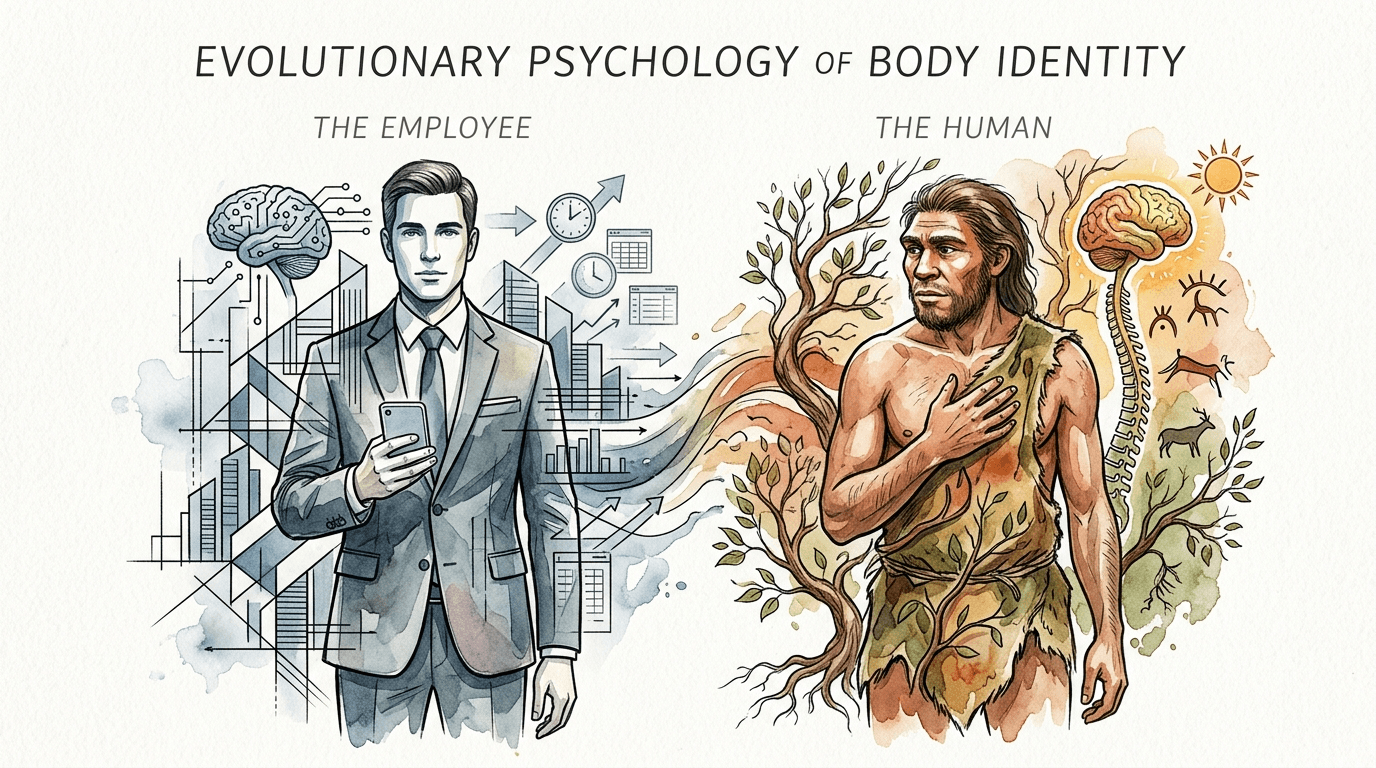
You aren’t broken; you’re just domesticated in an environment that wasn’t built for your biology. Modern life has domesticated us into ‘Urban’ identities—sedentary, screen-bound, and fueled by convenience. But deep inside, your biology is ‘Wild.’ It craves movement, sunlight, and real signals. When you shift your identity from ‘Office Worker’ to ‘Biological Human,’ the weight doesn’t stand a chance.
Most weight loss advice focuses on the mechanics of the “how”—the calories, the macros, and the minutes on a treadmill. While these factors matter, they are often symptoms of a deeper conflict. This conflict is the friction between your ancient operating system and the modern, high-calorie software it is forced to run. When you view yourself as an “Office Worker” trying to fit in a workout, you are fighting an uphill battle against your own self-image.
Changing your body requires more than a new gym membership; it requires a fundamental shift in how you perceive your place in the world. You are a biological entity first and a social role second. By reclaiming your identity as a “Biological Human,” you stop fighting your instincts and start working with them. This article explores the psychology of this shift and how to align your modern life with your wild biology.
Evolutionary Psychology Of Body Identity
Evolutionary psychology is the study of how our mental processes and behaviors were shaped by the survival pressures of our ancestors. For roughly 99.5% of human history, we lived as hunter-gatherers in environments where food was scarce and physical exertion was mandatory for survival. Our “Body Identity” in that world was one of capability, movement, and metabolic flexibility. We didn’t have to “exercise” because life itself was a workout.
In the modern world, we experience what scientists call “Evolutionary Mismatch Theory” (EMT). This occurs when an evolved adaptation—like the “thrifty gene hypothesis” that helps us store fat efficiently for times of famine—becomes a liability in an environment of constant calorie abundance. Our brains are still wired to save energy and seek out sugar, salt, and fat because those signals once meant survival.
Your current identity is likely “domesticated.” Much like a wolf becomes a pug through centuries of controlled environment and feeding, humans have been domesticated by the conveniences of urban life. We sit for 60% of our waking hours and consume processed foods that hijack our reward centers. Our identity becomes “Urban Man” or “Office Woman,” roles that prioritize productivity over physiology. This creates a psychological barrier where healthy choices feel like a “sacrifice” rather than a return to your natural state.
This identity shift is not about “going back to the cave.” It is about recognizing that your body is a vessel for ancient genetic code that expects certain signals. When you provide those signals—movement, sunlight, and whole foods—your body naturally gravitates toward its optimal weight. The “Biological Human” doesn’t struggle to choose broccoli over chips because they view their body as a high-performance machine rather than a passive consumer of convenience.
The Identity-Behavior Loop: How to Shift
The core of sustainable change lies in the identity-behavior loop. Research into identity-based habit change suggests that your actions are a reflection of who you believe you are. If you say, “I am trying to lose weight,” you are still identifying as the person who is “overweight” but struggling to change. If you say, “I am someone who nourishes my biology,” you are acting from a place of existing identity.
To shift your identity from “Urban” to “Wild,” you must use the “Small Wins Strategy.” Every time you take a five-minute walk or choose a protein-heavy meal, you are casting a vote for your new identity. These are not just “health choices”; they are pieces of evidence that prove to your brain that you are a Biological Human. Over time, these small actions rewire your self-perception until healthy choices feel automatic.
Language rewiring is also crucial. Instead of saying “I can’t have that cookie,” which implies a loss of agency and a feeling of deprivation, a Biological Human says “I don’t want that.” This subtle shift moves you from being a victim of your environment to a decision-maker who understands that processed sugar is an “environmental mismatch” signal that doesn’t serve your wild biology.
Step 1: Environmental Engineering
Your environment triggers your identity. If your desk is surrounded by snacks and your lights are on full blast until midnight, you are signaling to your biology that it is in a “domesticated” state. Start by engineering your space to favor movement. Use a standing desk, keep water nearby, and ensure you have access to natural light early in the morning.
Step 2: Movement as Metabolism
Stop viewing movement as a 60-minute block of “exercise” and start viewing it as a constant metabolic signal. Our ancestors never sat for eight hours straight. They moved frequently at low intensities—walking, climbing, and carrying. Incorporating “incidental exercise,” like taking the stairs or walking while on a phone call, tells your body that it needs to maintain muscle mass and burn fat for energy.
Step 3: Circadian Sourcing
Your biology is synchronized with the sun. Exposure to morning sunlight sets your cortisol and melatonin rhythms, which regulates hunger and energy. An “Urban” identity ignores the sun, living in artificial light that confuses the metabolism. A “Wild” identity prioritizes the sun, ensuring that the body knows exactly what time it is and when it should be burning fat versus storing it.
Benefits of the Biological Identity Shift
When you embrace the identity of a Biological Human, the benefits extend far beyond the scale. You aren’t just losing fat; you are reclaiming your metabolic flexibility. This is the ability of your body to switch efficiently between burning carbohydrates and burning stored body fat. In a domesticated state, we lose this flexibility and become “sugar burners,” constantly hungry and prone to energy crashes.
Another measurable benefit is the reduction of chronic low-grade inflammation. Modern diets and sedentary lifestyles keep our immune systems in a state of high alert. By aligning your lifestyle with evolutionary signals, you reduce the triggers for inflammation, which leads to better skin, clearer thinking, and faster recovery from physical stress. You move from a state of “surviving” the modern world to “thriving” within it.
The psychological liberation is perhaps the greatest advantage. You stop the exhausting cycle of willpower and “dieting.” When your identity is aligned with your biology, there is no “cheating” because there is no restriction. You are simply feeding the animal that you are the most nutrient-dense fuel possible. This shift creates a sense of confidence and autonomy that “Urban” identities often lack.
Challenges and Common Mistakes
The biggest challenge in this transition is the “Efficiency Trap.” Your brain is naturally wired to save energy, a trait that was useful when food was scarce but is disastrous when a couch and a refrigerator are five feet away. Your brain will try to convince you that sitting is better than standing and that the “quick hit” of sugar is a good survival strategy. Recognizing this as a relic of your ancient mind is the first step to overcoming it.
Social friction is another common pitfall. Modern social life is often centered around sedentary behavior and “domesticated” food. Choosing to stand at a party or opting for water over soda can feel alienating. Many people fail because they prioritize social conformity over biological integrity. It is important to find or create a community that values ancestral health principles to provide the necessary social support.
Many also make the mistake of “All-or-Nothing” thinking. They try to go from “Office Worker” to “Marathon Runner” overnight. This usually leads to injury or burnout. Evolution is a slow process, and so is identity change. If you miss a day of movement, don’t abandon the identity. A “Wild” animal might have a slow day, but it is still a wild animal. Get back to your signals as soon as possible.
Limitations and Realistic Boundaries
It is important to acknowledge that we live in a world that is fundamentally different from the one our ancestors inhabited. We cannot simply “be hunter-gatherers.” We have jobs, mortgages, and family responsibilities that require us to be in front of screens or in climate-controlled offices. Ignoring these realities is a recipe for frustration.
Environmental limitations, such as living in a “food desert” or a city with poor air quality, can make certain biological signals harder to obtain. In these cases, you must focus on the “modifiable lifestyle factors” that you can control. You might not be able to hunt your own food, but you can prioritize protein and fiber from the grocery store. You might not be able to hike for four hours, but you can use a standing desk for part of your workday.
Additionally, modern medicine and technology are not the enemy. We shouldn’t throw out the benefits of vaccines, surgery, or data tracking just to be “more wild.” The goal is a synthesis: using modern knowledge to satisfy ancient biological needs. This balanced approach ensures you aren’t just “cosplaying” a caveman, but actually improving your longevity and health span.
Comparison: The Urban Identity vs. The Wild Biology
| Feature | Urban Identity (Domesticated) | Wild Biology (Aligned) |
|---|---|---|
| Movement Pattern | Sedentary with bursts of intense “gym time” | Frequent low-intensity movement (walking/standing) |
| Nutritional Logic | Calorie counting and restriction | Nutrient density and metabolic signals |
| Light Exposure | Artificial light; minimal sun exposure | Morning sun; low blue light at night |
| Stress Response | Chronic, low-grade (emails, traffic) | Acute, resolved (sprints, cold, play) |
| Self-Image | Passive consumer / “Employee” | Active agent / “Biological Human” |
Practical Tips for Immediate Application
- The 10-Minute Sun Rule: Get outside within 30 minutes of waking up. This signals your brain to start the “daytime” metabolic clock.
- Protein-First Eating: Every meal should start with a high-quality protein source. This triggers satiety signals that “Urban” processed foods lack.
- The Standing Default: If you are on a phone call or watching a quick video, stand up. Turn movement into your default state rather than your exception.
- Digital Sunset: Turn off bright overhead lights and use orange-tinted lamps two hours before bed. This protects your melatonin and ensures deep, restorative sleep.
- Carry Things: Incorporate “functional loading” by carrying groceries or a backpack. This tells your body it needs to keep its muscle and bone density.
Advanced Considerations: Epigenetics and Signals
For those looking to go deeper, understand that you are an epigenetic machine. Your genes are not your destiny; they are a library of possibilities. Environmental signals—what you eat, how you move, and even what you think—determine which genes are “turned on.” By shifting your identity, you are essentially changing the instructions you give to your cells.
One advanced concept is the “Behavioral Immune System.” This is a suite of psychological mechanisms that help us avoid pathogens. In the modern world, this system can be misaligned, leading to social anxiety or avoidant behaviors that prevent us from engaging in the communal activities our biology craves. Strengthening your identity as a Biological Human allows you to recognize these “false alarms” and prioritize the social connection that is vital for hormonal health.
Another area of focus is metabolic flexibility training through “Time-Restricted Feeding.” By occasionally extending the window between dinner and breakfast, you teach your body to tap into stored fat. This isn’t just about weight loss; it’s about “stressing” the system in a way that makes it more resilient, similar to how our ancestors would have experienced periods of food scarcity.
Example Scenario: The Transformation of “The Employee”
Consider the case of “Sarah,” a 45-year-old manager who identified as an “Office Worker.” She spent 10 hours a day sitting, drank three cups of coffee to stay awake, and “treated” herself with wine and pasta at night. She viewed her body as something that needed to be “fixed” with a diet.
When Sarah shifted her identity to “Biological Human,” her approach changed. She didn’t start a diet; she started sending better signals. She traded her morning coffee at her desk for a 15-minute walk in the sun. She bought a standing desk and moved her bin to the other side of the room so she had to walk to use it. She stopped counting calories and started focusing on eating 30 grams of protein at every meal.
Within six months, Sarah lost 25 pounds without ever feeling like she was “dieting.” Her identity had shifted so completely that she no longer saw processed snacks as “food.” She saw them as “non-signals.” Her weight loss was a natural byproduct of her biology finally receiving the instructions it had been waiting for for decades. She wasn’t an office worker trying to lose weight; she was a biological human thriving in a modern world.
Final Thoughts
Your body is an incredibly sophisticated piece of biological technology. It has been refined over millions of years to be lean, energetic, and resilient. The reason it currently feels “broken” is simply because it is being fed the wrong information. By shifting your identity from the domesticated “Urban” role to the “Wild” biological reality, you change the fundamental source of your decisions.
Weight loss is not a battle of willpower; it is a project of alignment. When you start honoring your biology—through sunlight, movement, and real food—your body will reward you by returning to its natural, healthy state. You don’t need another fad diet. You need to remember who you actually are. Experiment with these shifts and watch how quickly your biology responds when it finally feels at home.
Sources
1 chriskresser.com | 2 chriskresser.com | 3 fitfornewmexico.com | 4 sciencealert.com | 5 tryshed.com | 6 apple.com | 7 bestlifefunctionalmedicine.com