


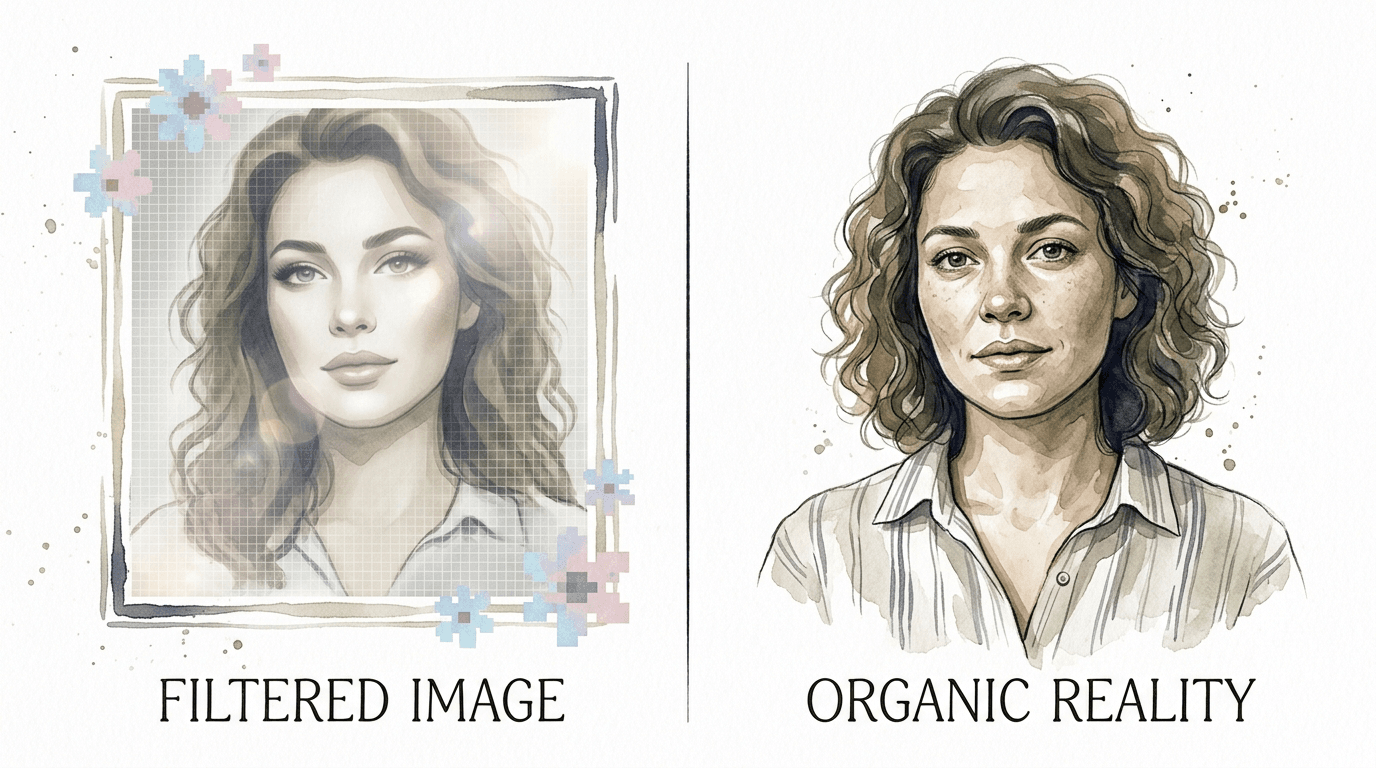
A synthetic identity requires constant maintenance, but an organic self just needs nourishment. We’ve traded our ‘Organic’ biological reality for a ‘Synthetic’ persona designed for screens. We chase a look that isn’t sustainable because it isn’t real. When you return to your Natural identity—one based on how you feel, move, and recover—the obsession with the ‘filter’ vanishes, and real health begins.
Social media has created a digital mirror that lies to us. We see sculpted abs and porcelain skin that exist only in the realm of pixels and post-production. This is the synthetic identity. It is a performance. It demands perfection, constant vigilance, and an exhausting amount of willpower. Most weight loss journeys fail because they are built to support this synthetic version of you.
When you shift your focus to your organic reality, the game changes. You stop fighting your biology and start working with it. This article explores how to bridge the gap between who you are on a screen and who you are in your own skin. It’s time to move beyond the filter and find a health that actually lasts.
Authenticity In Weight Loss Identity
Authenticity in weight loss identity is the transition from external validation to internal signaling. It means your health journey is no longer about “looking like a fitness influencer” and is instead about “becoming a person who prioritizes vitality.” This is a fundamental shift in how you perceive your place in the world.
For years, the weight loss industry has sold us on outcomes. We focus on the number on the scale or the size of our jeans. These are extrinsic motivators. Research shows that while external goals might provide a “nitro-boost” of motivation early on, they rarely sustain a lifestyle for the long haul.
An authentic identity is built on intrinsic motivation. You choose the salad because you enjoy the energy it provides. You lift weights because you love feeling strong. You sleep eight hours because your brain feels sharper. In this reality, the “look” is simply a side effect of the lifestyle, not the primary goal.
This concept exists at the intersection of psychology and biology. It’s about closing the gap between your physical body and your mental self-image. When these two are misaligned—such as when a person loses significant weight but still “feels” like their heavier self—it creates a psychological disconnect often called “phantom fat.” Authenticity is the process of reconciling these two versions of yourself.
How to Rebuild Your Identity Step-by-Step
Changing who you are is harder than changing what you eat. However, it is the only way to make weight loss permanent. Your brain is wired for efficiency. It wants to automate your behaviors so it can save energy for more complex tasks. This is the neurobiology of habit formation.
Step 1: Identify Your Values
Stop asking “How much do I want to lose?” and start asking “Who do I want to become?” If you want to be a runner, the goal isn’t the marathon. The goal is to become someone who doesn’t miss their morning run. Every time you lace up your shoes, you are casting a vote for that new identity.
Step 2: Leverage Small Wins
The basal ganglia—the part of your brain responsible for habits—thrives on repetition. You cannot overhaul your life in 24 hours. Start with a habit so small it’s impossible to fail. Drink one glass of water before your coffee. Walk for five minutes after lunch. These tiny actions rewire your neural pathways through neuroplasticity.
Step 3: Design Your Environment
Your environment is the invisible hand that shapes your behavior. If your kitchen is filled with “synthetic” ultra-processed foods, you will eat them. If your gym bag is packed and by the door, you are more likely to use it. Make the “organic” choice the easiest choice.
Step 4: Shift from Discipline to Ritual
Discipline is a finite resource managed by the prefrontal cortex. It gets tired. Rituals, however, are managed by the basal ganglia and are nearly automatic. Your goal is to move your healthy behaviors from the “effort” category to the “automatic” category.
Step 5: Master Your Internal Dialogue
The story you tell yourself is the blueprint for your reality. Stop saying, “I’m trying to lose weight.” This implies you are a person who struggles with their weight and is attempting to fight their nature. Instead, say, “I am a person who nourishes my body.” This shift in language reinforces your authentic identity.
The Benefits of an Organic Reality
Choosing an organic reality over a synthetic filter provides measurable physical and mental advantages. It moves you away from the “dieting” cycle and into a state of sustainable wellness.
Improved Metabolic Health
When you focus on nourishment rather than restriction, your hormones begin to stabilize. Insulin sensitivity improves, and hunger hormones like ghrelin and leptin return to their natural rhythms. This makes weight maintenance effortless because your body isn’t constantly signaling for “emergency” energy.
Reduced Psychological Stress
Chasing a filtered image is a high-cortisol lifestyle. The constant comparison to impossible standards triggers the body’s stress response. By returning to your natural identity, you lower your cortisol levels. This not only improves your mood but also reduces the likelihood of stress-induced abdominal fat storage.
Sustainable Energy Levels
Synthetic health often relies on stimulants and extreme calorie deficits. This leads to crashes and burnout. Organic health focuses on cellular energy. By prioritizing sleep, hydration, and whole-food nutrients, you experience a steady stream of energy that lasts the entire day.
Long-Term Consistency
Because this approach is based on who you are rather than what you want to achieve, there is no “finish line.” You don’t “go off” the diet because the lifestyle is part of your identity. This is the key to avoiding the yo-yo effect that plagues 95% of traditional dieters.
Challenges and Common Mistakes
The path to an authentic identity is not without obstacles. We live in a world designed to keep us in a “synthetic” state.
The Dopamine Loop of Social Media
Platforms like Instagram and TikTok are engineered to trigger dopamine releases through likes and notifications. This reinforces the need for external validation. When you stop posting for “likes” and start living for “feels,” you may experience a period of withdrawal. Your brain misses the quick hit of approval.
The Comparison Trap
Even with the best intentions, it is easy to compare your “behind-the-scenes” reality with someone else’s “highlight reel.” Remember that a filtered image is a product, not a person. It is a snapshot in time, often manipulated by lighting, angles, and software.
Over-Reliance on Willpower
Many people try to “white-knuckle” their way to a new identity. Willpower is a battery that drains. If you don’t build systems and habits to support your new identity, you will eventually revert to your old patterns when life gets stressful.
Ignoring Bio-Individuality
One of the biggest mistakes is following a “cookie-cutter” plan. Your biology is unique. Factors like genetics, gut microbiome health, and lifestyle stress mean that what works for a “fitness influencer” may not work for you. Authenticity requires listening to your own body’s signals.
Limitations and Realistic Constraints
While shifting to an identity-based approach is powerful, it is not a magic wand. There are realistic boundaries to consider.
Biological Set Points
Every body has a natural range where it functions best. While you can certainly improve your health and body composition, you cannot fight your basic genetic structure. Authenticity means accepting your organic frame while optimizing its health, rather than trying to force it into a shape it was never meant to hold.
Environmental Toxicity
We live in an “obesogenic” environment. High-calorie, low-nutrient foods are everywhere. Even with a strong internal identity, navigating a world of constant temptation requires strategy and awareness. You cannot purely “think” your way out of a toxic food environment; you must also manage it.
Time and Consistency
A synthetic identity can be created in seconds with a filter. An organic identity takes months or years to solidify. Research indicates that it can take anywhere from 66 to 254 days for a new habit to become truly automatic. This requires a level of patience that our fast-paced culture often discourages.
Comparison: Synthetic Identity vs. Organic Reality
| Feature | Synthetic Identity | Organic Reality |
|---|---|---|
| Primary Driver | External Validation (Likes/Filters) | Internal Signaling (Energy/Vitality) |
| Maintenance | High Effort / Constant Willpower | Low Friction / Automatic Habits |
| Sustainability | Short-term (Burst-driven) | Lifelong (Identity-driven) |
| Focus | The “Look” (Outcome) | The “Feel” (Process) |
| Stress Levels | High Cortisol / Anxiety | Balanced / Resilience |
Practical Tips for Daily Life
To successfully transition to an organic reality, you need actionable strategies that you can apply immediately.
Prioritize Protein and Whole Foods
Protein is the most satiating macronutrient. It signals to your brain that you are nourished. By building your meals around high-quality protein and fiber, you naturally crowd out ultra-processed “synthetic” foods. This isn’t about restriction; it’s about prioritization.
Get Morning Sunlight
Your circadian rhythm governs your hunger, mood, and energy. Exposure to natural light within 30 minutes of waking sets your internal clock. This improves sleep quality, which is the foundation of metabolic health and willpower.
Practice “Digital Minimalism”
If social media makes you feel inadequate, change your feed. Unfollow accounts that promote unrealistic standards. Follow accounts that focus on movement, strength, and genuine health science. Your digital environment shapes your mental identity.
Move for Joy, Not Just Calories
Find a form of movement that feels like a reward, not a punishment. Whether it’s hiking, dancing, or lifting, movement should be a celebration of what your body can do, not a payment for what you ate.
Advanced Considerations for Serious Practitioners
For those who have mastered the basics, deepening your understanding of bio-individuality and neurobiology can take your results to the next level.
The Gut-Brain Axis
Your gut microbiome produces over 90% of your body’s serotonin. A healthy gut is essential for a stable mood and strong identity. Incorporating fermented foods and diverse fiber sources supports the “second brain” in your gut, making it easier to stick to your health goals.
Hormonal Optimization
Weight loss isn’t just a math problem of calories in vs. calories out. It’s a hormonal problem. Understanding how insulin, cortisol, and thyroid hormones interact allows you to fine-tune your approach. For example, excessive cardio in a high-stress state can actually stall weight loss by spiking cortisol.
Cognitive Reframing
Advanced practitioners use techniques from Cognitive Behavioral Therapy (CBT) to dismantle old beliefs. If you identify as “the person who always fails,” you must actively challenge that thought with evidence of your recent wins. This is the manual work of neuroplasticity.
Example: The Shift in Practice
Consider two individuals: Sarah and Mike.
Sarah (Synthetic Approach)
Sarah wants to lose 20 pounds for a wedding. She follows a 30-day “shred” diet that restricts calories to 1,200 and requires two hours of cardio a day. She tracks her progress by taking filtered selfies. By week three, she is exhausted, her hair is thinning, and she’s obsessed with food. She reaches her goal, but two weeks after the wedding, she has regained 10 pounds and feels like a failure.
Mike (Organic Identity Shift)
Mike decides he wants to be a “high-energy father.” He doesn’t set a weight goal. Instead, he sets a rule: he will walk the dog every morning and eat a high-protein breakfast. He focuses on how much better he feels when playing with his kids. Over six months, he naturally loses 25 pounds. Because he sees himself as a “healthy dad,” he doesn’t struggle to maintain the habits. The weight stay off because it was never the primary focus.
Final Thoughts
The journey from a synthetic identity to an organic reality is the most important transformation you will ever make. It is the difference between a temporary “fix” and a permanent lifestyle. When you stop trying to look like a filter and start trying to feel like a human, the pressure evaporates.
Real health is not a performance. It is a quiet, consistent practice of nourishment and movement. It is the result of casting small votes for yourself every single day. By focusing on your organic self, you build a foundation that no social media trend can shake.
Start today by choosing one small, authentic action. Do it for the way it makes you feel, not the way it looks. Over time, these small choices will coalesce into a new identity—one that is sustainable, real, and uniquely yours. Embrace your organic reality and let the filter fade away.
Sources
1 nbcc.org | 2 helloklarity.com | 3 secondnature.io | 4 corporatefitnessworks.com | 5 psychologytoday.com | 6 sciencexcel.com | 7 tryshed.com | 8 globalrph.com | 9 powertechjournal.com | 10 joincarbon.com | 11 stevegranthealth.com | 12 livingto100.club | 13 ifpa-fitness.com