


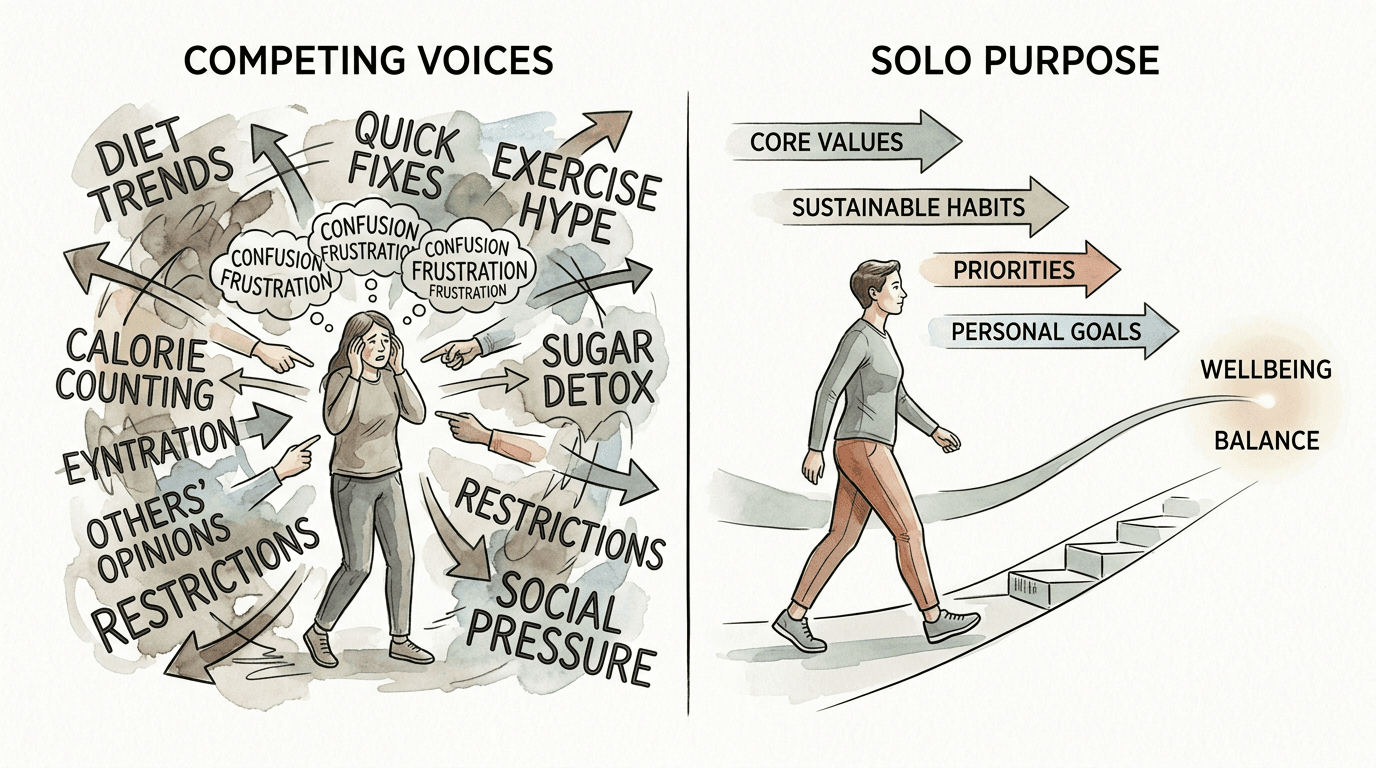
If your health is just another ball you’re juggling, you’ve already lost the game. In a state of ‘Chaos,’ your identity is pulled in every direction, and your diet is usually the first thing to drop. But in an ‘Ordered’ identity, your health is the non-negotiable base. You don’t ‘find time’ for your identity; you build your entire day on top of it.
Most people approach fitness like a chore on a list. They treat it as an external obligation rather than an internal reality. This is why the “New Year, New Me” energy fizzles out by February. Real, lasting change requires more than a gym membership; it requires a structural reorganization of your entire life. You are not just “trying to lose weight.” You are becoming the person who prioritizes vitality so they can show up for everything else.
Organizing Your Life Around Weight Loss
Organizing your life around weight loss is the process of designing your environment, schedule, and mindset to make healthy choices the default rather than a constant test of willpower. It is a shift from performance-based goals to identity-based systems. Instead of obsessing over a number on the scale, you focus on creating a life where “being healthy” is simply what you do.
This concept exists because willpower is a finite resource. Every decision you make—from what to wear to how to respond to an email—depletes your mental energy. If you have to “decide” to be healthy 200 times a day, you will eventually fail when your energy runs low. Successful weight management happens when you stop fighting your environment and start engineering it. It is used in real-world situations by high performers who treat their bodies like the engine of their success rather than an afterthought.
Think of it like an architect designing a building. If the kitchen is at the back of the house behind three locked doors, you won’t cook. If the stairs are hidden and the elevator is front and center, you won’t walk. Organizing your life for weight loss is about putting the “stairs” and the “kitchen” of your health in the most visible, accessible places possible.
How It Works: Systems Over Willpower
The secret to a sustainable health identity lies in automation. You must declare “Choice Bankruptcy” on the micro-decisions that drain your battery. This starts with creating “Decision-Light Rhythms” that remove the drama from your daily routine.
The Power of Identity-Based Habits
Traditional habits focus on outcomes, like losing 10 pounds. Identity-based habits focus on who you want to become, such as a person who moves daily. When your actions align with your sense of self, consistency feels natural rather than forced. Research shows that people who view themselves as “exercisers” are significantly more likely to maintain their routines over the long term because the behavior is intrinsically motivated.
Decision Fatigue Management
The average person makes over 200 decisions a day just about food. This mental load leads to “Decision Fatigue,” where the quality of your choices deteriorates as the day progresses. You can combat this by using the “Pick One” method: choosing one breakfast and one lunch option to repeat throughout the work week. This eliminates morning and afternoon guesswork, saving your mental energy for the complex tasks at work and the temptations of the evening.
Environmental Engineering
Your surroundings dictate your behavior more than you realize. A cluttered, messy kitchen can actually lead to consuming over 100 more calories in a single sitting than a tidy one. By organizing your physical space into “Zones,” you can cue healthy behaviors automatically. For example, a “Spotlight Zone” on the center shelf of your fridge should hold pre-cut vegetables and lean proteins, making them the first thing you see when hunger strikes.
Benefits of an Ordered Health Identity
Shifting to an ordered identity provides a sense of psychological safety and autonomy. You stop feeling like a victim of your schedule and start feeling like the captain of your ship.
- Reduced Stress: Automation removes the “What should I eat?” panic that usually leads to the drive-thru.
- Consistency Without Effort: Habits that are part of your identity require less willpower to execute.
- Better Decision Quality: By reducing micro-decisions, you preserve cognitive energy for high-stakes professional and personal choices.
- Long-term Sustainability: Unlike a crash diet, a reorganized life is something you can maintain forever.
This approach turns health from a stressful “Compounding Voice” into a “Solo Purpose.” When your health is the base, everything else—your career, your relationships, your hobbies—becomes easier to manage because you have the energy and clarity to handle them.
Challenges and Common Mistakes
The biggest mistake is trying to change everything at once. This triggers a “Chaos” response where the system becomes too complex to maintain.
One common pitfall is the “All-or-Nothing” trap. Many people believe that if they miss one workout or eat one “bad” meal, the entire system has failed. In reality, an ordered identity is resilient. A person who identifies as a “healthy person” simply gets back to their baseline at the next opportunity. They don’t let a single outlier define their identity.
Another error is relying on inspiration rather than structure. Inspiration is a feeling; structure is a fact. If your health depends on “feeling like it,” you will only be healthy about 30% of the time. You must build systems that work even when you are tired, grumpy, and overwhelmed.
Limitations: When the Method Faces Friction
No system is perfect, and organizing your life around health has realistic constraints. Social friction is one of the most common hurdles. Friends and family may not share your new identity, and social events often revolve around environments that cue unhealthy choices. In these cases, you need “Contingency Plans”—pre-decided strategies for how to navigate a restaurant menu or a holiday party without losing your momentum.
Environmental limitations can also play a role. If you travel frequently for work or live in a “food desert,” your ability to control your surroundings is diminished. During these times, you must pivot from “Environment Design” to “System Portability,” such as carrying high-protein snacks or using hotel gym rituals to maintain your identity.
Solo Purpose vs. Competing Voices
In the world of lifestyle design, you are often caught between your **Solo Purpose** (your health identity) and **Competing Voices** (social pressure, work stress, and marketing).
| Feature | Chaos Identity (Competing Voices) | Ordered Identity (Solo Purpose) |
|---|---|---|
| Focus | External goals (Lose 10 lbs) | Internal reality (I am an athlete) |
| Method | Willpower and restriction | Systems and environment design |
| Energy Use | High (Constant decisions) | Low (Automated routines) |
| Social Impact | Peer-driven choices | Boundary-driven choices |
| Resilience | Fragile (Fails under stress) | Durable (Built on the baseline) |
Practical Tips for Life Reorganization
Immediate action is the best way to solidify a new identity. Start with your physical environment and your digital calendar.
- The 10-Inch Plate Rule: Replace 12-inch dinner plates with 10-inch ones to naturally reduce portion sizes by up to 20%.
- Eye-Level Stocking: Place healthy staples like Greek yogurt and fruit at eye level in the fridge; hide trigger foods in opaque containers on high shelves.
- Calendar Blocking: Treat your workouts like non-negotiable doctor’s appointments. If it’s on the calendar, it’s a fact, not a suggestion.
- Meal Mapping: Instead of complex meal prep, use “Themes” (e.g., Taco Tuesday, Salad Wednesday) to simplify grocery shopping and cooking.
- The “One-Decision” Framework: Decide once that you always drink 16oz of water before coffee. This eliminates the need to “decide” to hydrate every morning.
Advanced Considerations: The Active Struggle
Serious practitioners understand that weight maintenance is not a passive state. It is an active physiological struggle against metabolic adaptation. When you lose weight, your body often responds by increasing hunger hormones and lowering your metabolic rate. This is known as the “Hunger Gap.”
To combat this, an advanced health identity prioritizes “Metabolic Currency”—muscle mass. Incorporating resistance training and high-protein intake isn’t just about looking good; it’s about protecting your metabolic rate so your “Ordered Identity” is easier to maintain biologically. You must move from a “Deficit Mindset” to a “Stability Framework,” where you monitor your weight and habits with the same precision an executive monitors their company’s cash flow.
Example Scenario: The Busy Executive
Consider “Sarah,” a marketing executive who used to live in a state of ‘Chaos.’ Her mornings were a rush of coffee and emails, her lunches were whatever was in the breakroom, and her dinners were late-night takeout. She felt like she was constantly “juggling” her health.
Sarah decided to build an **Ordered Identity**. She implemented a “Decision-Light” morning: she wears a “uniform” (pre-set outfits) and eats the same high-protein smoothie every day. She blocked 12:00 PM to 12:45 PM on her calendar for a brisk walk, regardless of meetings. She reorganized her kitchen, moving the communal snack bowl to a high cabinet and placing a bowl of apples on the island.
The result? Sarah didn’t “find time” to lose 15 pounds. She designed a life where losing weight was the inevitable outcome of her daily structure. Her health became the base that allowed her to handle 10-hour workdays with more clarity than ever before.
Final Thoughts
Organizing your life around weight loss is about more than just food and movement. It is about reclaiming your identity from the chaos of modern life. When you stop treating your body as a project to be finished and start treating it as the foundation of who you are, the struggle ends.
Success is found in the systems you build and the environment you curate. Small wins—like using smaller plates or setting a kitchen “close time”—eventually snowball into a transformation that feels effortless. You don’t need more willpower; you need a better plan.
Encouraging yourself to experiment with these systems is the first step. Start by picking one room or one hour of your day to “order.” Once the base is solid, you’ll find that the rest of the balls you’re juggling seem much lighter.
Sources
1 mensfitness.com | 2 enhancestrength.ca | 3 drsharongam.com | 4 prevention.com | 5 bodi.com | 6 eatrunlift.me | 7 hingehealth.com | 8 drsharongam.com | 9 webmd.com | 10 qubit.fit | 11 precisionnutrition.com | 12 forwellness.com | 13 nutrisystem.com | 14 golo.com | 15 bumpandbeyondderby.co.uk | 16 Source | 17 proformptma.com | 18 execfuel.com.au | 19 ashleymonzon.com | 20 crossfitsanitas.com