


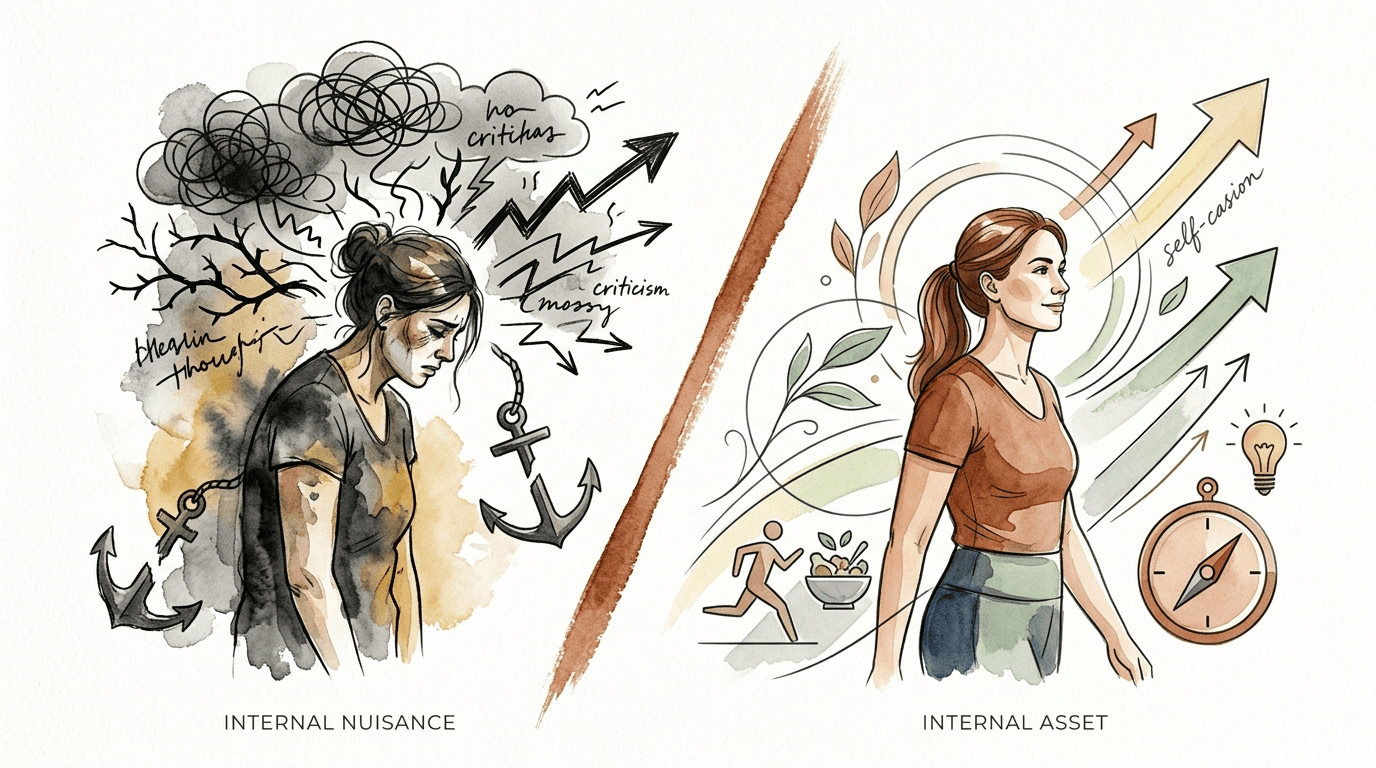
What if the voice telling you everything you’re doing wrong is actually your best coach in disguise? Most people try to drown out their self-criticism with positive affirmations that they don’t actually believe. In the ACE framework, we don’t ignore the critic; we give it a job. Your ‘nuisance’ thoughts are actually raw data points about your current identity that are ready to be optimized.
You have probably spent years fighting a war inside your own head. You want to lose weight, but your inner voice keeps shouting that you’re failing. This friction creates a massive amount of stress. It makes every workout feel like a punishment. It makes every healthy meal feel like a restriction.
The secret to breaking this cycle isn’t more willpower. It is a shift in how you process your own thoughts. When you stop seeing your self-criticism as an enemy, you unlock a powerful source of information. You can finally start using your brain’s natural feedback loop to fuel your progress instead of halting it.
Turning Self-criticism Into Weight Loss Success
Self-criticism is often viewed as a barrier to health. We are told to “be kind to ourselves” or “stay positive.” While well-intentioned, this advice ignores the biological reality of the human brain. Your brain is wired to look for problems. It is a survival mechanism designed to keep you safe from perceived threats.
In the context of weight loss, your brain perceives “failure” as a threat to your social standing or personal safety. The harsh voice that says “you shouldn’t have eaten that” is actually trying to protect you. It wants to keep you aligned with your goals. The problem is not the voice itself. The problem is the delivery method and how you react to it.
Turning self-criticism into success means treating these thoughts as raw data. Instead of letting a negative thought ruin your day, you analyze it. You look for the underlying concern. This approach exists in high-performance environments like elite athletics and executive coaching. Professionals don’t ignore their mistakes. They audit them without the emotional baggage.
Think of self-criticism like a smoke detector. If the alarm goes off, you don’t get mad at the detector. You don’t try to tell it “everything is fine” while the kitchen is on fire. You look for the source of the smoke. Once the fire is out, the alarm stops. Self-criticism works the same way. It is signaling a disconnect between your current actions and your desired identity.
The ACE Framework: How to Turn Noise into Power
The ACE framework stands for Awareness, Curiosity, and Empowerment. This three-step process is designed to help you catch a critical thought and redirect its energy toward a productive outcome. It moves you from a state of internal conflict to a state of internal alignment.
Step 1: Awareness
Awareness is the ability to “hear” the critic without becoming the critic. Most people are “fused” with their thoughts. When the brain says “I am a failure,” they believe they literally are a failure. Awareness creates a gap. You start saying, “I am noticing a thought that I am a failure.”
This subtle shift is massive. It allows you to observe the thought from a distance. You are no longer the one being attacked. You are the scientist observing a specimen. Research shows that this “cognitive defusion” reduces the emotional impact of negative thoughts. It keeps your prefrontal cortex online so you can make better decisions.
Step 2: Curiosity
Once you have identified the thought, you bring in curiosity. You ask, “What is the data point here?” If your critic says, “You’re lazy because you skipped the gym,” curiosity looks deeper. Is the data point that your current gym schedule is too aggressive? Is the data point that you didn’t sleep enough?
Curiosity removes the “good vs. bad” labels. It treats your behavior as an experiment. If the result of the experiment wasn’t what you wanted, you look at the variables. This prevents the “shame spiral” that usually leads to overeating or giving up entirely. You are simply looking for the “why” behind the “what.”
Step 3: Empowerment
Empowerment is where you give the critic a job. You take the data point and create an action plan. If the data shows you skipped the gym because you were exhausted, the new “job” for your critic is to help you optimize your sleep. You turn the negative energy into a strategy.
Instead of feeling guilty, you feel focused. You are taking control of the narrative. You are no longer a victim of your thoughts. You are the architect of your habits. This step transforms your internal environment from a battlefield into a laboratory.
Benefits of the ACE Approach for Weight Loss
Adopting the ACE framework provides immediate and long-term advantages. It changes the way you interact with your body and your goals. You start to see progress in areas that were previously stagnant.
One major benefit is the reduction of “decision fatigue.” When you aren’t fighting a mental war, you have more energy to make healthy choices. Self-criticism is exhausting. It drains the mental resources you need for willpower. By converting that criticism into data, you preserve your energy for action.
Another advantage is increased resilience. People who use this method don’t “fall off the wagon.” They simply acknowledge when a certain strategy didn’t work and adjust. This creates a sustainable lifestyle rather than a temporary diet. You become unshakeable because your mistakes are no longer personal flaws; they are just lessons.
Furthermore, this approach fosters “identity optimization.” You start to see yourself as someone who solves problems. You stop being “someone who is trying to lose weight” and start being “someone who manages their health system.” This shift in identity is the key to permanent weight loss maintenance.
Challenges and Common Mistakes
The biggest challenge with the ACE framework is the habit of “toxic positivity.” Many people try to skip Step 2 and Step 3. They notice the thought and immediately try to replace it with a “happy” thought. This usually backfires. Your brain knows when you are lying to it.
Another common mistake is “stealth criticism.” This is when you use the framework to criticize yourself for being critical. You might think, “I’m so bad at the ACE framework, I can’t even be curious.” This is just the old critic in a new mask. Recognition is the only way out. When you catch yourself doing this, just apply Step 1 again.
Consistency is also a hurdle. Your brain has years of practice in harsh self-judgment. It will take time to build the “curiosity” muscle. Expect to fail at this frequently in the beginning. The goal is not to be perfect at the framework. The goal is to use the framework to stop needing perfection.
Finally, some people struggle with the “Empowerment” phase because they don’t have a clear plan. If you find a data point but don’t know how to fix it, the critic will return. This is why having a library of healthy habits and strategies is crucial. Knowledge is the fuel for empowerment.
Limitations: When This May Not Be Ideal
While the ACE framework is powerful, it is not a cure-all. In cases of clinical depression or severe anxiety disorders, self-criticism can be deeply pathological. In these situations, professional therapeutic intervention is necessary. The framework is a coaching tool, not a medical treatment.
This method also requires a baseline level of stability. If you are in a state of extreme crisis or trauma, your brain may not be able to access the “Curiosity” phase. Your survival brain will be too loud. You must address basic safety and physiological needs before you can work on identity optimization.
Environmental factors can also limit success. If you are surrounded by people who constantly criticize you, your internal work will be much harder. You cannot always think your way out of a toxic environment. Sometimes the “empowerment” step requires changing your external surroundings rather than just your internal thoughts.
Internal Nuisance vs. Internal Asset
The fundamental shift in this article is moving from seeing your mind as a nuisance to seeing it as an asset. Most people treat their internal dialogue like a noisy neighbor they want to evict. High performers treat it like a high-level consultant.
| Feature | Internal Nuisance | Internal Asset |
|---|---|---|
| View of Thoughts | Obstacles to be suppressed. | Data points to be audited. |
| Emotional Response | Shame, guilt, and frustration. | Neutrality and focus. |
| Outcome | The “All or Nothing” spiral. | Continuous optimization. |
| Long-term Effect | Burnout and weight regain. | Sustainable identity shift. |
This comparison shows why traditional dieting fails. It treats the symptoms of a “nuisance” mind rather than harnessing the power of an “asset” mind. When your thoughts are assets, your brain works for you, even when you aren’t paying attention.
Practical Tips for Immediate Application
You can start using the ACE framework today. You don’t need a coach or a degree to begin auditing your thoughts. Start with small, non-weight-related thoughts to practice the mechanics.
- Keep a “Thought Audit” Log: Write down the most common critical thoughts you have during the day. Next to them, write “The Data Point” and “The Job.”
- Use the “Third Person” Technique: When you hear a critical thought, address yourself by name. “John, I notice you are thinking you failed today.” This increases the awareness gap instantly.
- Focus on “What” not “Why”: Instead of asking “Why am I like this?”, ask “What is happening right now?” This keeps you in the curiosity phase and prevents the shame spiral.
- Reward the Audit: Every time you catch a critical thought and turn it into data, give yourself a mental “win.” You are training your brain to love the process of optimization.
As you get better at these tips, you will find that the voice of the critic gets quieter. It doesn’t need to scream if it knows you are listening and taking notes. You are effectively “training” your internal coach to be more professional.
Advanced Considerations: Identity Fusion
For those who have mastered the basics, the next level is addressing “Identity Fusion.” This is the deep-seated belief that your weight or your habits define who you are as a human being. Advanced practitioners use the ACE framework to dismantle these core beliefs.
Optimization at this level involves questioning the source of the “Data Points.” Sometimes the data point isn’t about your behavior; it’s about a societal expectation you never agreed to. You might realize that your “critic” is actually a collection of voices from your past—parents, teachers, or media.
Scaling this framework means applying it to every area of your life. Success in weight loss often leads to success in career and relationships. The same “Internal Asset” mindset allows you to handle professional setbacks with the same calm neutrality. You become a person who is constantly evolving, making the concept of “failure” obsolete.
Consider the “Maintenance Phase” of weight loss. This is where most people fail. They reach their goal, the “threat” of being overweight is gone, and the critic stops shouting. Without the critic’s fuel, they lose motivation. Advanced practitioners use the ACE framework to find new data points—like energy levels or performance metrics—to keep the engine running.
Practical Example: The Office Donut Scenario
Imagine you are at the office and someone brings in donuts. You eat two. Immediately, your internal critic starts shouting: “You have no discipline! You’ve ruined the whole week. You might as well just eat whatever you want for dinner now.”
Using the ACE framework, you pause. Awareness: “I notice a thought that I have no discipline.” You take a breath. Curiosity: “What is the data here? I was hungry because I skipped breakfast. Also, I am stressed about the 2 PM meeting. The donuts were a quick hit of dopamine.”
Now, Empowerment: You give the critic a job. “Okay, Critic, your job is to remind me to pack a high-protein breakfast tomorrow. Also, let’s find a five-minute stress-relief routine for before meetings.” The result? You don’t “ruin the week.” You eat a healthy dinner because the data has been processed and the system is back in balance.
Final Thoughts
Transforming your inner critic into a coach is the ultimate weight loss “hack.” It removes the friction that causes 90% of people to quit their diets. By using the ACE framework—Awareness, Curiosity, and Empowerment—you stop fighting yourself and start building yourself.
Success is not the absence of negative thoughts. It is the ability to use those thoughts as a roadmap. Your brain is a powerful tool, but like any tool, you must learn how to operate it correctly. Stop trying to silence the noise and start listening for the signal.
As you move forward, remember that your ‘nuisance’ thoughts are just misunderstood assets. Every time you feel that sting of self-criticism, smile. It means your brain has found something it thinks is important. Take the data, give the critic a job, and keep moving toward the identity you deserve. Try it once today, and see how the energy in your head begins to shift.
Sources
1 myheartwhattoknow.com | 2 brisbaneactcentre.com.au | 3 littlebirdtherapy.co | 4 nih.gov | 5 thetappingsolution.com