


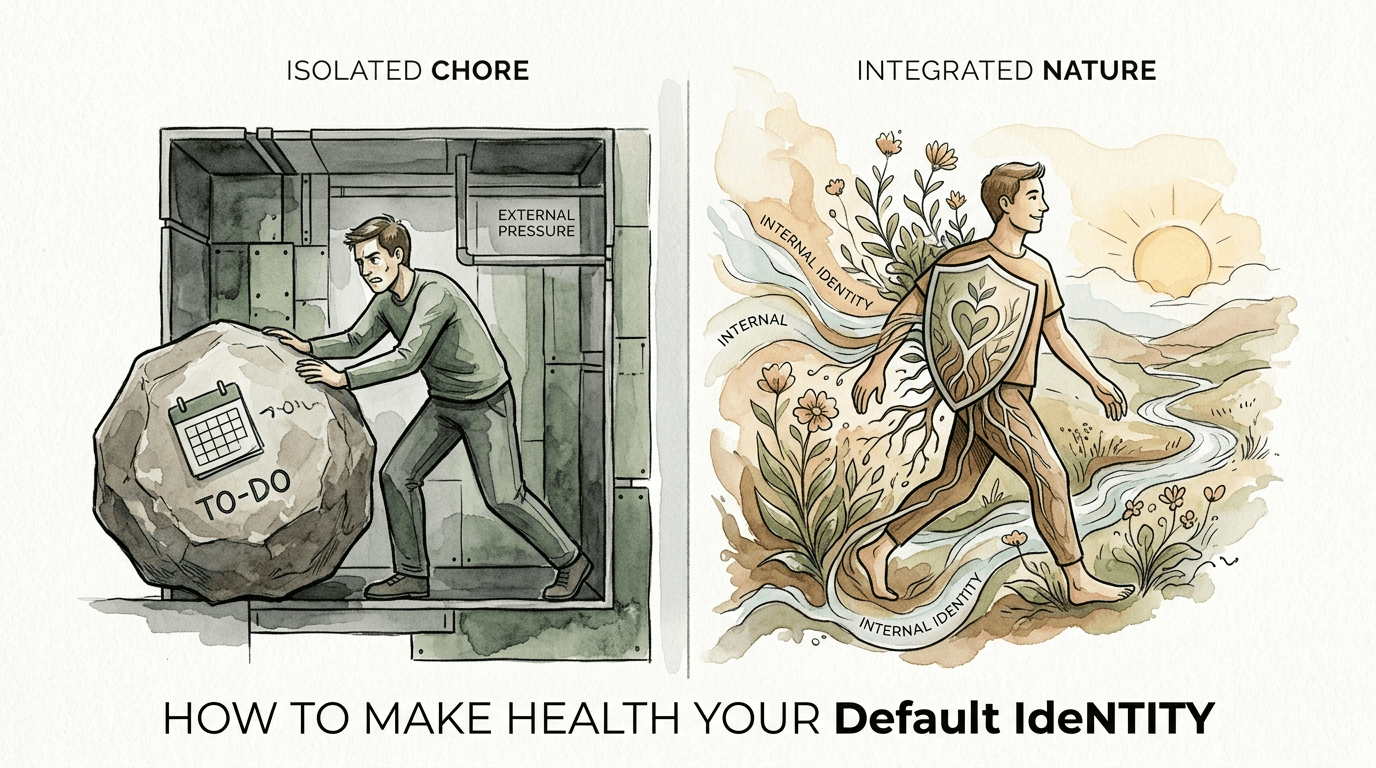
If your health is a ‘task,’ it will always be the first thing you cut when life gets busy. When your health is an isolated ‘side project,’ it is vulnerable to every distraction. When it is integrated into who you are, it becomes as automatic as breathing. It’s not what you do for an hour; it’s how you exist in the world.
Stop treating your body like a project with a deadline. Most people view fitness as a series of checkboxes. They wake up, “do” their workout, and then spend the rest of the day ignoring their physiology. This is the path to burnout. Real vitality happens when you stop doing health and start being healthy.
This guide will show you how to flip the switch from isolated effort to integrated nature. We are going to explore the science of identity-based habits and how to hardwire wellness into your DNA.
How To Make Health Your Default Identity
Making health your default identity means shifting your focus from outcomes to self-perception. Instead of saying “I want to lose ten pounds,” you say “I am the type of person who never misses a workout.” This subtle shift changes your relationship with every decision you make.
An identity is a set of beliefs you hold about yourself. These beliefs are not fixed; they are built through evidence. Every time you choose water over soda, you are casting a vote for your new identity. You are providing your brain with data that says, “I am a healthy person.”
This concept exists because willpower is a finite resource. If you have to “decide” to be healthy every single morning, you will eventually run out of mental energy. When health is your identity, the decision is already made. It becomes your default setting in a chaotic world.
How the Identity Shift Works
The process of building a health identity relies on a feedback loop between your actions and your self-image. Most people try to change their results first, but true change starts at the core of the circle.
The Three Layers of Behavior Change
Behavior change happens at three levels. The outer layer is outcomes—the results you want. The middle layer is processes—the systems you follow. The inner layer is identity—the person you believe you are.
Most people start from the outside. They pick a goal (outcome) and try to force a routine (process). This rarely sticks because the person hasn’t changed who they are. To make it permanent, you must start from the inside out. You define the person you want to be, and then you let the results flow naturally from that new self-image.
The Neuroscience of Automaticity
Your brain is designed for efficiency. When you start a new health routine, your prefrontal cortex is working overtime. This part of the brain handles conscious decision-making and complex planning. It is also the first part of the brain to shut down when you are tired or stressed.
Consistent repetition moves these behaviors to the basal ganglia. This is the region responsible for procedural learning and habits. When a behavior is stored here, it becomes automatic. This is why you don’t “decide” to brush your teeth; you just do it. Identity-based habits reach the basal ganglia faster because they align with your internal story.
The Benefits of an Integrated Health Identity
Shifting to an integrated identity offers measurable advantages over the “task-based” approach. It changes your biology and your psychology simultaneously.
Reduced Cognitive Load
You make thousands of decisions every day. If every meal is a negotiation with your willpower, you will experience decision fatigue. An integrated identity eliminates the negotiation. You don’t have to think about whether to go to the gym; you go because that is what you do. This saves your mental energy for more important tasks at work and in life.
Resilience During High-Stress Periods
Life will eventually get messy. During a crisis, your brain defaults to its strongest habits. If health is just a task, it gets dropped when the pressure rises. If health is your identity, stress actually reinforces your habits. You lean into your routine because it is the one thing that makes you feel like yourself.
Long-Term Consistency
Outcome-based goals have an “end date.” Once you lose the weight or run the race, the motivation often disappears. Identity has no finish line. You continue to make healthy choices because they are an expression of who you are, not a means to an end. This leads to decades of health rather than a few weeks of intensity.
Challenges and Common Mistakes
The transition to a health-centric identity is not without obstacles. Many people fall into predictable traps that reset their progress.
The “All or Nothing” Trap
One of the biggest mistakes is believing that a healthy person must be perfect. If you miss one workout or eat one bad meal, you might tell yourself, “I’m not actually a healthy person.” This is false. A healthy identity is built on the majority of your actions, not a perfect record.
Ignoring Environmental Cues
You are a product of your environment. If you try to build a healthy identity while surrounded by junk food and sedentary friends, you are fighting an uphill battle. Your environment often speaks louder than your internal narrative. You must curate your surroundings to reflect the person you are becoming.
Social Pressure and Old Narratives
Your friends and family may have a fixed image of who you “used to be.” When you start making different choices, they might push back. It is common to feel like a “fraud” in the beginning. This “imposter syndrome” is a natural part of rewriting your story. You must push through the discomfort until the evidence of your new identity outweighs the memory of the old one.
Limitations: When This Approach Faces Friction
While identity-based change is powerful, it is not a magic bullet. There are specific situations where you need more than just a mindset shift.
External constraints can sometimes limit your ability to act on your identity. If you are working three jobs or living in a food desert, the “choice” to be healthy is significantly harder. In these cases, the identity must be adapted to the available resources. You might not be able to spend two hours at a gym, but you can still be the person who “never sits for more than an hour.”
Biological limitations also play a role. A healthy identity cannot override a chronic injury or a clinical metabolic disorder on its own. It provides the framework for management, but it doesn’t replace medical intervention. You must balance your internal narrative with the reality of your physical state.
Comparison: Task-Based vs. Identity-Based Health
Understanding the difference between these two approaches is critical for long-term success.
| Feature | Task-Based (The Chore) | Identity-Based (The Nature) |
|---|---|---|
| Primary Driver | Willpower and discipline | Self-perception and beliefs |
| End Goal | Reaching a specific number | Embodying a lifestyle |
| Reaction to Stress | Health habits are abandoned | Health habits provide stability |
| Mental Energy | High (constant negotiations) | Low (actions are automatic) |
Practical Tips for Immediate Application
You can start shifting your identity today with these actionable strategies. Remember, you are not waiting for a feeling; you are looking for evidence.
- Cast Your Vote: Every healthy action is a vote for the person you want to become. Don’t worry about the size of the action. A five-minute walk is still a vote.
- The “Never Miss Twice” Rule: Missing once is an accident. Missing twice is the start of a new habit. If you miss a workout, your only priority is ensuring you don’t miss the next one.
- Change Your Language: Stop saying “I’m trying to eat better.” Say “I am a healthy eater.” This simple change in phrasing signals to your brain that the behavior is part of your core self.
- Audit Your Environment: Remove the friction for good habits and add friction for bad ones. If you are a “runner,” keep your shoes by the front door. If you “eat for fuel,” don’t keep processed snacks in the house.
Advanced Considerations: The Evolving Identity
Once you have established a baseline identity, you can refine it. Serious practitioners don’t just stay “healthy”; they specialize.
You might move from “I am a healthy person” to “I am an endurance athlete” or “I am a person who prioritizes recovery.” These specific identities require different inputs. As your identity evolves, your systems must scale. You might start tracking biometric data like Heart Rate Variability (HRV) or blood glucose to provide more precise evidence for your evolving self-image.
Scaling your identity also means looking at social contagion. Surrounding yourself with people who are further along the path will pull your identity toward their level. Your self-image is often a reflection of the five people you spend the most time with. Choose your tribe based on the identity you want to maintain.
Example Scenario: The Transformation of an Executive
Consider the case of Marcus, a high-level executive who worked 70 hours a week. Marcus viewed health as a “chore” that he squeezed in when he could. Consequently, he was overweight, sleep-deprived, and stressed.
Marcus decided to stop “doing” workouts and start “being” an athlete. He didn’t have more time, so he changed his approach. He began taking all his calls while walking. He stopped ordering the “client special” at dinners and started ordering what an athlete would eat for recovery.
Within six months, Marcus didn’t just lose weight; his entire presence changed. He no longer felt like a busy man trying to be fit. He felt like an athlete who happened to run a company. Because his health was now his identity, it was no longer vulnerable to his schedule. The busiest weeks were the weeks he was most disciplined, because his identity was the only thing keeping him grounded.
Final Thoughts
If you want a body that performs, you need a mind that believes. Health cannot remain an isolated chore if you want it to last a lifetime. It must be woven into the fabric of your daily existence.
Stop focusing on the scale and start focusing on the person standing on it. Ask yourself: “What would a healthy person do in this situation?” Then, go do that thing. Every repetition is a building block in the foundation of a new you.
Apply these principles immediately. Experiment with your language and your environment. The more evidence you gather, the faster the shift will occur. Your health is not a task—it is your nature. Embody it.
Sources
1 researchgate.net | 2 tumcso.com | 3 habitsdoctor.com | 4 psychologytoday.com | 5 stressmanagementclinic.com | 6 jamesclear.com | 7 drpaulmccarthy.com | 8 samuelthomasdavies.com | 9 listeningpartnership.com | 10 drlynnereid.com | 11 litcharts.com | 12 hingehealth.com | 13 reachlink.com