


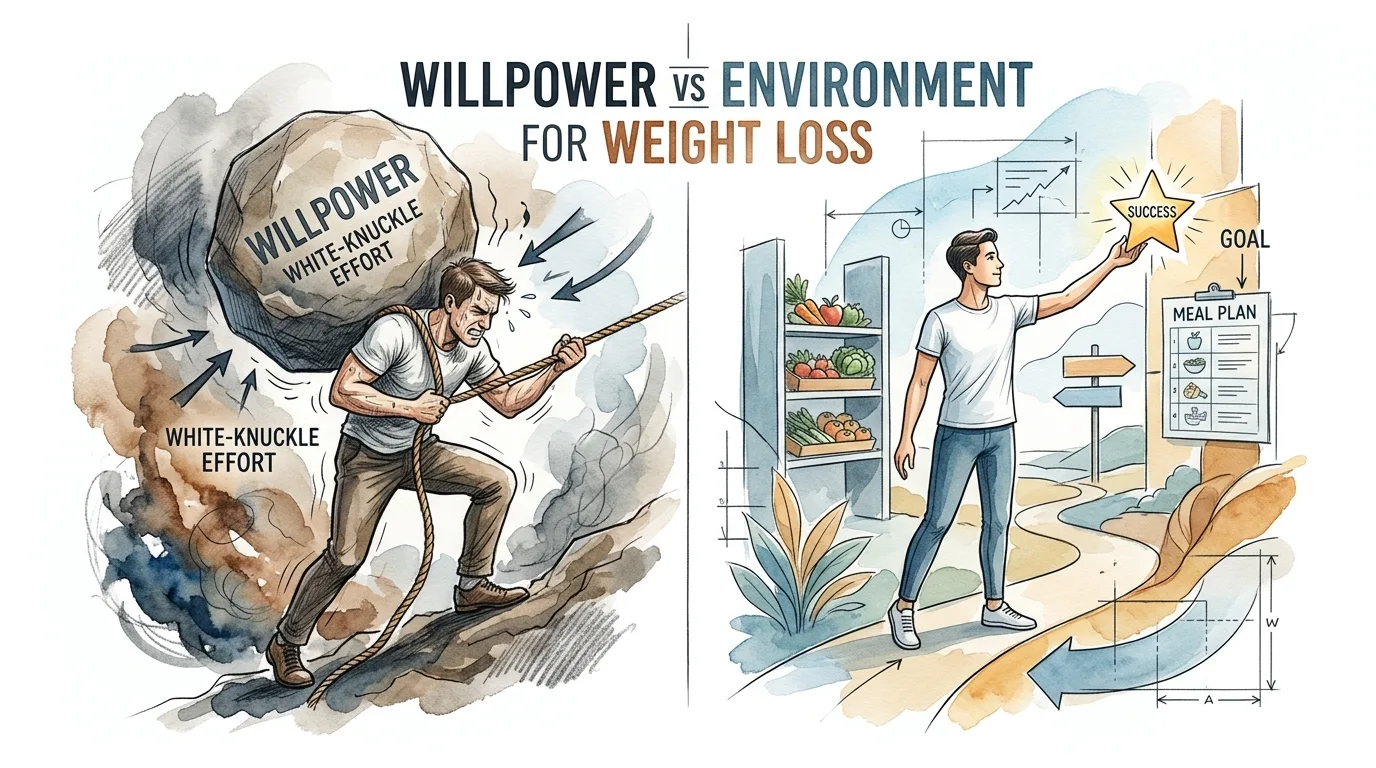
Willpower is a finite resource, but your kitchen layout is permanent. We’ve been told that losing weight is about ‘wanting it more.’ But even the strongest mind fails in a kitchen designed for failure. Stop using your brain as a shield and start using your environment as a filter. When the path of least resistance leads to health, you don’t need willpower.
Every day, you make roughly 200 decisions about food. Most of these happen on autopilot. You reach for the chips because they are on the counter. You finish the plate because it’s there. You pour a large drink because the glass is tall. If you try to fight these 200 decisions with pure mental strength, you will eventually lose. Stress, fatigue, and hunger will drain your battery.
Designing your kitchen for success means you don’t have to decide to be healthy. The room decides for you. It’s the difference between swimming against a current and building a boat that sails with it. This article explores how to transform your cooking and eating space into a weight loss machine.
Willpower Vs Environment For Weight Loss
Willpower is the mental energy used to resist immediate temptations in favor of long-term goals. It functions like a muscle; it gets tired after heavy use. Scientists often refer to this as ego depletion. If you spend all day resisting a difficult boss or navigating traffic, your “resistance muscle” is exhausted by the time you walk into your kitchen.
Environment design, also known as choice architecture, is the practice of organizing your surroundings to make the right choice the easiest choice. It acknowledges that human beings are “lazy” by design. We naturally gravitate toward the path of least resistance. If the healthiest snack is the easiest to see and reach, we eat it.
Studies show that people who rely solely on willpower for weight loss often regain the weight within two to three years. This happens because “white-knuckle effort” is unsustainable during periods of high stress. In contrast, an environment-first approach creates lasting habits by removing the need for constant decision-making. Researchers have found that weight management is multi-factorial, involving medical, behavioral, and nutritional components that go far beyond “trying harder.”
The environment acts as a persistent nudge. A “nudge” is a small change in physical space that alters behavior without forbidding any options. For example, moving a fruit bowl to the center of the table doesn’t ban cookies, but it makes the fruit the default choice. This subtle shift in focus can lead to significant caloric reductions over time.
How Environment Design Works in the Kitchen
Choice architecture works by manipulating three main factors: visibility, proximity, and friction. These three pillars determine what you eat and how much of it you consume. When these are aligned with your health goals, weight loss becomes a passive byproduct of your lifestyle.
Visibility is the most powerful trigger for eating. Humans are visual creatures. If you see a box of crackers, your brain begins to simulate the taste and texture of those crackers. This creates a “wanting” response that requires willpower to override. Research from the Syracuse Study found that women who kept breakfast cereal sitting on their counters weighed significantly more than those who didn’t. Specifically, those with cereal visible weighed roughly 21 pounds more than their neighbors with clear counters.
Proximity is the second pillar. The closer a food is to you, the more likely you are to eat it. In office experiments, placing candy just a few feet further away from a desk significantly reduced consumption. In your kitchen, this means the most calorie-dense foods should be the hardest to reach. High shelves and the back of the pantry are for treats; eye-level shelves are for essentials.
Friction refers to the effort required to perform an action. You can use friction to your advantage by making unhealthy habits “expensive” in terms of effort. If a snack is in its original box, it’s easy to grab. If it’s in a sealed container behind three other items, the friction increases. Conversely, you should remove friction from healthy habits. Pre-cutting vegetables and placing them in clear containers at the front of the fridge makes a salad the easiest meal to prepare.
Benefits of an Environment-First Approach
Choosing design over willpower offers several measurable advantages. The primary benefit is the reduction of “decision fatigue.” When the kitchen is organized correctly, you don’t have to think about what to eat. The “correct” food is already prepped and visible. This saves your mental energy for more important tasks, like work or family.
Long-term sustainability is another major advantage. Because you aren’t “fighting” yourself, you don’t feel the deprivation that usually leads to binges. You aren’t on a diet; you are living in a space that supports your body. This makes weight maintenance much easier over decades rather than just weeks.
Measurable caloric reduction is a proven outcome of environmental tweaks. Google’s “Project M&M” is a perfect example. The company moved chocolates into opaque containers and placed dried fruits and nuts in clear glass jars. This simple change led to 3.1 million fewer calories consumed by employees in their New York office over just seven weeks. This represents about nine fewer packages of candy per person without anyone feeling like they were “denied” food.
Finally, environment design improves the quality of your nutrition. When fresh produce is well-lit and prominently displayed, you are more likely to hit your daily fiber and vitamin targets. This leads to better energy levels, which further supports your ability to stay active and make good choices.
Challenges and Common Mistakes
One of the most common challenges is the “Family Factor.” You might be ready to hide the chips, but your spouse or children might resist. Shared spaces require negotiation. A common pitfall is trying to force everyone into a rigid environment, which often leads to hidden snack stashes and resentment.
Another challenge is the initial cost and time of reorganization. Buying clear glass containers, installing better lighting, or repainting the kitchen requires an upfront investment. Many people stall at this stage because it feels like “work” before the weight loss even begins. However, this is a one-time setup cost for a permanent benefit.
A frequent mistake is “over-clearing” the kitchen. While a clutter-free kitchen reduces stress, a space that is too stark can actually become stressful and uninviting. The goal is to prune the environment until it feels organized but still functional. If you hide every single appliance, you might find it too difficult to start cooking at all, which increases the likelihood of ordering takeout.
Misunderstanding the “Halos” of health is another trap. Some people replace junk food with “healthy” snacks like granola or trail mix but leave them in large, clear containers on the counter. Because these items are perceived as healthy, people often overeat them, forgetting that they are still calorie-dense. Visibility should be reserved for low-calorie, high-volume foods like fruits and vegetables.
Limitations of Environment Design
Environment design is a powerful tool, but it is not a complete cure for obesity. Biological presets play a massive role in weight management. Genetics can influence how your body responds to hunger signals and how it stores fat. For some individuals, the “biological drive” to avoid weight loss is so strong that environmental changes must be paired with medical interventions, such as GLP-1 medications.
Social eating presents another limitation. You can control your kitchen, but you cannot control a restaurant, a friend’s house, or a holiday party. Relying purely on a designed environment can leave you vulnerable when you step outside your “controlled zone.” It is essential to maintain a baseline of mental resolve for these external scenarios.
Emotional eating is another hurdle that physical space cannot entirely solve. If you eat as a primary coping mechanism for stress or trauma, your brain will find the hidden snacks regardless of how many opaque jars you use. In these cases, environmental design should be seen as a supporting structure while you work on the underlying psychological drivers of your eating habits.
White-Knuckle Effort vs. Environment Design
| Feature | White-Knuckle Effort | Environment Design |
|---|---|---|
| Mental Load | High; constant decision-making. | Low; choices are automated. |
| Sustainability | Short-term; ends when stress hits. | Permanent; works while you sleep. |
| Success Rate | Low for long-term maintenance. | High; changes the default behavior. |
| Primary Tool | Internal resolve and discipline. | External cues and friction. |
| Cost | Free initially; high emotional cost. | Upfront investment in tools/layout. |
Practical Tips for an Optimized Kitchen
Implementing the 20-second rule is one of the most effective ways to manage cravings. If a healthy snack takes 20 seconds less to prepare than an unhealthy one, you will choose the healthy option most of the time. Pre-wash your berries and put them in a clear bowl. Keep the chocolate in a high cabinet that requires a step stool to reach.
Downsizing your plates is a psychological hack that works on the Delboeuf illusion. When you put a small portion on a large plate, your brain perceives a deficit. When you put that same portion on a smaller salad plate, the plate looks full, and your brain signals satiety sooner. Research suggests that using a smaller plate can reduce the volume of food eaten by up to 22 percent.
Using opaque containers for “trigger foods” is a must. If you must keep chips or crackers in the house, move them out of their original, brightly colored packaging and into solid-colored bins. This breaks the visual cue that starts the craving cycle. Reserve clear glass jars for colorful, healthy items like nuts, seeds, and dried fruits.
Lighting also plays a role in how much you eat. Brighter, cooler lighting is associated with more alert, conscious eating. Dimmer, warmer lighting tends to encourage lingering and “grazing” behaviors. If your kitchen is a place for late-night snacking, consider installing brighter bulbs or task lighting that makes the space feel like a “work zone” rather than a “lounge zone.”
Advanced Considerations: Color and Flow
The color of your kitchen can subtly influence your appetite. Warm colors like red, orange, and peach have been shown to stimulate hunger. Many restaurants use these colors specifically to encourage more ordering. If you are designing for weight loss, consider cooler or more neutral tones like earth tones, blues, or greens, which can have a more calming and less stimulating effect.
Flow and “The Work Triangle” are traditional design concepts that can be adapted for health. A wellness kitchen should have a logical flow from the sink to the prep area to the stove. Making the prep area (where you chop vegetables) the most beautiful and well-lit part of the kitchen encourages you to spend time there. If the prep area is cramped and dark, you will subconsciously avoid it in favor of pre-packaged meals.
Ventilation is an overlooked aspect of environment design. Strong cooking odors can linger and trigger hunger hours after a meal is finished. A high-quality exhaust fan that vents to the outside helps clear the air of these olfactory cues. Fresh air and good ventilation also improve the overall “wellness” feel of the space, making it a place where you want to engage in healthy activities.
Plate color matters just as much as plate size. If the color of your food matches the color of your plate (e.g., white pasta on a white plate), you are likely to serve yourself about 18 percent more. Creating a high contrast between the food and the plate (e.g., green salad on a white plate or white rice on a blue plate) helps your brain accurately measure the portion size.
Examples of Environment Design in Practice
The “Syracuse Study” offers one of the clearest examples of how small changes lead to big results. Researchers photographed the kitchens of 240 households and weighed the occupants. They found that the presence of even one box of cereal on the counter was a predictor of higher body weight. The simple act of moving that box into a pantry could, theoretically, contribute to significant weight loss over a year by reducing “mindless” reaching and snacking.
Google’s “Nudge” experiments provide another blueprint. By simply rearranging the location of beverages, they influenced thousands of employees. They placed water at eye level in clear-door refrigerators and moved sugary sodas to the bottom shelf behind frosted glass. This resulted in a 45 percent increase in water intake and a 7% reduction in calories from drinks.
A final scenario involves the “Fruit Bowl Effect.” Placing a bowl of fresh fruit in a well-lit area on a path you walk frequently can increase fruit consumption by over 100 percent. It isn’t that you “wanted” the fruit more; it’s simply that the fruit presented itself as a viable option exactly when you were feeling a minor hunger pang.
Final Thoughts
Willpower will always be part of the human experience, but it should not be your only line of defense. By shifting the burden of choice from your mind to your kitchen, you create a system that works even when you are tired, stressed, or distracted. Small, physical changes to your layout—like plate size, container transparency, and lighting—can add up to thousands of calories saved every month.
Weight loss is often framed as a moral battle, but the science suggests it is actually a design challenge. When you stop fighting your nature and start designing for it, the “hard” parts of healthy living begin to feel automatic. You don’t need more grit; you need a better floor plan.
Start by clearing your counters of everything except a bowl of fruit. This single move is a declaration of intent. It tells your brain that the “white-knuckle” era is over and the “design-first” era has begun. Experiment with these shifts and watch how your habits follow the path you have built for them.
Sources
1 healthiton.com | 2 healthylifestylesecrets.com | 3 thedecisionlab.com | 4 psychologytoday.com | 5 kitchenmagic.com | 6 cbsnews.com | 7 wordpress.com | 8 foodservicedirector.com | 9 kiro7.com | 10 houzz.com | 11 wellable.co | 12 wllw.eco | 13 bvanudgeconsulting.com